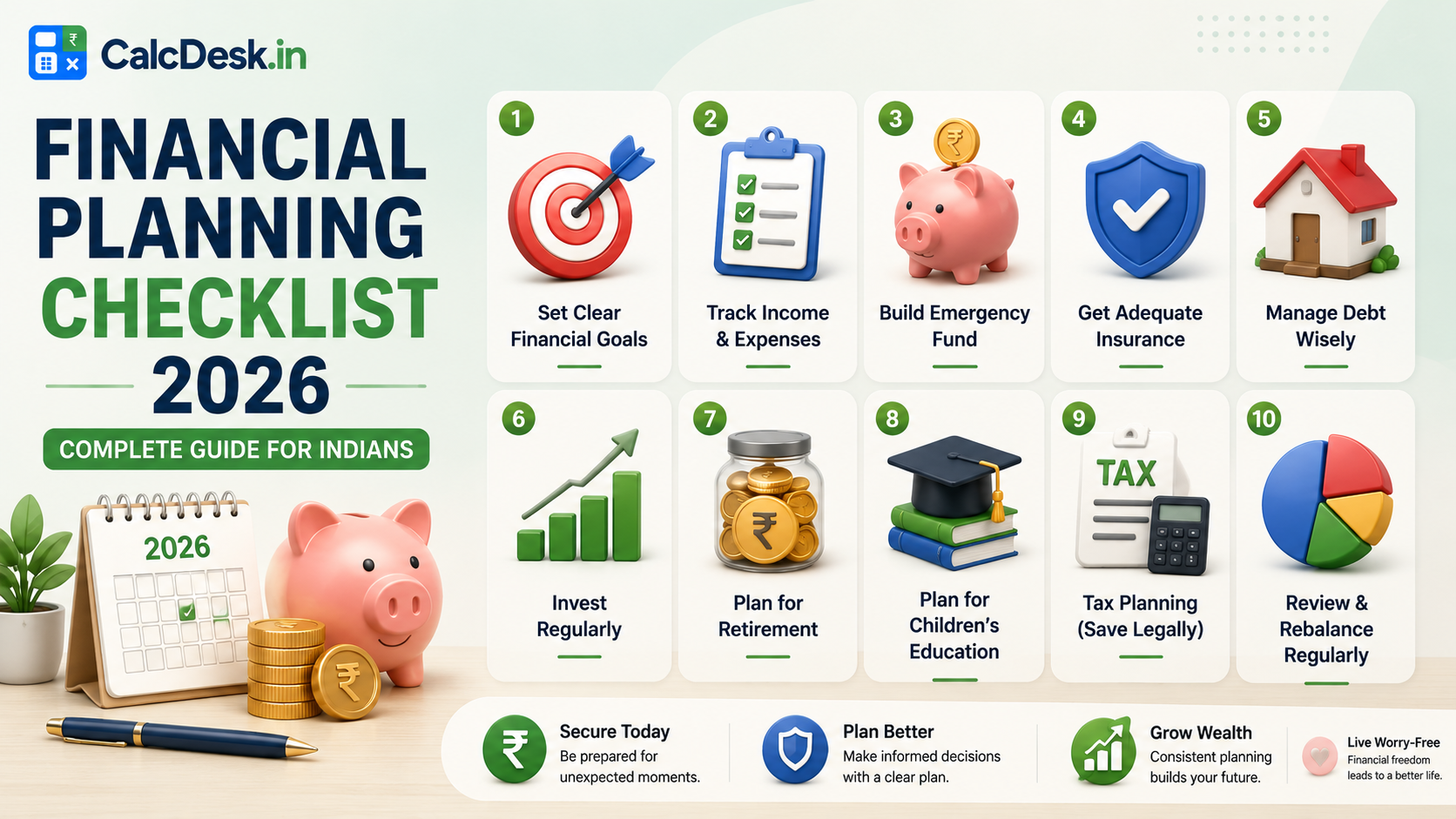
Financial Planning Checklist 2026 — Your Complete Money Roadmap
Financial planning is not about having complex spreadsheets or a CA on speed dial. It’s about making a series of clear, prioritised decisions — in the right order — that compound into financial security over decades. Most financial mistakes in India come not from making wrong investments but from skipping foundational steps: no emergency fund, no term insurance, no Will. This checklist covers everything you need, in the right sequence, for FY 2026-27 and beyond.
Step 1 — Emergency Fund (Non-Negotiable Foundation)
Before any investment, before any tax planning, before anything else: build an emergency fund.
Emergency Fund Formula
Emergency Fund Target = Monthly Essential Expenses × 3 to 6 months
Essential expenses: Rent/EMI + Groceries + Utilities + Insurance + School fees + Transport
Where to keep it: Liquid mutual fund (redemption in 1 working day, ~7% return) or high-yield savings account. NOT in stocks, NOT in FD with lock-in, NOT in PPF.
Example: Monthly essentials ₹40,000 × 6 months = ₹2.4 lakh emergency fund target
Step 2 — Insurance Coverage
Term Life Insurance — Priority #1
| Your Annual Income | Recommended Cover | Annual Premium (30yr, healthy) |
|---|---|---|
| ₹6 lakh | ₹75L – ₹1 crore | ₹6,000 – ₹10,000 |
| ₹12 lakh | ₹1.5 – ₹2 crore | ₹10,000 – ₹18,000 |
| ₹25 lakh | ₹3 – ₹4 crore | ₹20,000 – ₹35,000 |
Rules: Always buy term (pure protection). No ULIP or endowment. Cover until age 65 or retirement. Buy early — premiums rise with age and health issues.
Health Insurance — Priority #2
- Minimum: ₹10 lakh family floater (spouse + 2 children)
- Recommended: ₹20-25 lakh family floater in metros; ₹15L in smaller cities
- Don’t rely solely on employer health insurance — it terminates when you leave the job
- Include parents on a separate senior citizen health policy
- Sec 80D deduction: ₹25,000 (self+family) + ₹25,000 (parents <60) or ₹50,000 (parents 60+)
Step 3 — Pay Off High-Interest Debt
| Debt Type | Typical Rate | Priority |
|---|---|---|
| Credit card outstanding | 36–42% p.a. | Eliminate immediately — highest priority |
| Personal loan | 12–24% p.a. | Prepay before investing |
| Car loan | 8–11% p.a. | Prepay if no other investment earns more |
| Home loan | 8.5–9.5% p.a. | Can coexist with SIP (see prepay vs invest guide) |
Step 4 — Build Your Investment Portfolio
Invest based on your goal timeline:
| Goal Horizon | Recommended Investment | Expected Return |
|---|---|---|
| Under 1 year | Liquid funds, short-term FD | 6.5–7.5% |
| 1–3 years | Short-duration debt funds, FD | 7–8% |
| 3–7 years | Balanced/hybrid funds, PPF | 9–11% |
| 7+ years (retirement, wealth) | Equity SIP (large/mid cap), NPS | 11–14% CAGR |
Step 5 — Tax Planning Checklist
- ☐ Choose tax regime — New Regime for most; Old only if deductions >₹4-5L
- ☐ Max Sec 80C (₹1.5L): ELSS (for growth) + PPF (for safety)
- ☐ NPS Sec 80CCD(1B) (₹50K extra): Open NPS account if not done
- ☐ Employer NPS Sec 80CCD(2): Ask HR to add 14% of basic as employer NPS
- ☐ Sec 80D health insurance: Ensure premium receipts for self and parents
- ☐ HRA exemption: Submit rent receipts to employer if renting
- ☐ Home loan: Submit interest certificate to employer for Sec 24(b)
- ☐ Advance tax: Pay quarterly if additional income >₹10,000 expected
Step 6 — Retirement Planning
Retirement Corpus Target Calculator
Current monthly expenses: ₹X | Years to retirement: N | Post-retirement years: 25
Inflation rate assumed: 5% | Post-retirement investment return: 7%
Monthly expense at retirement: ₹X × (1.05)^N
Corpus needed: Monthly expense × 12 × [1 − (1.07)^−25] / (0.07/12) [annuity formula]
Rule of thumb: Corpus = 25× your annual expenses at retirement (4% withdrawal rule)
- Start SIP for retirement as early as possible — even ₹2,000/month at 25 creates significant corpus
- Maintain EPF contributions — 8.25% guaranteed tax-free is your safe base
- Add NPS for market-linked growth + exclusive ₹50K deduction
- Revisit retirement corpus target every 3 years as income and expenses change
Step 7 — Estate Planning (Often Ignored, Very Important)
- Write a Will: Without a Will, assets are distributed per succession law — often not your intention. A simple registered Will costs ₹2,000-5,000 and avoids years of legal complications for your family.
- Update nominations: Check nominations on EPF, PPF, bank accounts, mutual funds, insurance policies — many people have outdated nominations that create family disputes
- Joint account access: Ensure at least one family member knows account access and has operational knowledge of your investments
- Document location: Create a “financial life file” listing all policies, account numbers, locker details, and investment folios
Annual Financial Health Review — Checklist
- ☐ Emergency fund still covers 3-6 months expenses (recalculate after lifestyle changes)
- ☐ Life insurance cover adequate for current income and loans
- ☐ Health insurance sum insured still sufficient (medical inflation is 12-15%/year)
- ☐ SIP amount increased by at least 5-10% (step-up SIP)
- ☐ Portfolio rebalanced if equity allocation drifted >5% from target
- ☐ All deduction investments made and submitted to employer for TDS
- ☐ ITR filed and advance tax paid on time
- ☐ Will updated if any major life event (marriage, child, property purchase)
💡 The right order matters: Emergency fund → Insurance → High-interest debt payoff → Investing → Tax planning → Retirement → Estate. Many Indians skip steps 1-3 and start directly with investments — then a job loss, medical emergency, or credit card spiral undoes years of investment gains. The foundation determines how high the structure can rise.
📊 Use CalcDesk’s Free Financial Calculators
SIP, EMI, tax, EPF, HRA, CAGR — all in one place. Start planning today.
→ Explore All CalculatorsRelated Calculators & Articles
Frequently Asked Questions
Age-Specific Financial Priorities — Quick Reference
| Age | Top Priorities | Investment Mix |
|---|---|---|
| 22-30 | Emergency fund, term insurance, start SIP, clear student loans | 80-90% equity, 10-20% debt |
| 30-40 | Children’s education fund, home planning, maximise 80C+NPS, life insurance review | 70-80% equity, 20-30% debt |
| 40-50 | Retirement corpus acceleration, children’s college fund, health insurance review | 60-70% equity, 30-40% debt |
| 50-60 | Retirement corpus completion, reduce EMIs, shift to capital preservation, estate planning | 40-60% equity, 40-60% debt |
| 60+ | Income generation (SCSS, POMIS), healthcare corpus, estate transfer | 20-30% equity, 70-80% debt/income instruments |
The 10 Financial Rules Every Indian Should Know
- Emergency fund first: Always. No investment before this is set up.
- Insure before investing: Term insurance and health insurance precede any wealth-building investments.
- Never invest what you can’t afford to lose short-term: Equity is for 7+ year goals only — never for money needed within 3 years.
- Increase SIP by 10% annually: Step-up SIP with every salary hike, not just lifestyle upgrades.
- Debt above 14% = emergency: Any personal loan or credit card above 14% must be treated as a financial emergency — clear before any investing.
- The 50-30-20 rule: 50% needs, 30% wants, 20% savings — and increase the savings percentage with every income hike.
- Diversify but don’t over-diversify: 3-5 mutual funds is sufficient. 15+ funds is over-diversification that adds complexity without benefit.
- Review annually, not daily: Checking portfolio daily causes anxiety and bad decisions. Annual review is sufficient for long-term SIPs.
- Tax planning is not the purpose of investing: Never buy a product only for tax saving — the product must also make financial sense (an ELSS that earns 8% vs PPF’s 7.1% is marginal; ELSS that earns 14% is excellent).
- Start now, increase later: A ₹1,000/month SIP started today beats a ₹5,000/month SIP started 5 years from now. Time is the irreplaceable ingredient.