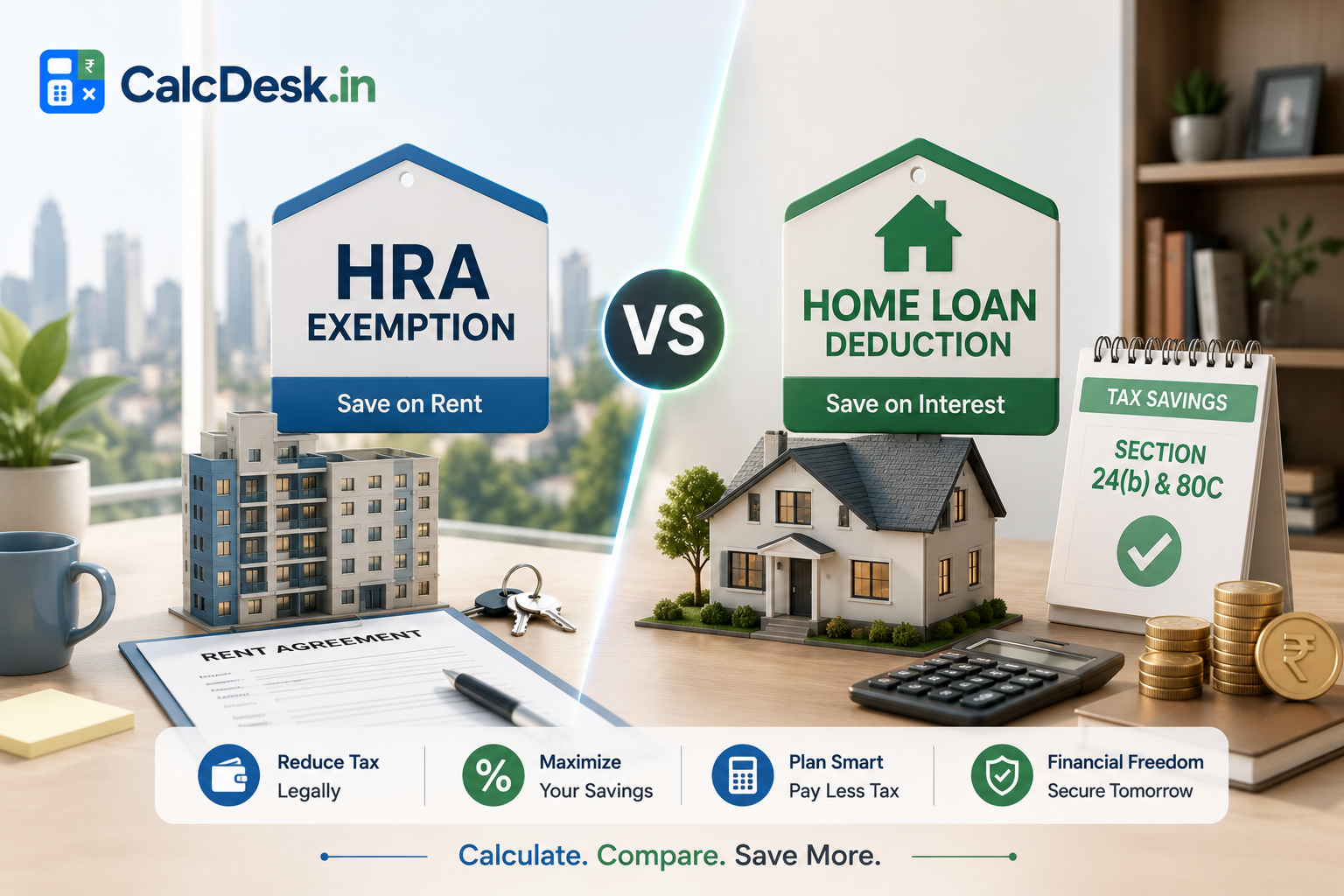
HRA Exemption vs Home Loan Deduction — Can You Claim Both?
Two of the most valuable tax benefits for Indian salaried employees are HRA (House Rent Allowance) exemption and home loan interest deduction. The common question: can you claim both? The answer is yes — under specific conditions. And understanding when each benefit applies helps optimise your tax strategy significantly.
This guide explains the conditions for claiming both simultaneously, the HRA calculation formula, the home loan deduction rules, worked examples comparing tax benefits, and which strategy wins in different scenarios. Use CalcDesk’s HRA Exemption Calculator to compute your exact exemption.
Claiming Both — The Conditions
You can claim HRA exemption AND home loan deduction simultaneously only when:
- Different cities: You own a house in City A but work in City B and pay rent there — both benefits apply simultaneously
- House rented out: You own a house but rent it out and live in rented accommodation yourself — HRA exemption applies on your rent; home loan interest has no cap as it’s a let-out property
- Under construction: Your purchased house is under construction; you live in rental accommodation — HRA applies on current rent, home loan interest is accumulated for pre-construction period deduction
⚠️ Not allowed: You cannot claim HRA exemption if you own a house in the same city where you work and that house is self-occupied (you live in it). The tax department expects you to live in your own house.
HRA Exemption Formula
HRA Exemption — Minimum of Three
1. Actual HRA received
2. Rent paid − 10% of Basic Salary
3. 50% of Basic (Metro) or 40% of Basic (Non-Metro)
Taxable HRA = Actual HRA − Exempt HRA
Home Loan Tax Benefits — Old Regime
| Benefit | Section | Limit | New Regime? |
|---|---|---|---|
| Interest on self-occupied home loan | Sec 24(b) | ₹2 lakh/year | ❌ Not available |
| Interest on let-out property | Sec 24(b) | Actual interest (set-off cap ₹2L) | ❌ Not available |
| Principal repayment | Sec 80C | Within ₹1.5L overall limit | ❌ Not available |
| Stamp duty and registration | Sec 80C | Within ₹1.5L (year of purchase) | ❌ Not available |
Worked Example 1 — Both HRA + Home Loan (Different Cities)
Employee works in Mumbai (rents flat), owns house in Pune (self-occupied by family)
Basic: ₹80,000/month | HRA: ₹40,000/month | Mumbai Rent: ₹30,000/month
HRA Exemption Calculation (monthly):
1. Actual HRA: ₹40,000 | 2. Rent − 10% basic: ₹30,000 − ₹8,000 = ₹22,000 | 3. 50% basic (metro): ₹40,000
HRA Exempt: Min(₹40K, ₹22K, ₹40K) = ₹22,000/month = ₹2,64,000/year
Pune Home Loan Interest: ₹1,80,000/year deductible under Sec 24(b)
Total tax benefit: ₹2,64,000 (HRA) + ₹1,80,000 (home loan) = ₹4,44,000
Tax saved at 30% bracket: ₹4,44,000 × 31.2% = ₹1,38,528/year
Worked Example 2 — Only HRA (Renting, No Home Loan)
Renting in Delhi, basic ₹60,000/month, HRA ₹25,000/month, rent ₹20,000/month
HRA Exempt: Min(₹25K, ₹20K−₹6K=₹14K, 50%×₹60K=₹30K) = ₹14,000/month = ₹1,68,000/year
No home loan → no Sec 24(b) benefit
Total HRA tax saving (30% bracket): ₹1,68,000 × 31.2% = ₹52,416/year
Worked Example 3 — Only Home Loan (Self-Occupied, Same City)
Owns flat in Bangalore, living in it, home loan interest ₹2,50,000/year
No HRA (owns and lives in own house) — no HRA exemption
Sec 24(b) deduction: Capped at ₹2,00,000/year (even though actual interest is ₹2.5L)
Sec 80C on principal: ₹1,50,000/year (within 80C limit)
Total deduction: ₹3,50,000 | Tax saved (30%): ₹1,09,200/year
HRA vs Home Loan — Which Gives More Tax Benefit?
| Scenario | Better Option | Why |
|---|---|---|
| High rent in metro, high basic salary | HRA (renting) | HRA exemption can be very large (40-50% of basic) |
| Low rent relative to basic | Home loan | HRA exemption limited by rent − 10% of basic formula |
| New Regime taxpayer | HRA (renting) | Home loan deductions not available in New Regime |
| Property in high-appreciation city | Home loan (buying) | Capital gain from appreciation often exceeds tax savings |
💡 New Regime consideration: If you’re in the New Tax Regime, home loan interest (Sec 24b) and principal (Sec 80C) deductions are not available for self-occupied property. This significantly reduces the tax benefit of buying — making renting with HRA comparatively more attractive in New Regime.
🏠 Calculate Your HRA Exemption — Free
Enter basic salary, HRA, and rent paid. Get exact exemption amount.
→ Open HRA CalculatorRelated Calculators & Articles
Metro vs Non-Metro City Classification for HRA
One of the most misunderstood aspects of HRA is the metro vs non-metro classification. The two rates — 50% of basic for metros, 40% for non-metros — make a substantial difference in the exemption amount, and many employees in IT hub cities are surprised to learn their city is not considered a “metro” for HRA purposes.
⚠️ Common mistake — Bengaluru, Hyderabad, Pune are NOT metros for HRA: The four cities that qualify for the 50% of basic salary HRA exemption are: Delhi (NCT including Gurgaon, Noida, Faridabad, Ghaziabad), Mumbai (including Thane, Navi Mumbai, Kalyan-Dombivali), Kolkata (Kolkata Municipal Corporation area), and Chennai (Chennai Municipal Corporation area). Every other city — including Bengaluru, Hyderabad, Pune, Ahmedabad, Surat, Jaipur — is classified as non-metro and gets only 40% of basic salary as the third limb of the HRA formula.
| City | HRA Classification | % of Basic Applied |
|---|---|---|
| Delhi, Mumbai, Kolkata, Chennai | Metro | 50% of Basic Salary |
| Bengaluru, Hyderabad, Pune | Non-Metro | 40% of Basic Salary |
| Ahmedabad, Surat, Jaipur | Non-Metro | 40% of Basic Salary |
| All other cities and towns | Non-Metro | 40% of Basic Salary |
Why This Matters — Bengaluru Employee Calculation
Employee: Basic salary ₹50,000/month | HRA received from employer: ₹25,000/month | Rent paid: ₹15,000/month
Correct calculation (40% — non-metro):
1. HRA received: ₹25,000 | 2. Rent − 10% basic = ₹15,000 − ₹5,000 = ₹10,000 | 3. 40% of basic = ₹20,000
HRA exempt = Minimum(₹25,000, ₹10,000, ₹20,000) = ₹10,000/month = ₹1,20,000/year
If incorrectly calculated at 50% (wrong — metro rate):
1. ₹25,000 | 2. ₹10,000 | 3. 50% of ₹50,000 = ₹25,000
HRA exempt would be ₹10,000/month — same answer in this case because the binding constraint is the “rent minus 10% basic” limb, not the city classification. But increase rent to ₹25,000:
Correct (40%): Min(₹25K, ₹20K, ₹20K) = ₹20,000/month exempt
Incorrect (50%): Min(₹25K, ₹20K, ₹25K) = ₹20,000/month — same again here
Increase rent to ₹30,000: Correct (40%): Min(₹25K, ₹25K, ₹20K) = ₹20,000 | Incorrect (50%): Min(₹25K, ₹25K, ₹25K) = ₹25,000 — claiming ₹5,000/month more than legally allowed = ₹60,000/year excess claim
The practical lesson: the city classification limb becomes the binding constraint when your rent is very high relative to your basic salary. High-rent Bengaluru employees who pay ₹30,000+ in rent on a ₹50,000 basic are most at risk of overclaiming if they use the metro rate incorrectly. Ensure your employer’s HRA component in Form 16 is computed correctly using 40% for Bengaluru, Hyderabad, and Pune.
Rent Paid to Parents — Complete Tax Planning Strategy
Paying rent to parents is one of the most effective and perfectly legal tax planning strategies available to salaried employees in India. When structured correctly, it reduces the employee’s taxable income via HRA exemption while keeping the money within the family — and if the parents are in a lower tax bracket or are senior citizens with minimal other income, the net family tax saving can be very substantial.
📌 Is paying rent to parents legal? Yes, completely. The Supreme Court and multiple High Courts have held that rent paid to parents is a legitimate transaction eligible for HRA exemption, provided the arrangement is genuine — backed by actual payment and proper documentation. The Income Tax Department accepts such arrangements during assessments when properly documented. The key word is “genuine” — all conditions below must be satisfied simultaneously.
Conditions for a legitimate rent-to-parents arrangement:
- Formal registered (or at minimum notarised) rent agreement on stamp paper specifying: property address, rent amount, payment date, duration, and both parties’ signatures
- Monthly rent transferred via bank transfer (NEFT, IMPS, or UPI) — never cash. The transaction narration should say “Rent for [Month] [Year].” This creates an auditable payment trail
- Parents must declare the rental income in their annual ITR under “Income from House Property.” Failure to declare makes the entire arrangement legally suspect
- The property must be owned by the parents — check the title deed or property tax receipt. If parents are co-owners, rent can be split accordingly
- You must actually reside in that property. The arrangement fails if you pay rent to parents but live elsewhere
Worked Example — Tax Saving via Rent to Parents (Old Regime)
Employee: 30% tax bracket | Basic: ₹80,000/month | HRA from employer: ₹32,000/month
City: Noida (non-metro, 40% applies) | Rent paid to parents: ₹25,000/month
HRA exemption calculation:
1. HRA received: ₹32,000 | 2. Rent − 10% basic = ₹25,000 − ₹8,000 = ₹17,000 | 3. 40% of basic = ₹32,000
HRA exempt = Min(₹32,000, ₹17,000, ₹32,000) = ₹17,000/month = ₹2,04,000/year
Tax saving on HRA exemption (30% + 4% cess): ₹2,04,000 × 31.2% = ₹63,648/year
Parents’ tax on rental income received:
Annual rent received by parents: ₹3,00,000 | Standard deduction on house property: 30% = ₹90,000
Net taxable rent for parents: ₹2,10,000
If parents are senior citizens with total income (including this rent) below ₹5L: zero tax after Section 87A rebate
Net family tax saving: ₹63,648 (employee saves) − ₹0 (parents pay) = ₹63,648/year
💡 TDS on rent to parents: If you pay rent above ₹50,000 per month to any individual (including parents), you must deduct 2% TDS on the rent and deposit it using Form 26QC within 30 days of the last month of the financial year (or 30 days of property vacating). At ₹25,000/month (₹3 lakh annually), TDS is not required. But at ₹60,000/month, 2% TDS = ₹1,200/month must be deducted and remitted. Keep this compliance requirement in mind when setting the rent amount with your parents.
Optimal rent amount to set: Set rent high enough to maximise your HRA exemption (the “rent minus 10% basic” limb is usually the binding constraint), but not so high that it creates a large taxable income problem for your parents or triggers TDS complications. The sweet spot is typically rent = HRA received from employer, which maximises limb 1 and limb 2 simultaneously while keeping rent at or below the monthly amount that avoids TDS (₹50,000/month).
Frequently Asked Questions
Special Case — Joint Home Loan with Non-Working Spouse
Many Indian couples take joint home loans but only one spouse is working. Here’s how the tax benefits distribute:
- Both borrowers must be co-owners to claim the tax deduction. If only the husband is on the title deed, the wife cannot claim any deduction even if she’s on the loan
- Deduction split for self-occupied property: Each co-borrower can claim up to ₹2L Sec 24(b) interest deduction in their own ITR — total possible deduction = ₹4L across both returns. Similarly, each can claim up to ₹1.5L Sec 80C on principal repayment
- If only one earns: The non-earning spouse has no taxable income to claim deductions against — only the earning spouse benefits from the deductions
- Rental income splitting: If the property is rented out, rental income is split between co-owners in proportion to ownership share — each pays tax on their share at their respective slab rates. This can significantly reduce total tax if spouses are in different tax brackets
Rent Receipt Requirements — Avoiding HRA Claim Rejection
The Income Tax Department scrutinises HRA claims, especially at higher amounts. To ensure your HRA exemption is accepted:
- Rent receipts: Maintain monthly rent receipts with landlord signature, date, property address, and amount. These should be on revenue stamps for amounts above ₹5,000/month
- Landlord PAN: Mandatory if annual rent exceeds ₹1,00,000 (₹8,333/month). Without landlord PAN, the HRA exemption can be disallowed during assessment
- Rental agreement: A registered rental agreement is strong evidence — unregistered agreements are weaker but still accepted
- Bank transfers: Paying rent via bank transfer (NEFT/UPI) rather than cash creates a clear audit trail. Cash rent payments are harder to substantiate if scrutinised
- Cannot be family member (general rule): Paying rent to parents is allowed and HRA can be claimed — but the parents must declare the rental income in their ITR and the arrangement must be genuine (fair market rent, actual payment record)