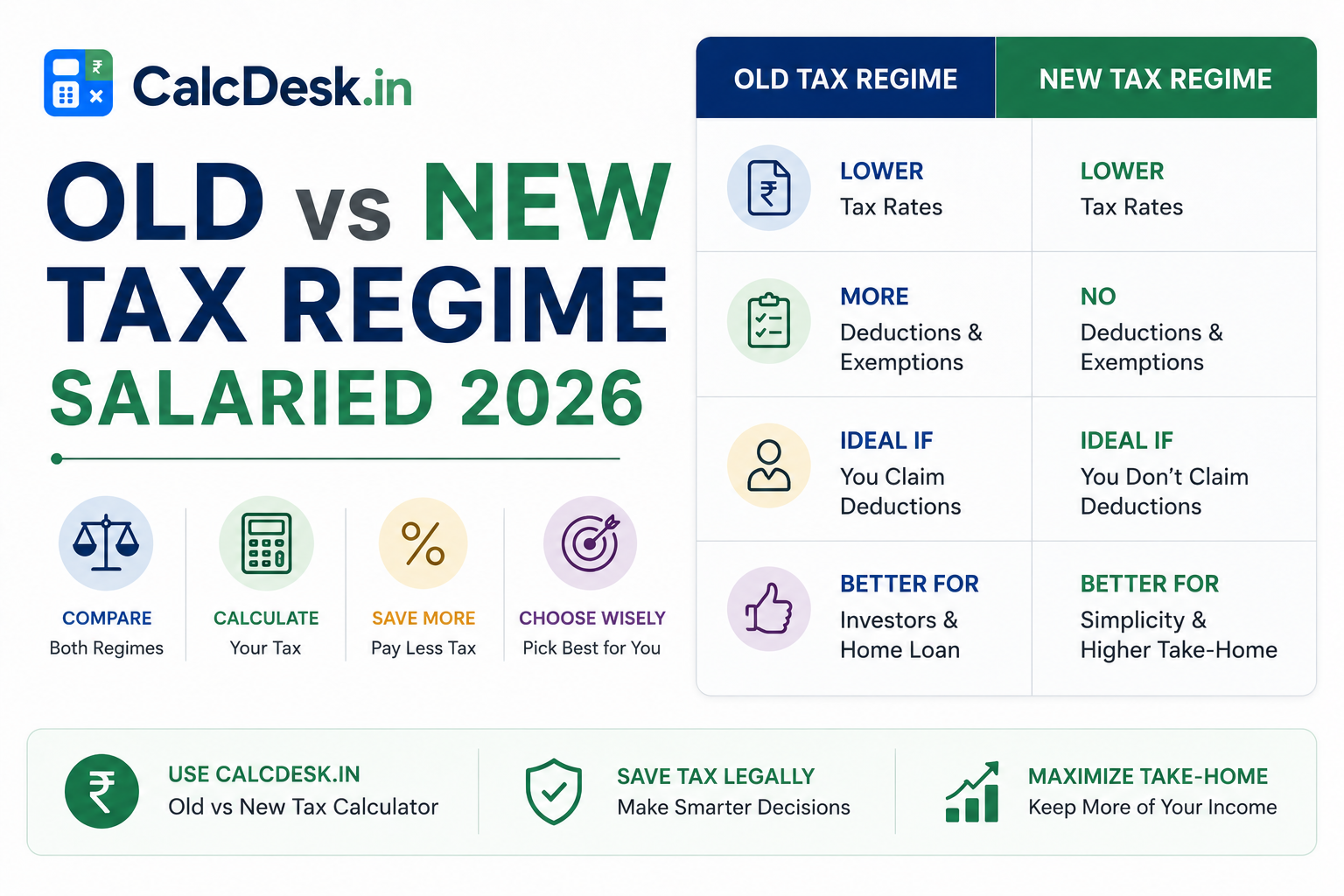
Old vs New Tax Regime 2026-27 — Which Saves More for Salaried?
The choice between Old and New Tax Regime is the most consequential annual tax decision for Indian salaried employees in FY 2026-27. Budget 2026 made the New Regime significantly more attractive by raising the Sec 87A rebate to ₹60,000 — effectively making income up to ₹12 lakh completely tax-free under the New Regime. This changes the break-even calculus and means many more salaried employees will find the New Regime superior.
This guide provides a clear comparison at different salary levels, identifies when the Old Regime still wins, and shows exactly what deductions you need to make Old Regime worthwhile. Use CalcDesk’s Income Tax Calculator to compare both regimes for your exact income and deductions.
New Tax Regime Slabs FY 2026-27
| Income Range | New Regime Tax Rate | Old Regime Tax Rate |
|---|---|---|
| Up to ₹4,00,000 | Nil | Nil |
| ₹4,00,001 – ₹8,00,000 | 5% | 5% (up to ₹5L) |
| ₹8,00,001 – ₹12,00,000 | 10% | 20% |
| ₹12,00,001 – ₹16,00,000 | 15% | 20–30% |
| ₹16,00,001 – ₹20,00,000 | 20% | 30% |
| ₹20,00,001 – ₹24,00,000 | 25% | 30% |
| Above ₹24,00,000 | 30% | 30% |
Key New Regime features: Standard deduction ₹75,000 available. Sec 87A rebate up to ₹60,000 (income up to ₹12L effectively tax-free). Employer NPS contribution (Sec 80CCD(2)) deductible even in New Regime.
Worked Example 1 — ₹10 Lakh Salary
Gross salary ₹10,00,000, minimal deductions
New Regime: Taxable income = ₹10L − ₹75K (std deduction) = ₹9,25,000
Tax: ₹0 (up to ₹4L) + ₹20,000 (5% on ₹4-8L) + ₹12,500 (10% on ₹8-9.25L) = ₹32,500
Rebate 87A: ₹32,500 (since income ≤ ₹12L) → Tax = ₹0
Old Regime: Assume deductions: 80C ₹1.5L + std deduction ₹50K = ₹2L total
Taxable: ₹10L − ₹2L = ₹8L | Tax: ₹12,500 + ₹60,000 = ₹72,500 + cess = ₹75,400
Winner: New Regime saves ₹75,400
Worked Example 2 — ₹15 Lakh Salary
₹15L salary, maximum deductions (Old Regime taxpayer)
Old Regime deductions: Std deduction ₹50K + 80C ₹1.5L + HRA exemption ₹1.5L + 80D ₹25K + NPS 80CCD(1B) ₹50K = ₹4.25L total
Taxable: ₹15L − ₹4.25L = ₹10.75L | Tax + cess = ₹1,56,000 approx
New Regime: Std deduction ₹75K | Taxable: ₹14.25L
Tax = ₹0 + ₹20K + ₹40K + ₹33,750 = ₹93,750 + 4% cess = ₹97,500
Old Regime tax ₹1,56,000 vs New Regime ₹97,500 → New Regime saves ₹58,500 even with ₹4.25L deductions
For Old Regime to win here, deductions must exceed ≈ ₹5.5L — very difficult for most employees
Worked Example 3 — ₹25 Lakh Salary (High Earner)
₹25L CTC, home loan, HRA — Old vs New
Old Regime: HRA ₹2L + Home loan interest ₹2L + 80C ₹1.5L + 80D ₹50K + NPS ₹50K + std ₹50K = ₹7L deductions
Taxable: ₹25L − ₹7L = ₹18L | Tax: ₹4,12,500 + cess = ₹4,29,000
New Regime: Taxable: ₹25L − ₹75K = ₹24.25L | Tax: ₹5,25,000 + cess = ₹5,46,000
Old Regime wins by ₹1,17,000 — for high earners with large home loan + HRA, Old Regime still superior
Break-Even Deduction Calculator
| Gross Salary | Deductions Needed to Make Old Regime Win | Typical Achievability |
|---|---|---|
| Up to ₹12L | N/A — New Regime always wins (zero tax) | New Regime always better |
| ₹15L | ≈ ₹5.5L+ | Difficult — needs HRA + Home Loan + max 80C |
| ₹20L | ≈ ₹4.5L+ | Possible with home loan + HRA + max 80C |
| ₹25L+ | ≈ ₹4L+ | Old Regime often better at this income with home loan |
📌 Key rule of thumb: If your income is below ₹12.75 lakh, choose New Regime (zero tax). If above ₹12.75L, compare both using CalcDesk’s calculator. Old Regime wins mainly when you have HRA exemption + home loan interest + maximum 80C + 80CCD(1B) — which means total deductions exceeding ₹4.5-5.5L.
🧮 Compare Old vs New Regime — Free
Enter your salary and deductions. Instantly see which regime saves more.
→ Open Tax CalculatorRelated Calculators & Articles
Deduction-by-Deduction Break-Even Analysis
The key question for any salaried employee is: “Do my actual deductions exceed the amount needed to make Old Regime better?” This table answers that precisely for FY 2026-27, factoring in the ₹75,000 standard deduction under New Regime (vs ₹50,000 under Old Regime). The ₹25,000 extra standard deduction in New Regime is already embedded in the thresholds below.
| Gross Salary | Deductions Needed to Make Old Regime Better | Typical Actual Deductions | Verdict |
|---|---|---|---|
| ₹8,00,000 | >~₹2.5 lakh | Std ₹50K + 80C ₹1.5L = ₹2L (no HRA) | New Regime better |
| ₹10,00,000 | >~₹3 lakh | ₹2L to ₹3.75L (with HRA ₹1L) | Borderline — depends on HRA |
| ₹12,00,000 | >~₹3.5 lakh | ₹2L basic, or ₹3–4L with HRA | Close call — calculate both |
| ₹15,00,000 | >~₹3.75 lakh | HRA ₹1.5L + NPS ₹50K + 80C ₹1.5L = ₹4.25L | Old Regime can win |
| ₹20,00,000 | >~₹4.25 lakh | With HRA ₹2L + 80C ₹1.5L + 80D ₹50K: ₹5L+ | Old Regime likely better |
| ₹25,00,000 | >~₹5 lakh | HRA + NPS ₹50K + 80D ₹50K: ₹5.5L | Old Regime marginally better |
How to read this table: If your actual deductions exceed the “Deductions Needed” column for your salary level, Old Regime saves more tax. The average salaried professional claiming 80C ₹1.5L + Standard ₹50K + HRA ₹1–2L + NPS ₹50K totals ₹3.5–4.5 lakh in deductions. At ₹10–15 lakh income, Old Regime is only marginally better or equivalent to New Regime for this average profile — the New Regime’s simpler zero-tax up to ₹12.75L makes it the default choice for most.
Regime Change Deadline and Consequences
Understanding the timeline and implications of switching regimes is critical — getting this wrong can result in unexpected tax dues or missed refunds.
For Salaried Employees — TDS and Filing Timeline
- April (beginning of FY): Declare regime choice to employer. Employer uses this for monthly TDS projection across the full financial year.
- Mid-year switch: If you told your employer “New Regime” in April but want “Old Regime” at filing time — you CAN switch at ITR filing. Salaried individuals may choose differently at filing versus employer declaration.
- Employer used New Regime but you file Old Regime: Old Regime typically means more deductions, so your actual tax liability is lower. Result: refund of excess TDS. File ITR under Old Regime, claim deductions, and the difference is refunded.
- Employer used Old Regime but you file under New Regime: Old Regime may have deducted less TDS (if your old regime tax was lower due to deductions). Filing under New Regime (which gives higher tax at certain income levels) could result in a shortfall — you pay self-assessment tax with interest under Sec 234B/234C.
Critical warning for business income holders: If you have ANY income from business or profession — even side consulting income, freelance work, or professional fees — you are classified differently. Once you opt out of the New Regime (i.e., choose Old Regime), you can switch back to New Regime only once. After switching back, you are locked into New Regime permanently unless you discontinue business income entirely. This is a one-time flexibility, not annual. Salaried individuals with ONLY salary income have full annual flexibility to switch every year.
Annual choice — salaried employees: Salaried professionals with only salary income (no business income from consulting, trading, or profession) can freely choose either regime every financial year — whichever gives lower tax. Recalculate at the start of every April using your projected income and deductions. The right regime this year may not be the right regime next year if your salary, HRA, or investment profile changes.
Frequently Asked Questions
Practical Decision Guide — Which Regime for Your Profile
| Salary & Situation | Recommended Regime | Reason |
|---|---|---|
| Up to ₹12.75L, no home loan | New Regime | Zero tax, no investment lock-in required |
| ₹12.75L–₹20L, renting in metro, no home loan | New Regime (usually) | New slabs + HRA worth calculating carefully |
| ₹15L–₹25L, home loan + HRA | Compare both | Sec 24b (₹2L) + HRA can tip Old Regime ahead |
| Above ₹25L, home loan + max deductions | Old Regime (often) | Deductions of ₹4-6L+ make Old Regime clearly better |
| Self-employed / business income, variable earnings | New Regime (usually) | Simpler, no mandatory investment, better for unpredictable income |
| Government employee with NPS | Old or New — calculate | Sec 80CCD(2) works in both; other deductions differ |
How to Switch Regimes — Practical Steps
- Start of financial year (April): Inform your employer (HR/payroll) which regime you want for TDS purposes. They’ll compute monthly TDS based on your declaration.
- Mid-year switch: You can change your regime declaration once during the year by submitting a revised Form 12BB to your employer. This recalculates TDS from that point.
- At ITR filing (July): Regardless of what you told your employer, you can choose either regime at ITR filing time. If you overpaid TDS (employer used Old, you file New), you get a refund. If underpaid, pay the difference with interest.
- Important for self-employed: Business income taxpayers can opt out of New Regime only once — after opting out, they cannot re-enter New Regime in future years. Salaried employees have annual flexibility.
💡 Best practice: In April each year, recalculate your tax liability under both regimes using the current year’s estimated income and deductions. Use CalcDesk’s tax calculator for this — it takes 5 minutes and can save thousands. The right regime isn’t permanent — reassess annually as your salary, deductions, and tax laws change.
Regime Comparison Calculator — Manual Method
If you prefer to do the calculation yourself before using an online tool, here’s the step-by-step manual method:
Manual Regime Comparison Steps
1. Gross salary
2. Less: HRA exemption (if renting)
3. Less: Standard deduction (Rs.50,000)
4. Less: Home loan interest — Sec 24(b) (up to Rs.2L)
5. Less: 80C investments (up to Rs.1.5L)
6. Less: NPS 80CCD(1B) (up to Rs.50K)
7. Less: 80D health insurance (up to Rs.75K)
8. = Taxable income → Apply old slabs → Add 4% cess
NEW REGIME:
1. Gross salary
2. Less: Standard deduction (Rs.75,000)
3. Less: Employer NPS 80CCD(2) (up to 14% of basic)
4. = Taxable income → Apply new slabs → Add 4% cess
5. Check if Sec 87A rebate applies (taxable income ≤ Rs.12L)
Compare Step 8 vs Step 5 total → choose lower
The regime with lower total tax is your answer. If the difference is under ₹5,000/year, consider the New Regime for its simplicity — no investment obligation, no documentation burden, no risk of missing deduction claims in ITR.