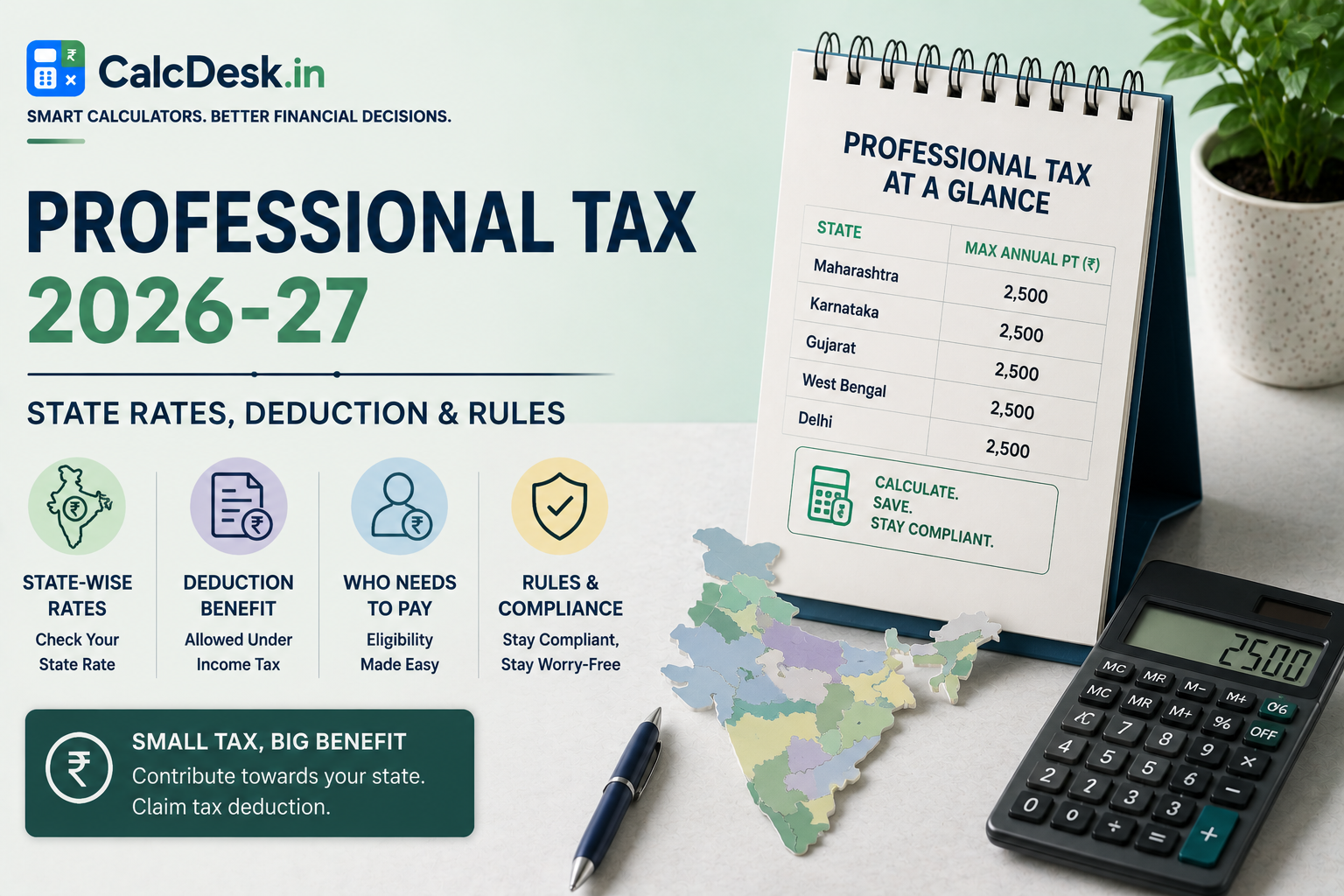
Professional Tax 2026-27 — State Rates, Deduction & Rules
Professional Tax (PT) is a state-level tax levied under Article 276 of the Indian Constitution on individuals earning a salary or practicing a profession. Unlike income tax — which is uniform nationwide — professional tax varies dramatically by state. Maharashtra, Karnataka, Andhra Pradesh, West Bengal, and Tamil Nadu levy PT; Delhi, Gujarat, Rajasthan, and Uttar Pradesh have no PT at all. Understanding your state’s PT slabs, your employer’s deduction obligation, and how PT qualifies for deduction under Section 16 ensures you neither pay incorrectly nor miss a legitimate tax saving.
This guide covers PT rates for all major states, the employer’s obligation, the Section 16 deduction rules (available under both Old and New Regimes), exemptions, and the key mistakes to avoid. Use CalcDesk’s Take-Home Salary Calculator to see your in-hand salary with PT and all other deductions correctly applied.
Legal Basis — Article 276 and State Acts
Professional Tax is authorised by Article 276 of the Indian Constitution, which allows state legislatures to impose a tax on professions, trades, callings, and employment. The Constitution caps the maximum at ₹2,500 per person per year. Each state that levies PT has its own Act — for example, the Maharashtra State Tax on Professions, Trades, Callings and Employments Act 1975, or the Karnataka Tax on Professions, Trades, Callings and Employments Act 1976.
Professional Tax Rates — Major States FY 2026-27
| State | Monthly Gross Salary | Monthly PT | Annual PT |
|---|---|---|---|
| Maharashtra | Up to ₹7,500 | Nil | Nil |
| ₹7,501 – ₹10,000 | ₹175 | ₹2,100 | |
| Above ₹10,000 | ₹200 (₹300 in Feb) | ₹2,500 | |
| Karnataka | Up to ₹14,999 | Nil | Nil |
| ₹15,000 – ₹29,999 | ₹150 | ₹1,800 | |
| ₹30,000 and above | ₹200 (₹100 extra in April) | ₹2,500 | |
| Andhra Pradesh / Telangana | Up to ₹15,000 | Nil | Nil |
| Above ₹15,000 | ₹200 | ₹2,400 | |
| West Bengal | Up to ₹8,500 | Nil | Nil |
| ₹8,501 – ₹25,000 | ₹90 – ₹150 | ₹1,080 – ₹1,800 | |
| Above ₹40,000 | ₹200 | ₹2,400 | |
| Tamil Nadu | Above ₹3,500 | ₹182 (approx) | ₹2,184 |
| Gujarat | — | Nil | Nil (No PT) |
| Delhi, UP, Rajasthan, Haryana | — | Nil | Nil (No PT) |
Section 16 Tax Deduction — Works in Both Regimes
Professional tax paid is deductible from gross salary under Section 16(iii) of the Income Tax Act 1961 — and crucially, this works under both the Old and New Tax Regimes. This is one of the very few deductions available under the New Regime. The deduction is applied against gross salary before standard deduction.
PT Deduction in ITR — How It Works
Scenario: Karnataka employee, ₹6,00,000 salary, PT = ₹2,500/year
Gross Salary: ₹6,00,000
Less PT (Sec 16(iii)): −₹2,500
Less Standard Deduction (New Regime): −₹75,000
Taxable Salary: ₹5,22,500
Tax (New Regime, below ₹12L threshold): ₹0 after Sec 87A rebate
Even at higher incomes the ₹2,500 PT deduction saves ₹750 in tax at 30% slab — small but always worth claiming.
📌 Always claim PT in ITR: Most employees forget to claim the PT deduction because it’s automatically deducted and may not be prominently shown in Form 16 Part B. Check your salary slips, calculate total PT paid for the year, and enter it under Sec 16(iii) when filing ITR. It’s a legitimate deduction you’re entitled to.
Worked Example 1 — Maharashtra Employee
₹15,000/month salary, Maharashtra
Monthly salary: ₹15,000 (above ₹10,000 threshold)
PT deducted: ₹200/month (₹300 in February) = ₹2,500/year
Annual PT claimed as Sec 16 deduction in ITR: ₹2,500
Tax saved at 5% slab: ₹125
Worked Example 2 — Karnataka IT Employee
₹60,000/month gross salary, Karnataka
Monthly PT: ₹200 (₹100 extra in April) = ₹2,500/year
Annual Sec 16 deduction: ₹2,500
Tax saved at 30% slab (Old Regime): ₹750 + cess = ₹780
Tax saved at 30% slab (New Regime — Sec 16 still applies): same ₹780
Worked Example 3 — Self-Employed CA in Pune (Maharashtra)
Self-employed professional — PT paid directly
A CA practising in Pune with annual professional income of ₹25 lakh must register under Maharashtra Professional Tax Act and pay PT directly.
Annual PT: ₹2,500 (same slab as salaried above ₹10K/month)
PT paid to Maharashtra government annually (or in 2 half-yearly instalments)
Deducted from professional income as business expense in ITR (different treatment from salaried — here it’s a business deduction under head PGBP, not Sec 16)
Employer Obligations
- Registration: Every employer with employees in a PT-levying state must register under the state PT Act within 30 days of establishment
- Deduction: Deduct PT from employee salaries each month per the applicable salary slab
- Remittance: Remit collected PT to state government — monthly (if annual liability > ₹50,000) or annually, depending on state rules
- Employer’s own PT: Pay the employer’s own professional tax registration fee (a fixed annual amount, different from employee PT)
- Certificate: Issue annual PT deduction certificate to employees on request
Common PT Mistakes
- Applying wrong state’s rates: PT is based on the state where work is performed, not where the employer is HQ’d or where the employee lives
- Not claiming Sec 16 deduction: PT paid should always be claimed in ITR — it’s deductible under both regimes
- Self-employed not registering: Freelancers and professionals must register and pay PT directly — failure attracts penalties of ₹5-₹250/day depending on state
- PT deducted in non-PT state: If your office is in Delhi (no PT) but employer HQ is in Mumbai, PT should not be deducted from your salary
💡 Tip: If you move to a different state mid-year for work, PT applies only for the months you work in the PT-levying state. Inform HR of your transfer date so deductions are correctly applied only for the applicable months.
💼 Calculate Your In-Hand Salary Including PT — Free
Enter salary, state, and deductions. Get exact monthly take-home with PT applied.
→ Open Take-Home Salary CalculatorProfessional Tax Return Filing — State-wise Due Dates
Employers registered under the Professional Tax Act must file returns and remit PT collected from employees within state-prescribed deadlines. Missing these triggers late fees and interest. Here are the key states with current filing deadlines for FY 2026-27.
| State | Return / Form | Due Date | Late Fee / Penalty |
|---|---|---|---|
| Maharashtra | PTRC monthly filers | 30th of following month | ₹1,000 + 1.25% monthly interest on tax due |
| Maharashtra | PTRC annual filers (PT ≤₹50K/year) | 31 March | Same as above |
| Maharashtra | PTEC (self-employed) | 30 June | ₹1,000 + 1.25%/month |
| Karnataka | Form PT-2 (monthly employer payment) | 20th of each month | 10% of tax due |
| Karnataka | Form 5 (annual employer return) | 20 April | 10% of tax due |
| West Bengal | Form III (employer annual return) | 30 April | ₹200/day of delay |
| West Bengal | Monthly employer payment | Last day of month | ₹200/day |
| Tamil Nadu | Form A (employer, quarterly) | 15th of month after quarter | 12% p.a. on dues |
| Tamil Nadu | Self-employed annual return | 31 May | 12% p.a. |
| AP / Telangana | Monthly employer payment | 10th of following month | ₹500–₹2,500 penalty |
| AP / Telangana | Annual employer return | 30 April | ₹500–₹2,500 |
⚠️ Employer responsibility: Employers must (a) register for PTRC (Professional Tax Registration Certificate for employers), (b) deduct PT from each employee’s salary per state slab, (c) remit the collected PT to the state government within the prescribed deadline, and (d) file the applicable return form. The employee has no separate PT filing obligation — the employer handles deduction, remittance, and return filing. Failure to register as an employer under PT can attract penalties separate from late filing penalties.
Professional Tax for Contract and Freelance Workers
The applicability of professional tax to gig workers, freelancers, and contractors is a grey area that many people mishandle — either by ignoring PT liability entirely or by paying unnecessarily when they are exempt.
Contractors engaged by companies: When a company pays professional fees to an individual contractor, the company (principal employer) should ideally deduct PT if the contractor qualifies as an “employee” under the state PT Act’s definition. In practice, many companies do not deduct PT for short-term or project-based contractors. In that case, the contractor bears personal responsibility to register and pay PT as a self-employed person if their earnings from the state exceed the applicable threshold.
Self-employed freelancers: If your consultancy or freelance income is in your individual name (not through a company or LLP), PT applies on your gross income from all sources in the states where you operate. You register as a self-employed professional, self-assess your PT slab, and pay directly to the state government — no employer to handle it for you.
📌 Gig platform workers (Ola, Uber, Swiggy, Zomato): PT applicability for gig workers varies by state. Some states explicitly include platform workers in their PT definitions; others have not updated their PT Acts to address the gig economy. Gig workers should check their specific state’s PT notification. Where PT applies, the platform company may deduct it; where it does not, self-assessment applies if earnings cross the threshold.
Moonlighting scenario: If you have a primary employer who deducts PT from your salary, and you also earn consulting income on the side, you may owe additional PT if your total income places you in a higher PT slab. However, since most states cap PT at ₹2,500 per year regardless of income level, and your employer likely already deducts the maximum, no additional PT liability exists in those states. Verify your state’s slab structure — some states have progressive PT slabs with no upper cap until the constitutional maximum of ₹2,500.
💡 PT and income tax interaction: Professional tax paid — whether deducted by employer or self-paid — is deductible under Section 16(iii) of the Income Tax Act, available in both Old and New Tax Regimes. This is one of the very few deductions that survives under the New Regime. Always ensure PT paid appears in your salary slip (employer-deducted) or retain payment receipts (self-employed) so it is correctly reflected when filing ITR.
Frequently Asked Questions
Professional Tax Registration — Process for Employers and Self-Employed
Both employers and self-employed professionals must register under their state’s Professional Tax Act. The process varies by state but follows a broadly similar pattern:
Employer Registration
- Timeline: Within 30 days of establishment or first hiring an employee in the state
- Documents: PAN, GST registration, address proof of place of business, list of employees, bank account details
- Where to register: State’s Commercial Tax Department portal (most states now have online registration)
- Two certificates obtained: (a) Enrolment Certificate — for the employer’s own PT liability as a business entity; (b) Registration Certificate — to deduct and remit PT from employees
- Penalty for delay: ₹5-₹250 per day depending on state
Self-Employed Registration
- Register under the PT Enrolment Certificate in your state
- Pay PT annually or per the state’s schedule (quarterly in some states)
- File returns as required (annual in most states for self-employed)
- PT paid is deductible as a business expense under PGBP head in ITR — different from Sec 16(iii) which applies to salaried
Professional Tax in the New Tax Regime
This is a critical and often misunderstood point: Professional tax deduction under Sec 16(iii) is available in the New Tax Regime. It is one of the only deductions retained under the New Regime (along with standard deduction of ₹75,000 and Sec 80CCD(2) employer NPS contribution). The reason: professional tax is a statutory levy — it’s not an investment or voluntary expenditure, so it qualifies as a deduction from gross salary in both regimes.
This is especially relevant for employees in Karnataka (₹2,500/year PT) and Maharashtra (₹2,500/year) who are in the New Tax Regime — they still save ₹780/year at 30%+ cess by claiming this deduction.
📌 Verification step: To confirm your PT is correctly deducted, check your monthly payslip for a line item showing “Professional Tax” of ₹150-₹200/month (state dependent). Also verify it appears in Form 16 Part B under “Any other deduction under Sec 16.” If missing from Form 16, contact HR — you’re entitled to the deduction regardless.