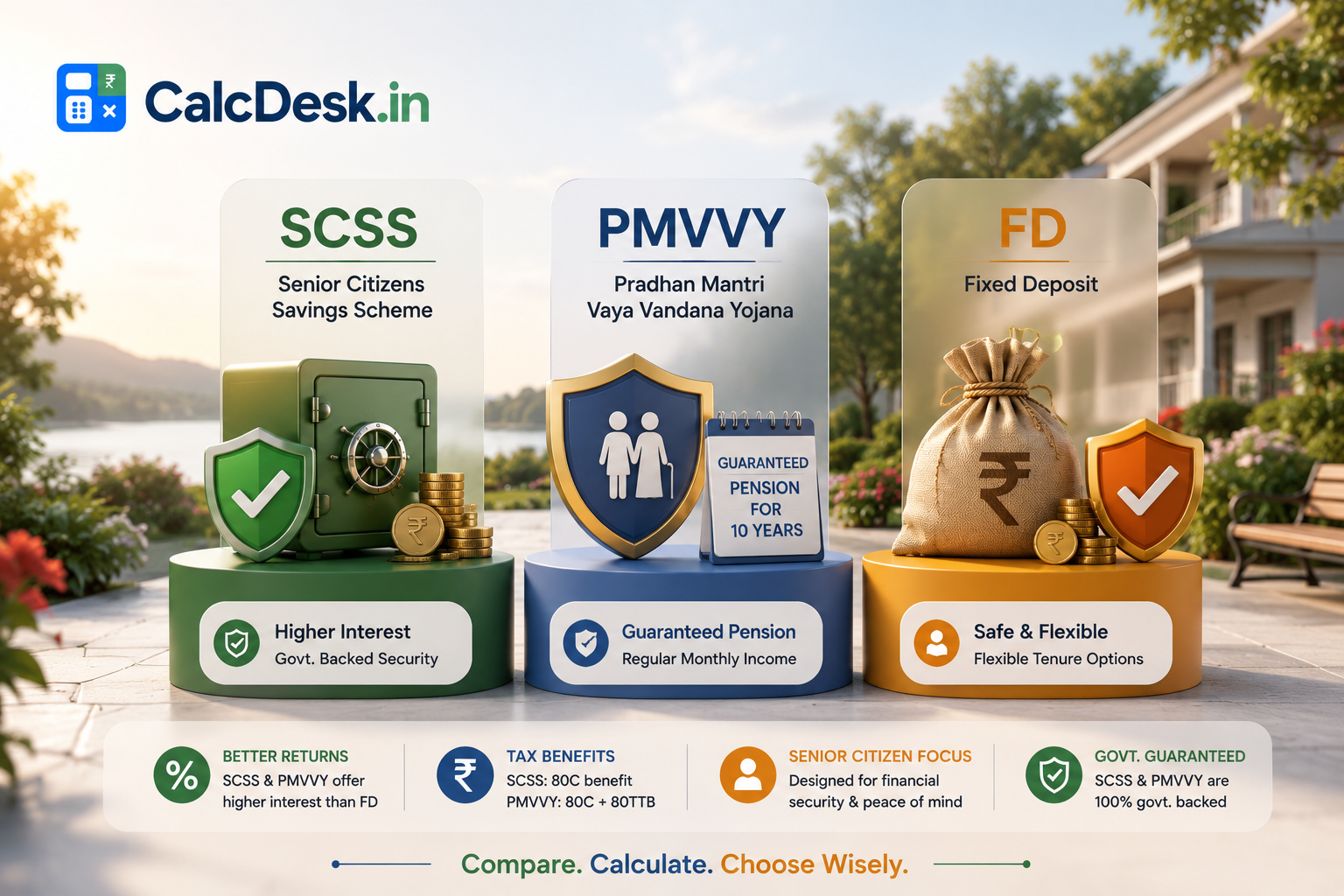
SCSS vs PMVVY vs FD 2026 — Best Income for Senior Citizens
For Indian retirees seeking safe, regular income in 2026, three products historically dominate the comparison: SCSS, PMVVY, and Senior Citizen FDs. However, PMVVY closed for new subscriptions in March 2023 — meaning the relevant comparison for new retirees in 2026 is primarily SCSS vs Senior Citizen FDs, supplemented by the RBI Floating Rate Savings Bond. This guide provides a complete comparison with current rates, examples, and optimal allocation strategies.
SCSS vs PMVVY vs Senior Citizen FD — 2026 Comparison
| Feature | SCSS | PMVVY | Senior Citizen FD |
|---|---|---|---|
| Interest Rate | 8.2% p.a. (Q1 FY2026-27) | 7.4% p.a. (closed to new) | 7.0–8.0% (varies by bank) |
| Payout Frequency | Quarterly | Monthly (pension) | Monthly, Quarterly, or Cumulative |
| Maximum Investment | ₹30 lakh per individual | ₹15 lakh (closed) | No limit |
| Tenure | 5 years (extendable 3 years) | 10 years | Flexible (7 days to 10 years) |
| Safety | Government backed | LIC backed (government) | DICGC insured up to ₹5L |
| New subscriptions | Available | Closed (March 2023) | Available |
| Tax on Interest | Taxable as per slab | Taxable as per slab | Taxable as per slab |
| Sec 80C on Principal | Yes (up to ₹1.5L, Old Regime) | Yes (up to ₹1.5L, Old Regime) | 5-yr tax saver FD only |
PMVVY in 2026 — Current Status
PMVVY was a LIC-backed monthly pension scheme offering 7.4% per annum for 10 years, available to senior citizens above 60. The scheme closed for new subscriptions on 31 March 2023. Existing policyholders continue receiving pension until their policy matures. for 2026, PMVVY is no longer an option for new investors — SCSS at 8.2% is the superior government-backed choice for comparable safety with higher returns.
Best Alternatives to PMVVY in 2026
| Alternative | Rate | Payout | Limit | Safety |
|---|---|---|---|---|
| SCSS | 8.2% quarterly | Quarterly (divide by 3 for monthly equivalent) | ₹30L/person | Government |
| RBI Floating Rate Savings Bond | 8.05% (floating, linked to NSC) | Semi-annual | No limit | Government (sovereign) |
| Post Office Monthly Income Scheme | 7.4% | Monthly | ₹9L single / ₹15L joint | Post Office (government) |
| Senior Citizen FD (SBI) | 7.5% (extra 50 bps for seniors) | Monthly/Quarterly/Cumulative | ₹5L DICGC insured | Bank + DICGC |
Worked Example 1 — SCSS Maximum Investment
Retired couple, each investing ₹30L in SCSS at 8.2%
Husband: ₹30L × 8.2% ÷ 4 = ₹61,500/quarter = ₹20,500/month equivalent
Wife: ₹30L × 8.2% ÷ 4 = ₹61,500/quarter
Combined quarterly income: ₹1,23,000 (≈ ₹41,000/month combined)
Over 5 years: ₹24,60,000 total interest received before tax
Tax note: If each spouse’s total income stays below ₹5L (basic exemption + standard deduction), effective tax on SCSS may be low with proper planning
Worked Example 2 — SCSS + FD + POMIS Portfolio
₹50L retirement corpus — optimal senior citizen income allocation
SCSS: ₹30L at 8.2% → quarterly income ₹61,500
POMIS: ₹9L at 7.4% → monthly income ₹5,550
Bank FD: ₹11L at 7.5% → cumulative (for capital growth)
Total monthly equivalent income: ₹20,500 (SCSS) + ₹5,550 (POMIS) = ₹26,050/month
FD portion grows to ₹15.7L in 5 years for reinvestment or emergency
Worked Example 3 — Senior Citizen FD for Flexibility
₹10L in Senior Citizen FD vs SCSS for short-term (2 years)
SCSS: 8.2% for 2 years → but premature closure penalty 1.5% of deposit after year 1
If you close SCSS after 2 years: penalty ₹15,000 → net interest ≈ ₹1,49,000
Senior Citizen FD (SBI, 7.5%, 2-year): Interest ≈ ₹1,50,000 with no premature closure penalty (only 0.5% for breaking FD)
For short tenures (1-2 years), FD is better than SCSS due to premature closure rules
💡 Optimal 2026 senior citizen income strategy: Maximise SCSS (₹30L per person) for highest guaranteed quarterly income. Add POMIS for monthly income supplementation. Use RBI Floating Rate Bond for unlimited government-backed investment above ₹30L. Keep 10-15% in liquid FD for emergency access. Avoid PMVVY (closed to new investors) and any insurance-cum-investment products.
👴 Calculate SCSS Quarterly Income — Free
Enter deposit amount. See exact quarterly payout and 5-year interest projection.
→ Open SCSS CalculatorRelated Calculators & Articles
Monthly Income Planning for Retirees — Complete Framework
The most common mistake retirees make is treating their corpus as a fixed pool and withdrawing from it without a framework. A structured approach — pairing guaranteed income instruments for predictable needs with growth assets for inflation protection — extends corpus longevity significantly. Here is a practical planning framework with worked numbers.
Step-by-Step Monthly Income Framework
Step 1 — Estimate current monthly expenses: Example: ₹50,000/month = ₹6L/year for a retired couple in a mid-sized city.
Step 2 — Account for inflation: At 6% inflation, ₹50,000/month today becomes approximately ₹1,60,357/month in 20 years. Plan for this progression — the income instruments you choose today must either grow with inflation or be supplemented over time.
Step 3 — Allocate ₹50L corpus across income instruments:
| Instrument | Amount | Rate | Monthly Income (equiv.) |
|---|---|---|---|
| SCSS | ₹15,00,000 | 8.2% quarterly | ₹10,250/month equivalent |
| POMIS | ₹9,00,000 | 7.4% monthly | ₹5,550/month |
| Bank FD (Senior Citizen rate 7.5%) | ₹26,00,000 | 7.5% monthly payout | ₹16,250/month |
| Total monthly income | ₹50,00,000 | — | ≈ ₹32,050/month |
This ₹32,050/month covers roughly 64% of the ₹50,000/month need. The gap is typically covered by pension (if any), spouse income, or rental income. If there is no other income source, the FD allocation should be increased or an annuity product considered for the gap.
₹1 Crore Corpus — Maximised Income Allocation
SCSS (husband): ₹15,00,000 at 8.2% = ₹30,750/quarter = ₹10,250/month equivalent
SCSS (wife): ₹15,00,000 at 8.2% = ₹30,750/quarter = ₹10,250/month equivalent
POMIS (husband, individual): ₹9,00,000 at 7.4% = ₹5,550/month
POMIS (wife, individual): ₹9,00,000 at 7.4% = ₹5,550/month
Bank Senior Citizen FD: ₹22,00,000 at 7.5% monthly payout = ₹13,750/month
RBI Floating Rate Bond: ₹30,00,000 at 8.05% semi-annual = ₹1,20,750 per 6 months = ₹20,125/month equivalent
Total monthly income (from ₹1 Cr corpus): ₹10,250 + ₹10,250 + ₹5,550 + ₹5,550 + ₹13,750 + ₹20,125 = ≈ ₹65,475/month
This assumes full SCSS limits used by both spouses (₹15L each), maximum POMIS for both (₹9L each), and the remainder split between FD and RBI bond. The couple generates over ₹65K/month from a ₹1 Cr corpus without touching the principal.
Tax Planning for Senior Citizens — Deductions Available
Senior citizens (age 60 and above) have access to specific tax provisions that reduce their interest income tax burden. Using these correctly can mean the difference between paying significant tax on FD and SCSS interest versus paying zero tax on the same income.
Section 80TTB: Senior citizens can claim a deduction of up to ₹50,000/year on interest income from deposits (savings accounts, FD, RD, SCSS, post office deposits). This replaces Section 80TTA (which allows only ₹10,000 for non-seniors and covers only savings accounts). Section 80TTB is available only under the Old Tax Regime — it is not available if you choose the New Regime.
Zero Tax at ₹7L Income — Senior Citizen, FY 2026-27
Income profile: Pension ₹4,80,000 + Interest income (SCSS + FD) ₹2,20,000 = ₹7,00,000 total
New Regime calculation:
Standard deduction: ₹75,000. Taxable income: ₹6,25,000.
Tax on ₹6.25L (New Regime slabs): ₹0 to ₹4L = nil; ₹4L to ₹6.25L = ₹45,000. Tax before rebate: ₹45,000.
Section 87A rebate: Total income ₹7L is below the ₹12L threshold → full rebate applies (max ₹60,000; tax due ₹45,000 is within cap). Final tax = ₹0.
Old Regime calculation:
Deductions: 80TTB ₹50,000 + 80D health insurance ₹50,000 + Standard deduction ₹50,000 = ₹1,50,000 total deductions.
Taxable income: ₹7,00,000 − ₹1,50,000 = ₹5,50,000. Tax on ₹5.5L (Old Regime senior slabs): ₹0 to ₹3L = nil; ₹3L to ₹5L = ₹20,000; ₹5L to ₹5.5L = ₹10,000. Total: ₹30,000. Section 87A rebate: income ≤ ₹5L? No — ₹5.5L. No rebate under Old Regime for income above ₹5L. Tax after cess: ₹31,200.
Verdict for this profile: New Regime is far better — zero tax vs ₹31,200 under Old Regime. The New Regime’s higher rebate threshold (₹12L) and standard deduction (₹75K) make it superior for most senior citizens with total income up to ₹12L.
Practical action: Submit Form 15H to your bank and post office at the start of each financial year if your total income falls below the taxable threshold. This prevents TDS deduction on SCSS and FD interest — avoiding the need to file for a refund later.
Key deductions available for senior citizens in FY 2026-27:
- Section 80TTB (Old Regime only): ₹50,000 deduction on interest from all deposits
- Section 80D: Health insurance premium deduction of ₹50,000/year for senior citizens (versus ₹25,000 for those below 60)
- Standard deduction: ₹75,000 (New Regime) or ₹50,000 (Old Regime) on pension income treated as salary
- Section 80C (Old Regime): SCSS principal deposit up to ₹1.5L qualifies for 80C deduction
- Advance tax exemption: Senior citizens with only pension or interest income (no business income) are exempt from advance tax requirements — they pay tax only at ITR time without 234B/234C interest
Frequently Asked Questions
Alternatives for Monthly Income — POMIS and Post Office Instruments
Since PMVVY is closed, the Post Office Monthly Income Scheme (POMIS) is the closest like-for-like replacement for monthly pension income at a government-safe level:
| Feature | POMIS | SCSS | PMVVY (Existing) |
|---|---|---|---|
| Rate | 7.4% p.a. | 8.2% p.a. | 7.4% p.a. |
| Payout | Monthly (1st of month) | Quarterly | Monthly / Quarterly / Annual |
| Tenure | 5 years | 5 years + 3 yr extension | 10 years |
| Single account limit | ₹9 lakh | ₹30 lakh | ₹15 lakh (closed) |
| Joint account limit | ₹15 lakh | ₹30 lakh each | ₹15 lakh total |
| Age restriction | None | 60+ years | 60+ years |
Optimal Portfolio Construction — ₹1 Crore Retirement Corpus
How to allocate ₹1 crore for senior citizen income optimisation
SCSS: ₹30L at 8.2% → ₹61,500/quarter (₹20,500 equivalent/month)
POMIS: ₹9L at 7.4% → ₹5,550/month
RBI Floating Rate Bond: ₹30L at 8.05% → ₹1,20,750 semi-annually (₹20,125/month equivalent)
Liquid Fund: ₹15L for emergency + short-term needs at 7%
Senior Citizen FD: ₹16L at 7.5% → cumulative for capital growth
Total monthly income equivalent: ₹20,500 + ₹5,550 + ₹20,125 = ₹46,175/month
Plus ₹31L in liquid fund and FD for emergencies and reinvestment
RBI Floating Rate Savings Bond — The Unlimited Safe Option
For senior citizens who have exhausted SCSS limits (₹30L per person), the RBI Floating Rate Savings Bond is the best next option:
- Rate: 8.05% per annum (for Jan-Jun 2026 period), linked to NSC rate + 35 basis points, reviewed every 6 months
- Payout: Semi-annually (every 6 months) — January and July
- Limit: No maximum investment limit — can park ₹1 crore, ₹5 crore, or any amount
- Safety: Sovereign-backed — direct Government of India obligation through RBI. Highest possible safety, even above bank FD (no ₹5L insurance cap)
- Lock-in: 7 years for general investors; 6 years for 60-70 age group; 5 years for 70-80 age group; 4 years for 80+ years
- Taxability: Interest fully taxable — same as SCSS and FD
How to Invest in RBI Floating Rate Bond
- Visit any authorised bank branch — SBI, HDFC, ICICI, Axis, and most public sector banks are authorised
- Fill the RBI Bond application form with KYC documents (PAN, Aadhaar)
- Bonds are issued in dematerialised form (stored in RBI’s Bond Ledger Account — BLA)
- Alternatively, invest online through the RBI Retail Direct portal at rbiretaildirect.org.in — direct without bank intermediary
- Interest credited directly to your bank account semi-annually