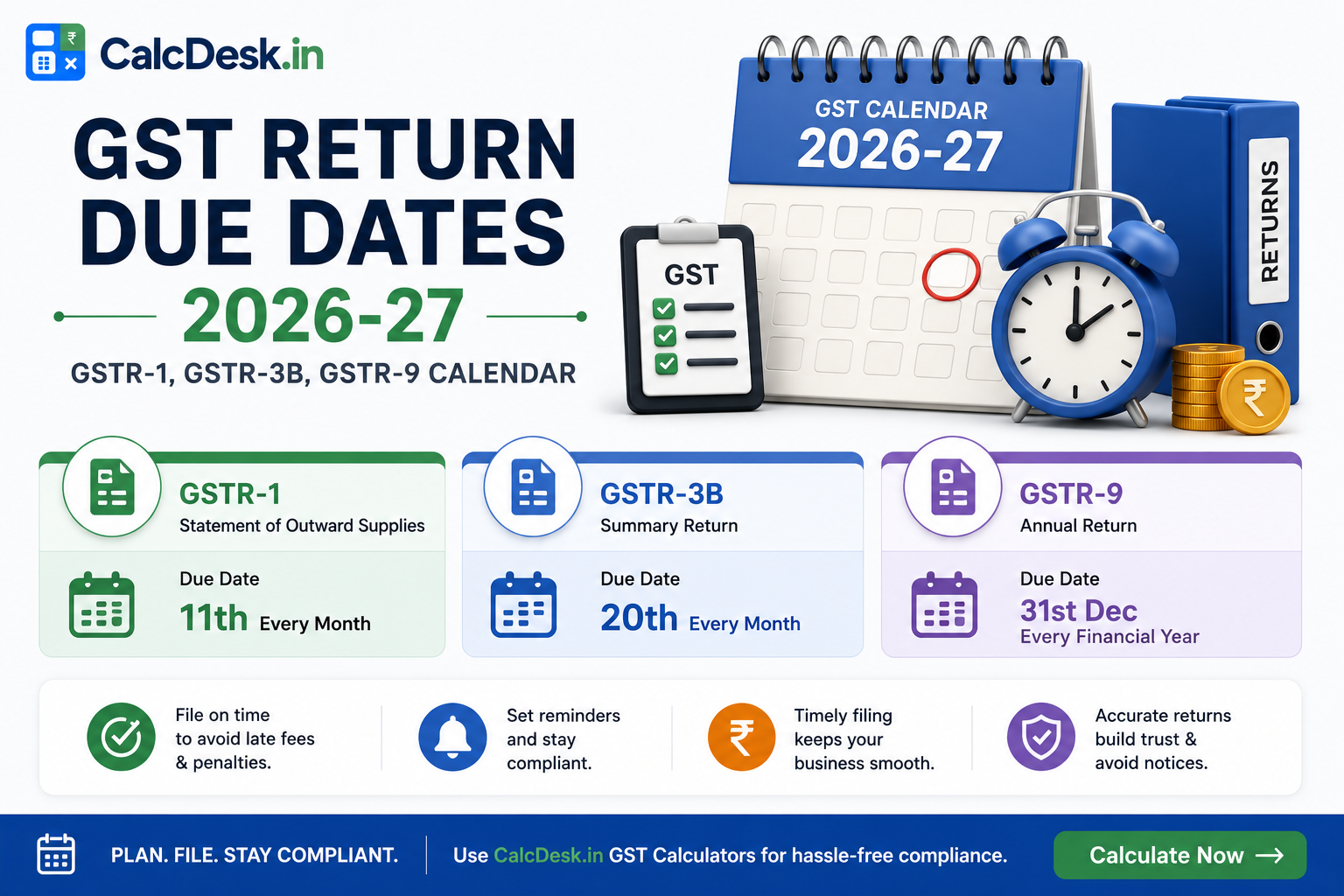
GST Return Due Dates 2025-26 — Complete Filing Calendar
GST compliance requires filing multiple returns each month or quarter, with strict due dates. Missing a deadline — even by one day — triggers daily late fees of ₹20-₹200, and unpaid tax attracts 18% annual interest. This complete calendar covers all GST return due dates for FY 2025-26, with monthly tables for GSTR-1 and GSTR-3B, the QRMP scheme deadlines, and the GSTR-9 annual return.
GST Return Types — Quick Reference
| Return | Who Files | What It Covers | Frequency |
|---|---|---|---|
| GSTR-1 | All regular taxpayers | Outward supply details (sales invoices) | Monthly or Quarterly (QRMP) |
| GSTR-3B | All regular taxpayers | Summary return: ITC, tax payable, paid | Monthly or Quarterly (QRMP) |
| GSTR-9 | Regular taxpayers (>₹2Cr turnover) | Annual consolidated return | Annual (by 31 Dec) |
| GSTR-9C | Taxpayers with >₹5Cr turnover | Reconciliation statement | Annual (by 31 Dec) |
| GSTR-4 | Composition scheme taxpayers | Quarterly summary + annual return | Annual (by 30 April) |
| GSTR-7 | TDS deductors under GST | TDS return | Monthly (10th) |
GSTR-1 Monthly Due Dates — FY 2025-26
| Month | GSTR-1 Due Date (Monthly Filers) |
|---|---|
| April 2025 | 11 May 2025 |
| May 2025 | 11 June 2025 |
| June 2025 | 11 July 2025 |
| July 2025 | 11 August 2025 |
| August 2025 | 11 September 2025 |
| September 2025 | 11 October 2025 |
| October 2025 | 11 November 2025 |
| November 2025 | 11 December 2025 |
| December 2025 | 11 January 2026 |
| January 2026 | 11 February 2026 |
| February 2026 | 11 March 2026 |
| March 2026 | 11 April 2026 |
GSTR-3B Monthly Due Dates — FY 2025-26
| Month | Turnover >₹5Cr (20th) | QRMP Cat 1 States (22nd) | QRMP Cat 2 States (24th) |
|---|---|---|---|
| April 2025 | 20 May 2025 | 22 May 2025 | 24 May 2025 |
| May 2025 | 20 June 2025 | 22 June 2025 | 24 June 2025 |
| June 2025 | 20 July 2025 | 22 July 2025 | 24 July 2025 |
| September 2025 | 20 October 2025 | 22 October 2025 | 24 October 2025 |
| December 2025 | 20 January 2026 | 22 January 2026 | 24 January 2026 |
| March 2026 | 20 April 2026 | 22 April 2026 | 24 April 2026 |
QRMP filers pay tax via PMT-06 challan for months 1-2 of each quarter by the 25th. Full GSTR-3B filed for month 3 (June, September, December, March) by the 22nd/24th.
QRMP Scheme — Category 1 vs Category 2 States
| Category 1 States (22nd deadline) | Category 2 States (24th deadline) |
|---|---|
| Chhattisgarh, MP, Gujarat, Maharashtra, Karnataka, Goa, Kerala, TN, Telangana, AP, Rajasthan, UP, J&K, Ladakh, HP | Himachal Pradesh (alternate), Punjab, Uttarakhand, Haryana, Delhi, Bihar, Sikkim, Arunachal Pradesh, Nagaland, Manipur, Mizoram, Tripura, Meghalaya, Assam, WB, Jharkhand, Odisha, Daman & Diu, Dadra & NH, Puducherry, Andaman & Nicobar |
GSTR-9 Annual Return — Key Facts
- Due date: 31 December 2026 for FY 2025-26
- Who must file: Taxpayers with annual aggregate turnover above ₹2 crore
- Who is exempt: Turnover up to ₹2 crore — filing optional; composition scheme dealers file GSTR-4
- GSTR-9C: Self-certified reconciliation for taxpayers with turnover above ₹5 crore
- Late fee: ₹200/day (₹100 CGST + ₹100 SGST), capped at 0.25% of annual turnover
💡 Compliance tip: File GSTR-1 before GSTR-3B every month — GSTR-1 supplies flow into your buyers’ GSTR-2B for ITC claims. Late GSTR-1 disrupts buyer’s ITC and creates downstream compliance issues. Set calendar reminders for the 10th (GSTR-1 prep) and 18th (GSTR-3B prep) of every month to ensure on-time filing.
🧮 Calculate GST on Any Transaction — Free
Enter amount and GST rate. Get CGST, SGST, IGST breakdown instantly.
→ Open GST CalculatorRelated Calculators & Articles
GST Calendar FY 2025-26 — Complete Month-by-Month Table
The table below consolidates all key GST return deadlines for FY 2025-26 in a single view. Monthly filers have turnover above ₹5 crore; QRMP filers have turnover up to ₹5 crore. IFF = Invoice Furnishing Facility (for QRMP filers to report large B2B invoices in months 1 and 2 of each quarter).
| Month | GSTR-1 (Monthly, 11th) | GSTR-1 / IFF (QRMP) | GSTR-3B (Monthly, 20th) | GSTR-3B (QRMP, 22nd/24th) |
|---|---|---|---|---|
| April 2025 | 11 May 2025 | 13 May 2025 (IFF) | 20 May 2025 | 22/24 May 2025 |
| May 2025 | 11 June 2025 | 13 June 2025 (IFF) | 20 June 2025 | 22/24 June 2025 |
| June 2025 | 11 July 2025 | 31 July 2025 (Q1 GSTR-1) | 20 July 2025 | 22/24 July 2025 |
| July 2025 | 11 August 2025 | 13 August 2025 (IFF) | 20 August 2025 | 22/24 August 2025 |
| August 2025 | 11 September 2025 | 13 September 2025 (IFF) | 20 September 2025 | 22/24 September 2025 |
| September 2025 | 11 October 2025 | 31 October 2025 (Q2 GSTR-1) | 20 October 2025 | 22/24 October 2025 |
| October 2025 | 11 November 2025 | 13 November 2025 (IFF) | 20 November 2025 | 22/24 November 2025 |
| November 2025 | 11 December 2025 | 13 December 2025 (IFF) | 20 December 2025 | 22/24 December 2025 |
| December 2025 | 11 January 2026 | 31 January 2026 (Q3 GSTR-1) | 20 January 2026 | 22/24 January 2026 |
| January 2026 | 11 February 2026 | 13 February 2026 (IFF) | 20 February 2026 | 22/24 February 2026 |
| February 2026 | 11 March 2026 | 13 March 2026 (IFF) | 20 March 2026 | 22/24 March 2026 |
| March 2026 | 11 April 2026 | 30 April 2026 (Q4 GSTR-1) | 20 April 2026 | 22/24 April 2026 |
22nd deadline applies to Category 1 states (Maharashtra, Gujarat, Karnataka, TN, AP, Telangana, Kerala, MP, Chhattisgarh, Rajasthan, UP, Goa, J&K, Ladakh). 24th deadline applies to Category 2 states (Delhi, WB, Bihar, Odisha, Punjab, Haryana, Jharkhand, Uttarakhand, NE states, Andaman, Daman & Diu, Puducherry). QRMP filers pay tax for months 1–2 of each quarter via PMT-06 challan by the 25th — only the quarter-end month requires a full GSTR-3B.
What Happens When the GST Portal is Down on the Due Date
GSTN portal downtime near filing deadlines is a recurring reality. Knowing how to document it and what recourse exists can save you from paying late fees you do not owe.
GSTN’s official policy on downtime: When the portal is unavailable due to a technical failure on or near a due date, GSTN typically issues an advisory on its home page extending the deadline by 2–4 days. These advisories are also announced on the @askGST_GoI Twitter/X handle and on gstn.org.in. The extension is automatic — you do not need to apply separately.
How to document portal downtime yourself: Take screenshots of the error message (showing “Service Unavailable,” error codes, or login failure) with the timestamp clearly visible. Save these with date-stamped filenames. If a late fee is later levied despite the portal being down, these screenshots are your primary evidence in any appeal or condonation request.
💡 Condonation process if late fee is wrongly charged: File an application on the GST portal under “Grievance” section → describe the downtime, attach screenshots as evidence. Alternatively, approach your jurisdictional GST officer with a written application for condonation of delay. Many officers waive late fees when GSTN itself acknowledged downtime. Reference the GSTN advisory number (if one was issued) in your application for faster resolution.
📌 Best practice — file 2–3 days early: Portal load is highest in the last 2 days before any GST deadline. Login failures and slow response times are common. Filing by the 8th (for 11th deadline) and 17th (for 20th deadline) eliminates downtime risk entirely. For QRMP quarterly deadlines, file by the 28th of the quarter-end month. Set recurring calendar reminders 3 days before each deadline.
Frequently Asked Questions
GSTR-2B — Understanding Your Automatic ITC Statement
GSTR-2B is the auto-generated Input Tax Credit (ITC) statement that shows all ITC available to you based on your suppliers’ GSTR-1 filings. Understanding it helps avoid ITC mismatches:
- Generated on: 14th of every month (reflects all supplier GSTR-1 filed by 13th of that month)
- What it shows: All invoices your suppliers have uploaded in their GSTR-1 that are addressed to your GSTIN — the ITC you can legally claim
- What’s NOT in GSTR-2B: Invoices from suppliers who filed late GSTR-1 (after the 13th) don’t appear until next month’s GSTR-2B
- Reconcile before GSTR-3B: Always reconcile your purchase register against GSTR-2B before claiming ITC in GSTR-3B. ITC claimed in 3B but absent from GSTR-2B can be challenged during scrutiny
- Rule 36(4): ITC can only be claimed to the extent it appears in GSTR-2B. If your supplier hasn’t filed, you cannot claim that ITC in GSTR-3B — you must follow up with your supplier to file their GSTR-1
Consequences of Not Filing GST Returns
| Duration of Non-Filing | Consequence |
|---|---|
| 1-30 days | Late fee accumulates; portal access restricted for next period filing |
| 2+ consecutive months (GSTR-3B) | E-way bill generation blocked |
| 6+ months | GST registration liable to be suspended by tax authorities |
| 1+ year or persistent default | Show Cause Notice for cancellation of GST registration |
| Cancelled registration | Cannot issue valid GST invoices; buyers cannot claim ITC from your invoices |
GST Annual Return — GSTR-9 Filing Guide
GSTR-9 reconciles the entire year’s GST activity — it’s the annual summary and any unreported transactions or ITC adjustments should be captured here:
- Who files: Taxpayers with annual aggregate turnover above ₹2 crore (voluntary for ≤₹2 crore)
- Data it requires: Monthly summary of outward and inward supplies, ITC availed vs ITC as per GSTR-2B, tax paid, refunds claimed, demands and orders
- Key reconciliations to do before filing: (1) Outward supply per GSTR-1 vs books — should match; (2) ITC per GSTR-3B vs GSTR-2B — explain any excess or shortfall; (3) Tax paid in GSTR-3B vs Electronic Tax Liability Register — confirm no gaps
- Common GSTR-9 errors: Incorrectly claiming amendments from previous year in current year; ITC reversal amounts entered incorrectly; HSN summary not matching GSTR-1 data
How to Avoid Last-Minute GST Filing Rush
- Reconcile GSTR-1 vs books monthly — don’t accumulate 12 months of reconciliation for year-end. Monthly reconciliation takes 30 minutes; year-end takes days
- Maintain a GST compliance calendar — export all due dates to your calendar app with 3-day advance reminders
- Set up auto-payment for GSTR-3B from your Electronic Cash Ledger — ensure the ledger has adequate balance by the 18th of each month to enable timely filing
- Keep supplier communication active: Chase suppliers who haven’t filed GSTR-1 by the 12th — their late filing delays your GSTR-2B and ITC claims
QRMP Scheme — Complete Guide for Small Businesses
The QRMP (Quarterly Return Monthly Payment) scheme was introduced to reduce the compliance burden for small GST taxpayers. Here’s everything you need to know to decide if it’s right for your business:
Who Should Use QRMP?
- Businesses with annual aggregate turnover up to ₹5 crore in the previous financial year
- Businesses with predominantly B2C transactions (retail, small services) — where buyers don’t urgently need your GSTR-1 data for ITC claims
- Businesses where the owner or accountant handles GST compliance personally and filing 24 returns per year (12 GSTR-1 + 12 GSTR-3B) is burdensome
Who Should Stay on Monthly Filing?
- Businesses with significant B2B sales — your buyers depend on your monthly GSTR-1 for their GSTR-2B and ITC claims. Quarterly GSTR-1 delays their ITC by 2-3 months each quarter
- Businesses with turnovers between ₹2-5 crore that are growing — once you cross ₹5 crore, you’re automatically moved to monthly filing anyway
- Businesses where cash flow management requires precise monthly ITC availability
QRMP Monthly Payment — PMT-06 Challan
Under QRMP, you still pay tax monthly (months 1 and 2 of each quarter) via PMT-06 challan. Two methods are available:
- Fixed Sum Method: Pay 35% of the previous quarter’s tax liability (automatically calculated by the portal) — simpler but may result in over/under payment
- Self-Assessment Method: Calculate actual tax liability for the month based on your books and pay that amount — more accurate, avoids over/under payment
📌 QRMP enrolment: Opt in or out of QRMP scheme on the GST portal under Services → Returns → Opt-in for Quarterly Return. The deadline to opt in for a quarter is the last day of the first month of that quarter. For Q2 (July-September), opt in by 31 July. Changes take effect from the next quarter.
GST Portal Downtime — What to Do When Filing is Impossible
The GSTN portal occasionally experiences downtime, especially near filing deadlines. If you cannot file due to portal issues:
- Take a screenshot of the error message with timestamp — this is your evidence of attempted filing
- Check GSTN’s official Twitter/X handle (@askGST_GoI) for downtime announcements — the department sometimes extends deadlines when portal issues are widespread
- File the return as soon as the portal is restored — late fee calculation considers the actual filing date, not the deadline
- If the portal was down on the deadline day and you can prove attempted filing (screenshot, GSTN’s own acknowledgment of downtime), you can petition for late fee waiver through your jurisdictional GST officer