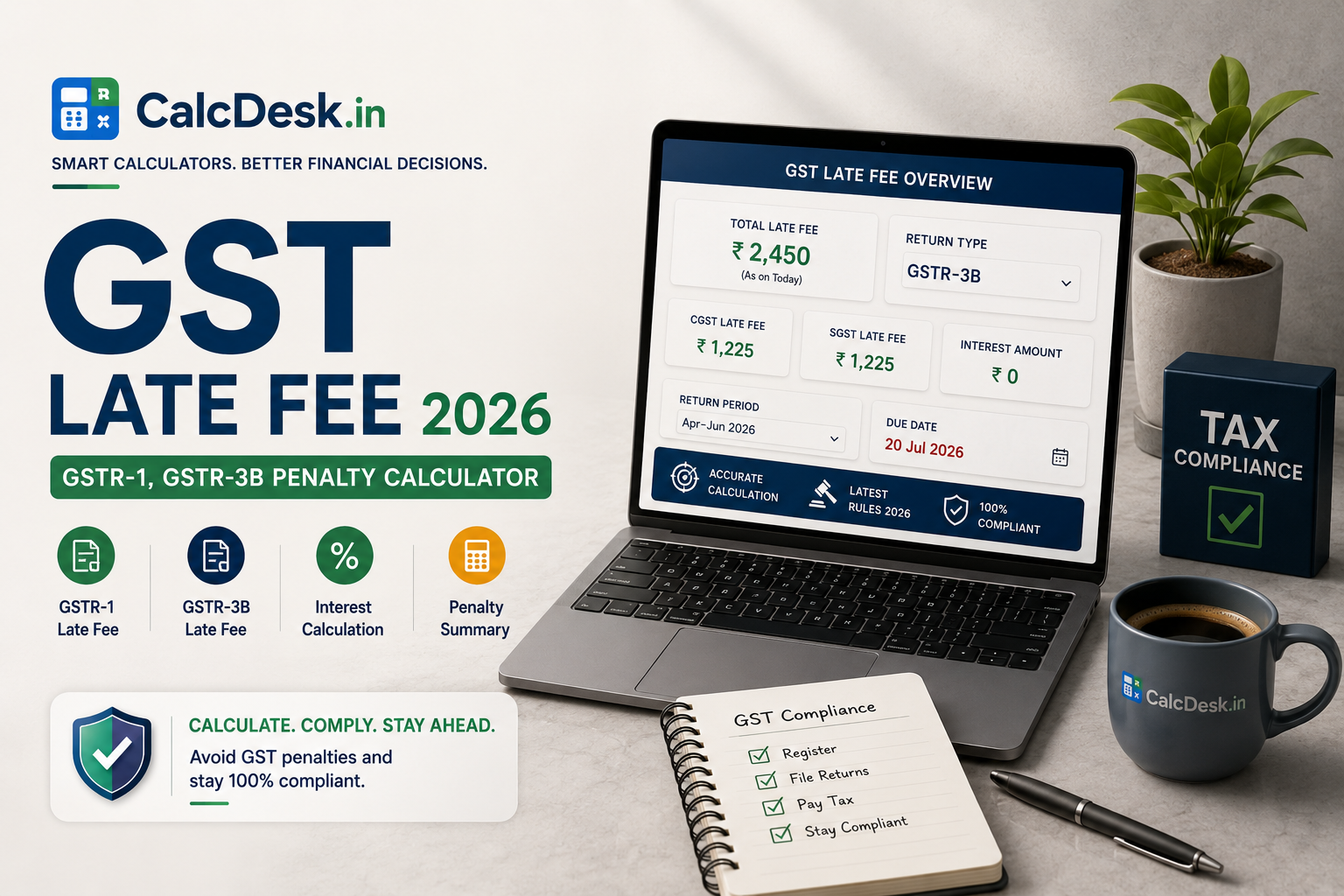
GST Late Fee 2026 — GSTR-1, GSTR-3B Penalties Explained
GST late fees are one of the most common and avoidable compliance costs for Indian businesses. Missing a GSTR-3B or GSTR-1 deadline by even a few days triggers daily late fees, and if there’s unpaid tax, an additional 18% annual interest compounds the penalty. Understanding the exact late fee structure, caps, and calculation method helps you budget for delays and prioritise timely filing.
This guide covers the complete GST late fee structure for FY 2026-27, daily rates for each return type, maximum caps, the 18% interest on unpaid tax, and strategies to minimise penalties. Use CalcDesk’s GST Calculator to compute your GST liability accurately before filing.
GST Late Fee Structure — All Major Returns
| Return Type | Due Date | Late Fee/Day (With Tax) | Late Fee/Day (Nil Return) | Maximum Cap |
|---|---|---|---|---|
| GSTR-1 (Monthly) | 11th of next month | ₹50/day (₹25 CGST + ₹25 SGST) | ₹20/day (₹10+₹10) | ₹10,000 per return |
| GSTR-3B (Monthly) | 20th of next month | ₹50/day (₹25 CGST + ₹25 SGST) | ₹20/day (₹10+₹10) | ₹10,000 per return |
| GSTR-3B (Turnover ≤ ₹5 Cr, Cat 1 states) | 22nd of next month | ₹50/day | ₹20/day | ₹10,000 |
| GSTR-3B (Turnover ≤ ₹5 Cr, Cat 2 states) | 24th of next month | ₹50/day | ₹20/day | ₹10,000 |
| GSTR-9 (Annual Return) | 31st December | ₹200/day (₹100 CGST + ₹100 SGST) | ₹200/day | 0.25% of turnover in state |
| GSTR-4 (Composition) | 30th April | ₹200/day (₹100+₹100) | ₹200/day | ₹5,000 per return |
Interest on Unpaid Tax — Sec 50 CGST Act
GST Interest Formula
Example: ₹50,000 GST unpaid for 30 days
Interest = ₹50,000 × 18% × 30/365 = ₹739
For wrongful ITC claims: 24% per annum applies
Both late fee AND interest apply simultaneously if return is delayed AND tax is unpaid
Worked Example 1 — GSTR-3B filed 15 days late with tax liability
Monthly taxpayer, ₹2,00,000 GST due, GSTR-3B filed 15 days late
Late fee: 15 days × ₹50/day = ₹750 (₹375 CGST + ₹375 SGST)
Interest on unpaid tax: ₹2,00,000 × 18% × 15/365 = ₹1,479
Total penalty = ₹750 + ₹1,479 = ₹2,229
Note: Late fee is capped at ₹10,000; interest has no cap and continues to accumulate daily
Worked Example 2 — Nil Return Filed 40 Days Late
No transactions for the month, GSTR-3B nil return filed 40 days late
Late fee: 40 days × ₹20/day = ₹800 (₹400 CGST + ₹400 SGST)
Interest: ₹0 (no tax liability, so no interest)
Total penalty: ₹800
Key lesson: File nil returns on time — even with no transactions, delay costs ₹20/day
Worked Example 3 — GSTR-9 Annual Return Late
Turnover ₹80 lakh, GSTR-9 filed 20 days late
Daily late fee: ₹200/day (₹100 CGST + ₹100 SGST)
20 days: ₹200 × 20 = ₹4,000
Maximum cap for GSTR-9: 0.25% of annual turnover = 0.25% × ₹80,00,000 = ₹20,000
Actual late fee: ₹4,000 (below cap, so full ₹4,000 is payable)
GST Due Dates 2026-27 — Monthly Filers
| Month | GSTR-1 Deadline | GSTR-3B Deadline (Turnover > ₹5 Cr) |
|---|---|---|
| April 2026 | 11 May 2026 | 20 May 2026 |
| May 2026 | 11 June 2026 | 20 June 2026 |
| June 2026 | 11 July 2026 | 20 July 2026 |
| July 2026 | 11 Aug 2026 | 20 Aug 2026 |
| August 2026 | 11 Sep 2026 | 20 Sep 2026 |
| September 2026 | 11 Oct 2026 | 20 Oct 2026 |
Late Fee Waiver Schemes — Past Precedents
The GST Council has periodically issued late fee waiver schemes for taxpayers who had accumulated large late fees due to non-filing over multiple periods. These amnesty schemes typically cap the maximum late fee per return at a reduced amount (e.g., ₹500 or ₹1,000) if the taxpayer files all pending returns within a specified window. Check gstn.gov.in and GST Council notifications for any active waiver schemes. Do not rely on expecting a waiver — file on time.
⚠️ Important: Late GSTR-1 filing blocks GSTR-3B filing for the next period for your buyers — it also prevents them from seeing your invoices in GSTR-2B, disrupting their ITC claims. This creates downstream compliance issues beyond your own late fee liability.
💡 Tip: If you cannot pay GST on time, still file the return on time. The late fee applies only to the return filing delay. Filing on time but paying late only triggers interest at 18% — much less than the combination of late fee + interest for both delayed return AND delayed payment.
🧮 Calculate Your GST Liability — Free
Compute GST on any transaction amount before filing. Supports all GST rates.
→ Open GST CalculatorRelated Calculators & Articles
Frequently Asked Questions
How to Pay GST Late Fee — Step by Step
Once a late fee has accumulated, you cannot skip it — the GSTN portal automatically calculates the outstanding late fee and requires payment before accepting the return. Here’s the payment process:
- Log into the GST portal at gstn.gov.in with your GSTIN credentials
- Navigate to Services → Returns → Returns Dashboard
- Select the pending return period (e.g., GSTR-3B for April 2026)
- The portal displays the auto-calculated late fee based on days delayed. This amount populates in the “Late Fee” field automatically
- Pay the late fee using the Electronic Cash Ledger — if your cash ledger has sufficient balance, it is debited automatically on return submission
- If cash ledger is insufficient, deposit additional funds via Challan PMT-06 before submitting the return
- Submit and file the return — late fee payment is mandatory; the portal will not allow submission without it
Impact of Late Filing on ITC for Your Buyers
Late GSTR-1 filing doesn’t just hurt you — it directly impacts your B2B buyers’ ITC claims. Here’s how:
- Your buyers’ GSTR-2B (auto-populated input tax credit statement) pulls data from your filed GSTR-1
- If you file GSTR-1 late, the invoices appear in buyers’ GSTR-2B only in the month you eventually file — not the month of the actual transaction
- This delays buyers’ ITC claims, potentially forcing them to pay GST from their own pocket while waiting for your GSTR-1
- Under Rule 37A, buyers must reverse ITC if their supplier doesn’t file GSTR-3B within the prescribed period — your filing delay can trigger ITC reversal requirements for your customers
- This is why large companies (particularly listed companies) require their vendors to file GSTR-1 on time as a contract condition
⚠️ Business relationship risk: Repeatedly late GSTR-1 filing can cause buyers to drop you as a vendor — the ITC disruption is costly for them. Timely GST filing is not just a compliance matter; it’s a business relationship issue, particularly in B2B supply chains.
1 thought on “GST Late Fee 2026 — GSTR-1, GSTR-3B Penalty Calculator | CalcDesk.in”