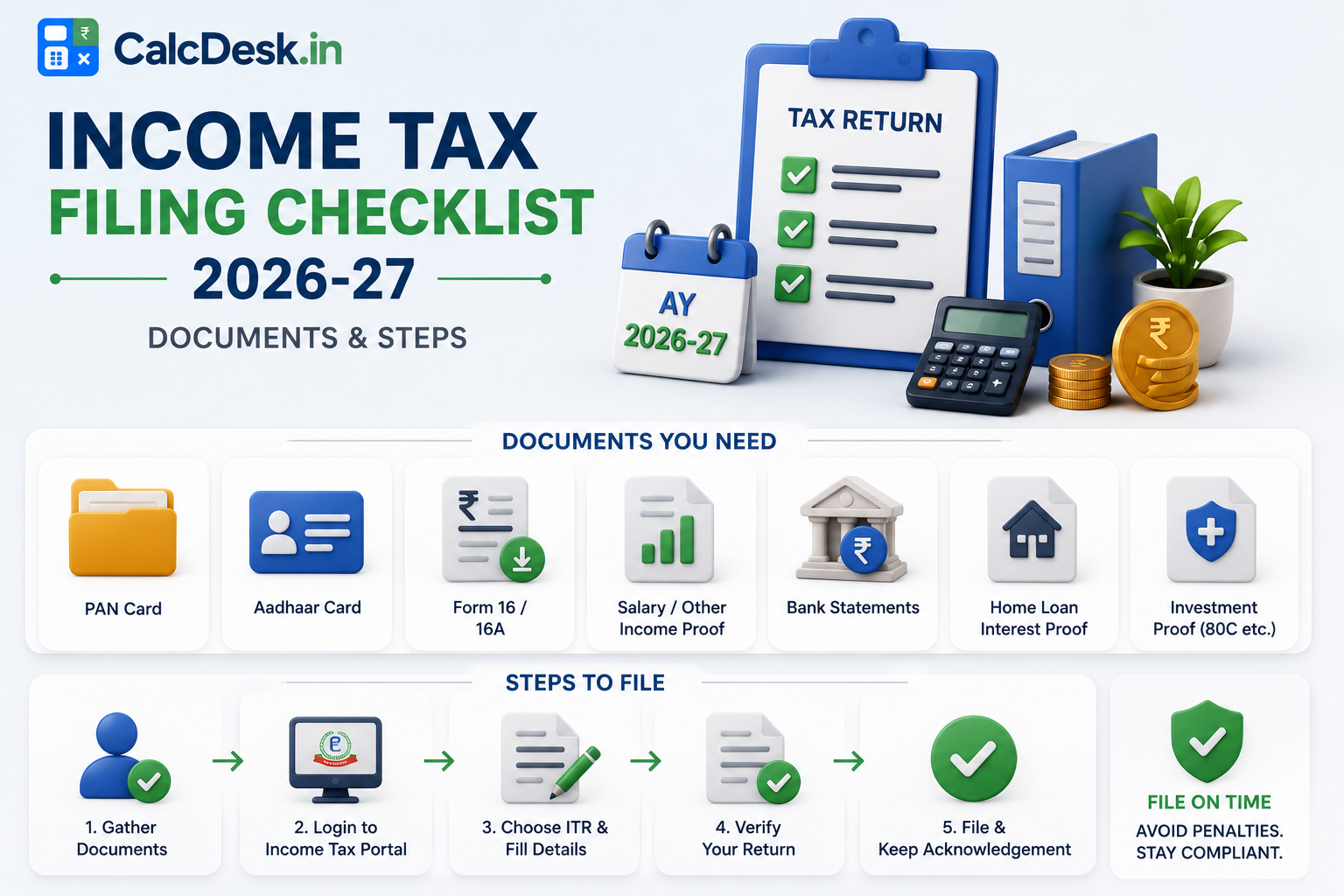
Income Tax Filing Checklist FY 2026-27 — Everything You Need
Filing your Income Tax Return for FY 2026-27 (AY 2027-28) correctly requires having the right documents, choosing the right ITR form, and claiming every deduction you’re entitled to. Missing a single document — like your Annual Information Statement or capital gains statement — can cause mismatches that lead to income tax notices. This checklist covers everything you need, organised by category, so you don’t miss anything.
Key Dates — AY 2027-28 (FY 2026-27)
| Event | Date | Notes |
|---|---|---|
| ITR filing deadline (individuals, non-audit) | 31 July 2026 | File before this to avoid penalty |
| Belated ITR filing | 1 Aug – 31 Dec 2026 | Penalty ₹5,000 (₹1,000 if income ≤₹5L) |
| Form 16 from employer | By 15 June 2026 | Employers must issue by this date |
| Advance tax last instalment | 15 March 2026 | Self-employed and additional income |
| AIS/TIS available | Ongoing on incometax.gov.in | Check and reconcile before filing |
Which ITR Form to Use?
| Your Situation | Correct Form |
|---|---|
| Salary + one house property + interest, total income ≤₹50L, no capital gains, no foreign assets | ITR-1 (Sahaj) |
| Salary + capital gains (sold MF/stocks) or income >₹50L or foreign assets | ITR-2 |
| Business or professional income (Sec 44AD/44ADA presumptive tax) | ITR-4 (Sugam) |
| Business income with books of accounts | ITR-3 |
| Company or LLP | ITR-6 or ITR-5 |
Document Checklist
Identity & Banking
- PAN card
- Aadhaar card (for e-verification)
- Bank account number + IFSC (for refund, if applicable)
- Bank statements for all accounts (to report interest income)
Income Documents
- Form 16 Part A and Part B from all employers
- Salary slips for any employer not providing Form 16
- Form 16A (TDS certificates for non-salary income — FD interest, professional fees received)
- Form 26AS — download from incometax.gov.in (shows all TDS deducted)
- Annual Information Statement (AIS) — shows all income reported to tax dept
- Capital gains statement from mutual fund registrars (CAMS, KFintech) and broker
- Rental income details (annual rent, property tax paid)
Deduction Documents
- PPF passbook / statement (Sec 80C)
- ELSS/mutual fund investment statements (Sec 80C)
- Life insurance premium receipts (Sec 80C)
- Home loan principal repayment certificate from bank (Sec 80C)
- Home loan interest certificate from bank (Sec 24(b) — up to ₹2L)
- Health insurance premium receipts (Sec 80D — self, family, parents)
- NPS contribution statement (Sec 80CCD(1B) — up to ₹50K extra)
- HRA rent receipts and rental agreement (if claiming HRA exemption)
- Donation receipts with 80G registration number of NGO
- Education loan interest certificate (Sec 80E)
Commonly Missed Deductions — Don’t Leave Money Behind
| Deduction | Section | Maximum | Often Missed Because |
|---|---|---|---|
| Professional tax | Sec 16(iii) | Actual PT paid | Auto-deducted, easily forgotten |
| Savings account interest | Sec 80TTA | ₹10,000/year | Seems small but counts |
| Senior citizen FD interest | Sec 80TTB | ₹50,000/year | Applicable only to 60+ investors |
| NPS extra deduction | Sec 80CCD(1B) | ₹50,000 | Separate from 80C — often not filed |
| Parents’ health insurance | Sec 80D | ₹25,000-₹50,000 | Premium paid for parents qualifies |
| Pre-construction home loan interest | Sec 24(b) | Deductible in 5 instalments | Few know pre-construction interest is deductible |
Step-by-Step ITR Filing Process
- Download Form 26AS and AIS from incometax.gov.in. Verify all income shown matches your records.
- Reconcile mismatches — if AIS shows income you didn’t receive, contact the deductor to correct it before filing
- Choose your ITR form (see table above)
- Enter income details: salary from Form 16, interest from bank statements, capital gains from CAMS/broker statement
- Claim all deductions — go through the checklist section by section
- Compute tax liability — the portal computes tax automatically; verify TDS credit matches Form 26AS
- Pay remaining tax / claim refund — if tax payable > ₹0, pay via Challan 280 before submitting
- E-verify within 30 days — using Aadhaar OTP, net banking, or DSC. Without e-verification, ITR is invalid.
⚠️ Critical step: Always reconcile your ITR with the AIS before filing. Tax authorities compare your ITR against AIS data. Mismatches trigger scrutiny notices. If AIS shows income you didn’t receive (e.g., a dividend credited to wrong PAN), use the AIS feedback option to report the error before filing your ITR.
📊 Calculate Your Tax — Free
Enter salary and deductions. Get exact Old Regime vs New Regime comparison.
→ Open Tax CalculatorRelated Calculators & Articles
Pre-Filing Reconciliation — AIS vs Form 26AS vs Your Records
Before filing your ITR, the single most important step is reconciling three data sources: the Annual Information Statement (AIS), Form 26AS, and your own financial records. Skipping this reconciliation is the leading cause of income tax notices.
Annual Information Statement (AIS): Available on the income tax portal (incometax.gov.in) → Services → Annual Information Statement. The AIS shows all income and financial transactions reported to the Income Tax Department by banks, employers, mutual fund houses, property registrars, dividend-paying companies, and other institutions. It is far more comprehensive than Form 26AS.
Form 26AS: The consolidated TDS certificate — shows TDS deducted by each deductor and deposited against your PAN. Available on TRACES or the income tax portal. It is now largely a subset of AIS data.
Step-by-Step Reconciliation Process
- Download AIS from incometax.gov.in → check each entry: salary income, bank interest, dividend income, mutual fund redemptions, property sale proceeds, and any other income reported by third parties
- Download Form 26AS → verify TDS amounts match your salary slips, Form 16, Form 16A, and bank TDS certificates
- Cross-check both against your own records — bank statements, broker statements, Form 16, dividend warrants, and property sale documents
- Note every mismatch — do not ignore even small differences. Each mismatch is a potential scrutiny trigger
⚠️ Mismatches that most commonly trigger scrutiny: (a) Freelance income from platforms like Upwork or Fiverr reported via TDS but missing from ITR; (b) FD interest reflected in AIS but not declared as income; (c) Property sale proceeds reported by the registrar in AIS — must be disclosed even if there is no capital gain; (d) Dividend income from stocks reported by the company but absent from ITR. Each of these triggers a system-generated intimation under Section 143(1).
📌 How to correct AIS if an entry is wrong: Log in to the income tax portal → AIS → click on the specific entry → “Feedback” → mark as “Information is incorrect” and provide your reason. The department will verify and may update the entry. Always file this feedback before submitting your ITR — correcting AIS after filing is more complicated.
ITR Filing for Freelancers and Consultants — Special Notes
Freelancers, consultants, and independent professionals have different ITR obligations compared to salaried employees. Choosing the wrong form or the wrong taxation scheme can mean paying unnecessary tax or missing out on the presumptive benefit.
Which ITR form to use: ITR-3 if you maintain books of accounts; ITR-4 if you opt for the Presumptive Taxation Scheme under Section 44ADA (no books required, no audit required).
Eligible professions for Sec 44ADA: Doctors, lawyers, architects, engineers, Chartered Accountants, Company Secretaries, Cost Accountants, interior designers, technical consultants, and film artists — that is, professions specified under Section 44AA(1). IT professionals and software consultants are generally included under “technical consultants.”
How Section 44ADA works: 50% of your gross professional receipts is deemed to be your taxable profit. You pay income tax on that 50% figure. You do not need to prove or document your expenses — no books of accounts, no balance sheet, no profit-and-loss statement, and no audit unless you declare income below the 50% threshold.
Worked Example — Freelance Architect under 44ADA
Gross receipts from architecture consulting in FY 2026-27: ₹30,00,000
Threshold check: ₹30L < ₹75L limit for 44ADA — eligible for presumptive scheme
Deemed taxable income (50% of receipts): ₹15,00,000
Tax under New Regime on ₹15L (after standard deduction of ₹75,000):
Taxable: ₹14,25,000 | Tax = ₹20,000 + ₹40,000 + ₹45,000 = ₹1,05,000 + 4% cess = ₹1,09,200
Effective tax rate on gross receipts: 3.64% — significantly lower than if all receipts were taxed at slab
📌 Threshold for FY 2026-27: Gross professional receipts must be ₹75 lakh or less to use Sec 44ADA. This was enhanced from ₹50 lakh in recent years. If receipts exceed ₹75L, you must maintain books and get a tax audit under Sec 44AB. If receipts are within ₹75L but you declare profit below 50%, you also require an audit — so most 44ADA assessees simply declare exactly 50%.
Advance tax for 44ADA taxpayers: Presumptive scheme assessees must pay 100% of their advance tax by 15 March. They are exempt from the regular quarterly instalments (15 June, 15 September, 15 December). Missing the March 15 deadline attracts interest under Section 234B and 234C.
GST and income tax link: If your gross professional receipts exceed ₹20 lakh (₹10 lakh in special category states), GST registration becomes mandatory. You will file monthly or quarterly GSTR-1 and GSTR-3B. The income declared in ITR should be consistent with GST turnover — a large gap between GST turnover and ITR income is a red flag for both departments.
Frequently Asked Questions
ITR Filing for Specific Scenarios
If You Changed Jobs During FY 2026-27
- Collect Form 16 from BOTH employers (old and new)
- Submit Form 12B to the new employer when joining — this informs them of income from previous employer so they can calculate TDS correctly for the full year
- If you didn’t submit Form 12B, both employers may have given you standard deductions independently — resulting in under-deduction of TDS. You’ll need to pay the difference at ITR time
- In ITR, enter salary from both Form 16s under “Income from Salary” — do NOT file two separate ITRs
If You Sold Mutual Funds or Stocks
- Download capital gains statement from CAMS (camsservices.com) for all MF transactions and from your broker’s portal for stocks
- Mutual funds: Short-term gains (held <1 year) taxed at 20% (STCG, equity); Long-term gains above ₹1.25L taxed at 12.5% (LTCG, equity). Debt MF gains taxed at slab rate regardless of holding period
- Equity shares: Same as equity MF — 20% STCG, 12.5% LTCG above ₹1.25L annual limit
- Use ITR-2 (not ITR-1) if you have any capital gains — ITR-1 does not support Schedule CG
If You Have Foreign Income or Assets
- NRIs and returning NRIs with foreign bank accounts must declare them in Schedule FA of ITR-2
- Foreign income is taxable in India for Resident Indians — declare it and compute double taxation relief under Sec 90/91 if tax was paid abroad
- Non-disclosure of foreign assets attracts severe penalties under the Black Money Act — up to 300% of tax on undisclosed foreign income
Errors That Trigger Income Tax Scrutiny — Avoid These
The income tax department’s AI-driven systems flag returns with specific patterns for scrutiny. Knowing what triggers notices helps you file correctly:
- High cash deposits: Cash deposits above ₹10 lakh in a financial year are reported by banks to the IT department. If you deposited cash and didn’t report the income source, expect a notice. Always be able to explain cash deposits — gifts, sale of assets, salary withdrawn from ATM over time
- ITR income far below Form 26AS: If Form 26AS shows TDS on ₹8L income but your ITR shows ₹5L income, the department will notice the ₹3L gap. Reconcile 26AS completely before filing
- High-value transactions not matching ITR: AIS captures property sales, mutual fund redemptions, dividend income, and even large credit card spends. All of these should be explained by your ITR income or explained as non-taxable receipts
- Large HRA claims without supporting rent payments: Claiming ₹15L HRA exemption but having no rent payment record is a common trigger for notices in high-value HRA cases
- Sudden large capital gains not declared: If you sold property or large MF holdings and AIS shows the proceeds but no capital gains declared in ITR, an intimation is certain