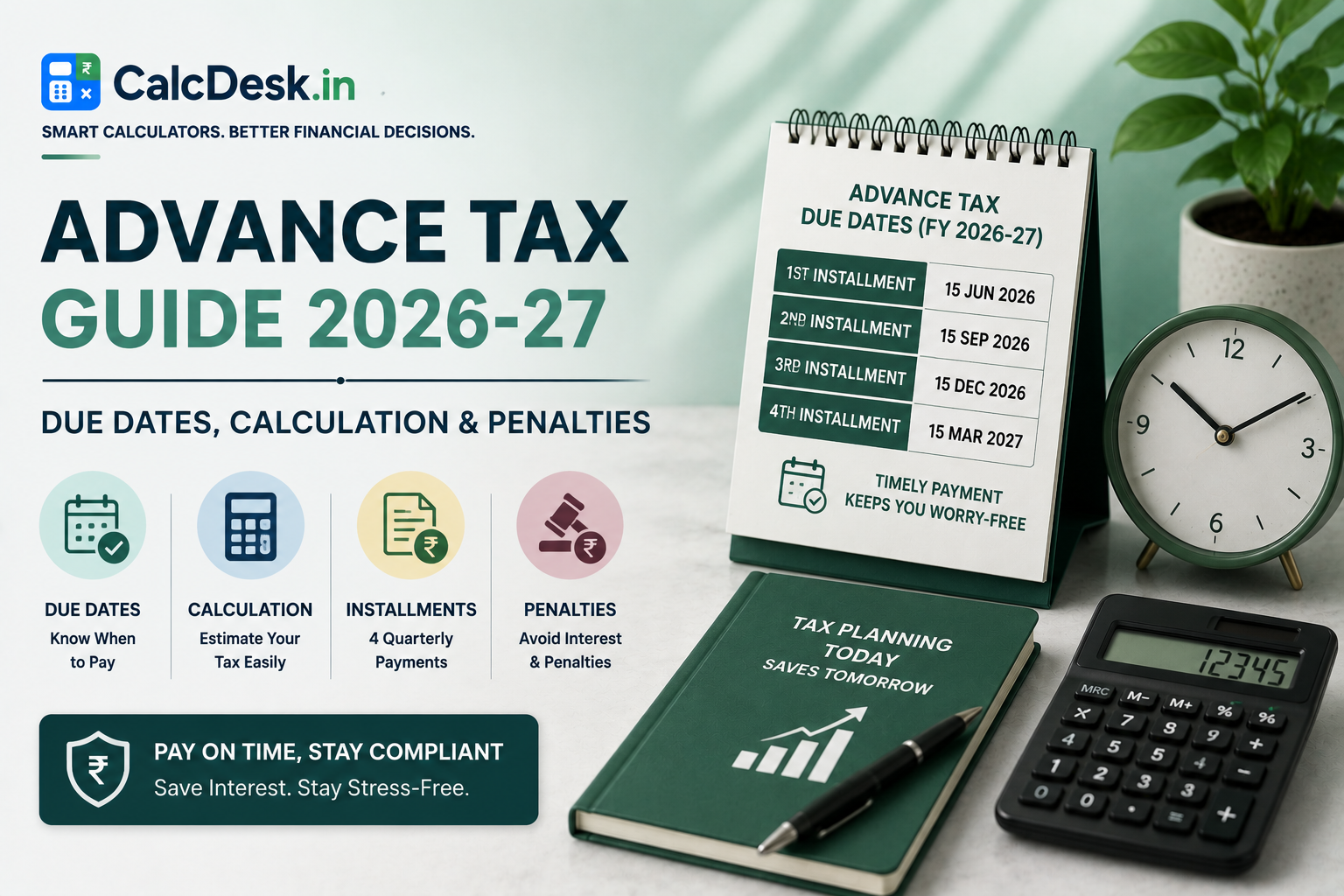
Advance Tax Guide 2026-27 — Due Dates, Calculation & Penalties
Advance tax is the mechanism by which Indian taxpayers pre-pay their income tax liability in four instalments during the financial year, rather than in one lump sum at filing time. If your total tax liability (after TDS credits) exceeds ₹10,000 for the year, you are required to pay advance tax — and if you don’t, the Income Tax Department levies interest under Sections 234B and 234C, which can add up to a significant amount over a full year of non-compliance.
This guide explains who must pay, the exact due dates for FY 2026-27, how to calculate each instalment, and how the interest penalties are computed. Use CalcDesk’s Income Tax Calculator to estimate your annual tax liability and plan your advance tax payments accordingly.
Who Must Pay Advance Tax
- Threshold: Anyone whose tax liability (after TDS) is ₹10,000 or more in a financial year
- Salaried employees: If your employer deducts correct TDS on salary, advance tax may not be needed — but if you have rental income, capital gains, freelance income, or interest income beyond what’s covered by TDS, advance tax applies on that additional income
- Self-employed / business owners: Must compute and pay advance tax quarterly based on estimated annual income
- Senior citizens (60+): Exempt from advance tax if they have no income from business or profession
- Presumptive taxpayers (Sec 44AD/44ADA/44AE): Must pay 100% of advance tax in a single instalment by 15 March 2026
Advance Tax Due Dates — FY 2026-27
| Instalment | Due Date | Cumulative % to Pay | Amount (if annual tax ₹1 lakh) |
|---|---|---|---|
| 1st instalment | 15 June 2025 | 15% | ₹15,000 |
| 2nd instalment | 15 September 2025 | 45% (cumulative) | ₹45,000 total paid by this date |
| 3rd instalment | 15 December 2025 | 75% (cumulative) | ₹75,000 total paid by this date |
| 4th instalment | 15 March 2026 | 100% (cumulative) | ₹1,00,000 total paid by this date |
📌 Key rule: The percentages are cumulative — not per instalment. By 15 September, you must have paid at least 45% of your annual estimated tax in total (including whatever you paid in June). The difference between instalments is: June contribution = 15%, September = 30% more, December = 30% more, March = 25% more.
How to Calculate Your Advance Tax
Advance Tax Calculation Steps
Step 2: Subtract eligible deductions (regime-specific)
Step 3: Calculate gross tax on taxable income + cess
Step 4: Subtract TDS already deducted (from employer, bank, etc.)
Step 5: Remaining tax = advance tax liability
Step 6: If remaining tax > Rs.10,000 → pay in 4 instalments
Worked Example 1 — Salaried Employee with Rental Income
₹12L salary + ₹3L annual rental income, New Regime
Gross income: ₹15,00,000 | Standard deduction: ₹75,000
Taxable income: ₹14,25,000 | Tax (New Regime): ₹93,750 + 4% cess = ₹97,500
TDS deducted by employer (on ₹12L salary): ₹8,125/month × 12 = ₹97,500
But employer’s TDS was only on salary — doesn’t include tax on ₹3L rent
Additional tax on rental: approximately ₹25,000 (15% slab on rent above exemption)
Advance tax due: ₹25,000 (exceeds ₹10,000 threshold)
15 June: ₹3,750 | 15 Sept: ₹11,250 | 15 Dec: ₹18,750 | 15 March: ₹25,000
Worked Example 2 — Freelancer/Self-Employed
Freelance designer, estimated ₹18L annual income
Gross income: ₹18,00,000 | Professional expenses: ₹2,00,000
Net income: ₹16,00,000 | Standard deduction (New Regime): ₹75,000
Taxable: ₹15,25,000 | Tax + cess: ≈ ₹1,08,000
TDS from clients (10% on professional fees received): ₹1,80,000 × 10% = ₹18,000 (if any)
Net advance tax due: ₹1,08,000 − ₹18,000 = ₹90,000
Quarterly payments: ₹13,500 (June) → ₹40,500 (Sept) → ₹67,500 (Dec) → ₹90,000 (March)
Interest Penalty for Non-Payment — Sections 234B & 234C
| Section | Trigger | Rate | Period |
|---|---|---|---|
| 234B | Paid less than 90% of total tax by 31 March | 1% per month (simple) | From 1 April to actual payment date |
| 234C | Each instalment paid short of required % | 1% per month (simple) | From due date of each instalment (3 months) |
Interest calculation — missed June instalment
Annual tax: ₹1,00,000 | Required by 15 June: ₹15,000 | Actually paid: ₹0
Sec 234C interest: ₹15,000 × 1% × 3 months = ₹450
This applies separately for each instalment shortfall
How to Pay Advance Tax Online
- Go to incometax.gov.in → e-Pay Tax
- Select Challan 280 (Income Tax on Companies / Other than Companies)
- Select Assessment Year: 2026-27 (for FY 2026-27 income)
- Select Type of Payment: 100 — Advance Tax
- Enter amount and pay via net banking, debit card, or UPI
- Save the BSR code and Challan Serial Number for ITR filing
Common Advance Tax Mistakes
- Not accounting for capital gains: Short-term equity gains (sold a mutual fund mid-year) create sudden advance tax obligations — re-estimate after every significant transaction
- Wrong Assessment Year: Always select AY 2027-28 (not FY 2026-27) when paying via Challan 280
- Forgetting rental income: Employer TDS doesn’t cover rental income; many salaried employees miss this
- Not revising estimates: Advance tax is based on estimated income — re-estimate at each instalment date if your income picture changes significantly
💡 Tip: If you receive a large lump sum (bonus, property sale, redemption of investments) during the year, immediately re-estimate your advance tax liability and pay the revised amount by the next instalment date. Waiting until March means 3 months of 234C interest on the entire shortfall for each missed instalment.
🧮 Estimate Your Tax and Advance Tax — Free
Enter your income from all sources. Get your exact annual tax and instalment schedule.
→ Open Income Tax CalculatorAdvance Tax for Freelancers and Gig Workers
The advance tax system was designed with salaried employees and businesses in mind — predictable monthly income, predictable quarterly estimates. Freelancers and gig workers face a different reality: project-based payments, seasonal income swings, and no employer deducting TDS on their behalf throughout the year. The result is that the entire tax liability often lands in their lap at year-end, along with 234B and 234C interest penalties.
The solution is a quarterly re-estimation strategy based on actual income earned so far, not a fixed projection locked in at April:
Safe Harbor Rule: You avoid 234B interest entirely if you have paid at least 90% of your actual tax liability by 31 March. Alternatively, if you pay 100% of the previous year’s assessed tax (by the quarterly schedule), you are protected from 234C deferment interest even if your actual income this year turns out higher. Use the previous year’s tax as your floor estimate if this year’s income is uncertain.
Quarterly Re-Estimation for a Freelance Designer
15 June 2025 (Q1 installment): Freelancer earned ₹3L in Q1. Projects annualised estimate: ₹12L. Tax on ₹12L (New Regime, after ₹75K std deduction = ₹11.25L taxable): approximately ₹80,000. June installment (15%): ₹12,000 paid.
15 September 2025 (Q2 installment): Actual H1 income: ₹8L (higher than expected). Revised annual estimate: ₹15L. Tax on ₹15L: approximately ₹1,05,000. Cumulative 45% = ₹47,250. Less already paid ₹12,000 → pay ₹35,250 by 15 September.
15 December 2025 (Q3 installment): Re-estimate based on 9-month actuals. Say annual income now looks like ₹14L. Tax: ₹90,000. Cumulative 75% = ₹67,500. Less ₹47,250 already paid → pay ₹20,250.
15 March 2026 (Q4 installment): Full year income: ₹13.8L. Tax: ₹87,000. Less paid ₹67,500 → pay remaining ₹19,500. Done — no 234B or 234C interest.
Key principle: re-estimate at every installment date rather than locking in a fixed annual projection in April. Gig income is variable; your advance tax schedule should be equally flexible.
Advance Tax and Capital Gains
Capital gains — from equity, mutual funds, or property sales — create advance tax obligations that many investors miss entirely. The trap: you sell equity shares in February, realise ₹5L in LTCG, and assume you will deal with it while filing the ITR in July. By then, Section 234C interest has already accrued.
Q4 Capital Gains Relief: Capital gains realised between 1 January and 31 March (the last quarter) can be included entirely in the March 15 installment without 234C interest on earlier installments for that portion. This is a specific carve-out in the law. However, gains realised in Q1, Q2, or Q3 must be included in the respective installment for that quarter — the Q4 relief applies only to last-quarter gains.
LTCG in February — Advance Tax Calculation
Salary income throughout year: ₹15L. TDS deducted by employer covers salary tax entirely. No advance tax due on salary portion.
Equity shares sold in February 2026: LTCG = ₹5L. Exemption under Sec 112A: ₹1,25,000. Taxable LTCG = ₹3,75,000 at 12.5% = ₹46,875 tax.
Q4 carve-out applies: Since the sale was in February (Q4 of FY 2026-27), the entire ₹46,875 can be included in the 15 March 2026 installment. No 234C interest on earlier installments for this LTCG.
If not paid by 15 March: 234C interest = 1% × 1 month × ₹46,875 = ₹469. Manageable, but avoidable entirely by paying by 15 March.
Critical point: If these same shares had been sold in October 2025 (Q3), the LTCG tax would need to be included in the December 15 installment — the Q4 carve-out would not apply to October gains. Track the timing of your capital gains events carefully.
Interest Calculation — Exact Method
Most taxpayers know they owe interest for not paying advance tax, but very few can calculate the exact amount before the notice arrives. Here is the precise computation method for both 234B and 234C, with a worked end-to-end example.
Section 234B and 234C — Computation Method
Trigger: Total advance tax paid < 90% of assessed tax by 31 March
Interest = 1% per month (or part of month) × shortfall
Period: From 1 April to date of self-assessment / actual payment
Section 234C — Deferment of installments:
Trigger: Each installment below the required cumulative %
Interest = 1% per month × shortfall for each installment
Period: 3 months for June and September shortfalls;
3 months for December shortfall;
1 month for March shortfall
Full Year with Zero Advance Tax Paid — Complete Interest Calculation
Profile: Self-employed consultant, receiving professional fees without TDS, annual income ₹15L, New Regime.
Tax liability: ₹15L − ₹75K (std deduction) = ₹14.25L taxable. Tax = ₹93,750 + 4% cess = approximately ₹97,500.
Required installments:
June 15: ₹14,625 (15%) | September 15: ₹43,875 (cumulative 45%) | December 15: ₹73,125 (cumulative 75%) | March 15: ₹97,500 (cumulative 100%)
Assumed: Zero advance tax paid all year. Full amount paid at ITR filing in July 2026.
Section 234C interest (each installment shortfall × 1% × months):
June shortfall ₹14,625: 1% × 3 months = ₹439
September shortfall ₹43,875: 1% × 3 months = ₹1,316
December shortfall ₹73,125: 1% × 3 months = ₹2,194
March shortfall ₹97,500: 1% × 1 month = ₹975
Total 234C interest: ₹4,924
Section 234B interest: Full ₹97,500 unpaid by 31 March. Filing in July = 4 months (April, May, June, July). 1% × 4 × ₹97,500 = ₹3,900.
Total interest penalty: ₹4,924 + ₹3,900 = ₹8,824 on a ₹97,500 tax liability — entirely avoidable by paying quarterly installments on time.
Even paying half the required amount each quarter reduces this penalty by over 70%. The math strongly favours quarterly compliance over annual lump-sum payment at filing.