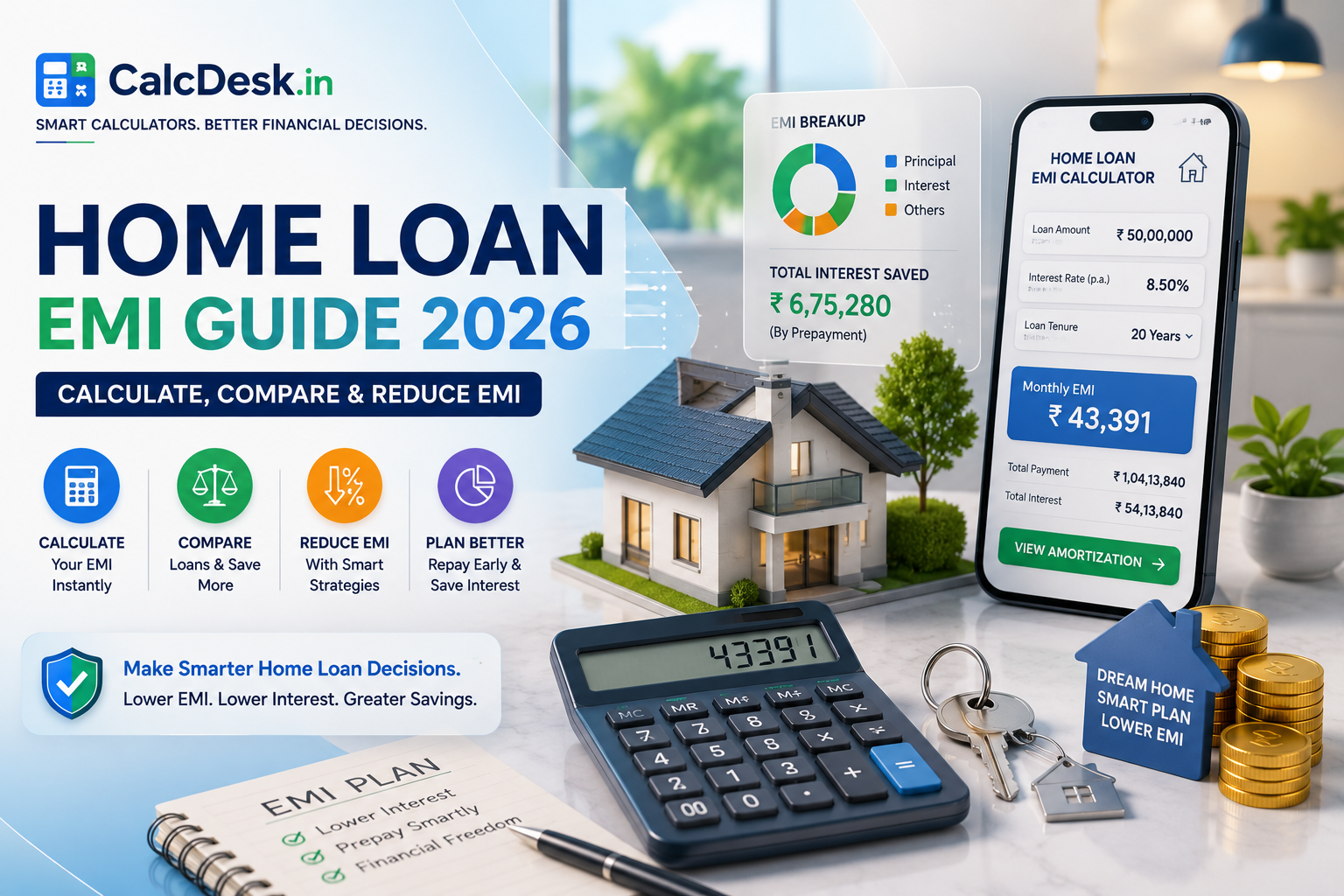
Home Loan EMI Guide 2026 — Calculate, Compare & Reduce Your EMI
A home loan is the largest financial commitment most Indians will ever make — and the EMI you agree to on Day 1 shapes your finances for the next 20-30 years. Yet most buyers accept the first EMI quote from their bank without understanding how it’s calculated or what they can do to reduce it. On a ₹50 lakh loan at 8.5%, a 0.5% difference in interest rate saves over ₹8 lakh in total interest. Knowing the math puts that power in your hands.
This complete home loan EMI guide covers the EMI formula, step-by-step calculations for loan amounts from ₹20 lakh to ₹1 crore, a full amortisation schedule example, income tax deductions under Sec 24(b) and Sec 80C, and strategies to reduce your EMI or loan tenure. Use CalcDesk’s free Home Loan EMI Calculator to compute your exact EMI with a downloadable amortisation table.
The Home Loan EMI Formula — How It Works
All Indian banks and housing finance companies (HFCs) calculate home loan EMI using the reducing balance method — your interest is recalculated every month on the outstanding principal, not on the original loan amount. The formula is:
EMI Formula (Reducing Balance Method)
─────────────────────
(1 + r)^n − 1
Where:
P = Principal loan amount
r = Monthly interest rate = Annual Rate ÷ 12 ÷ 100
n = Loan tenure in months (years × 12)
Every EMI you pay has two components: interest and principal repayment. In the early years, interest dominates. As the loan ages, more of each EMI goes toward reducing the principal. This is called amortisation.
EMI at Different Loan Amounts — Quick Reference Table
At 8.5% annual interest rate (approximate RBI repo rate + spread as of mid-2026):
| Loan Amount | 10-Year EMI | 15-Year EMI | 20-Year EMI | 25-Year EMI |
|---|---|---|---|---|
| ₹20 lakh | ₹24,797 | ₹19,713 | ₹17,356 | ₹16,090 |
| ₹30 lakh | ₹37,195 | ₹29,570 | ₹26,035 | ₹24,135 |
| ₹40 lakh | ₹49,594 | ₹39,427 | ₹34,713 | ₹32,180 |
| ₹50 lakh | ₹61,992 | ₹49,284 | ₹43,391 | ₹40,225 |
| ₹75 lakh | ₹92,988 | ₹73,926 | ₹65,087 | ₹60,338 |
| ₹1 crore | ₹1,23,984 | ₹98,568 | ₹86,782 | ₹80,451 |
Worked Example 1 — ₹40 Lakh Home Loan, 20 Years, 8.5%
Complete EMI calculation step by step
Loan amount (P): ₹40,00,000
Annual interest rate: 8.5%
Monthly rate (r): 8.5 ÷ 12 ÷ 100 = 0.0070833
Tenure (n): 20 × 12 = 240 months
EMI = 40,00,000 × 0.0070833 × (1.0070833)^240 / ((1.0070833)^240 − 1)
(1.0070833)^240 = 5.3133 (approx)
EMI = 40,00,000 × 0.0070833 × 5.3133 / (5.3133 − 1)
EMI = 40,00,000 × 0.03764 / 4.3133
EMI ≈ ₹34,913/month
Total amount paid over 20 years: ₹34,913 × 240 = ₹83,79,120
Total interest paid: ₹83,79,120 − ₹40,00,000 = ₹43,79,120 (more than the principal!)
The Amortisation Schedule — Year 1 vs Year 10 vs Year 20
Understanding amortisation reveals why early prepayment is so powerful. For the ₹40L loan above:
| Year | Opening Balance | Total EMI Paid | Interest Component | Principal Repaid | Closing Balance |
|---|---|---|---|---|---|
| Year 1 | ₹40,00,000 | ₹4,18,956 | ₹3,36,640 | ₹82,316 | ₹39,17,684 |
| Year 5 | ₹36,53,000 | ₹4,18,956 | ₹3,07,400 | ₹1,11,556 | ₹35,41,444 |
| Year 10 | ₹30,12,000 | ₹4,18,956 | ₹2,52,720 | ₹1,66,236 | ₹28,45,764 |
| Year 15 | ₹20,14,000 | ₹4,18,956 | ₹1,68,850 | ₹2,50,106 | ₹17,63,894 |
| Year 20 | ₹4,12,000 | ₹4,18,956 | ₹17,320 | ₹4,01,636 | ₹10,364 |
📌 Key insight: In Year 1, only ₹82,316 of your ₹4.19L annual payment actually reduces your loan. The rest (₹3.37L) is pure interest. This is why prepaying in the early years has such a dramatic effect on total interest savings.
Worked Example 2 — ₹75 Lakh Home Loan, 25 Years, 8.0%
Higher loan amount, longer tenure at lower rate
Loan amount: ₹75,00,000 | Rate: 8.0% | Tenure: 25 years (300 months)
Monthly rate: 8.0 ÷ 12 ÷ 100 = 0.006667
EMI ≈ ₹57,861/month
Total paid: ₹57,861 × 300 = ₹1,73,58,300
Total interest: ₹1,73,58,300 − ₹75,00,000 = ₹98,58,300
You pay ₹1.31 in interest for every ₹1 borrowed over 25 years at 8%
Worked Example 3 — How Prepayment Saves Money
₹50 lakh loan, 20 years, 8.5% — effect of ₹5L prepayment in Year 3
Original EMI: ₹43,391 | Total interest without prepayment: ₹54,13,840
Prepayment of ₹5 lakh in month 36 (end of Year 3):
Outstanding balance at that point: ≈ ₹47,25,000
New balance after prepayment: ₹42,25,000
Keeping EMI the same, new tenure: approximately 16.5 years (vs 17 remaining)
Interest saved: approximately ₹8,40,000
Net benefit: Paid ₹5L early, saved ₹8.4L in interest = net gain of ₹3.4L
Use the Prepayment Savings Calculator to model your exact scenario.
Income Tax Benefits on Home Loan — FY 2026-27
A home loan offers two major tax deductions under the Old Tax Regime:
| Deduction | Section | Limit | For What | Available In |
|---|---|---|---|---|
| Interest on home loan | Sec 24(b) | ₹2,00,000/year | Self-occupied property | Old Regime only |
| Principal repayment | Sec 80C | ₹1,50,000 combined | Principal portion of EMI | Old Regime only |
| Stamp duty / registration | Sec 80C | Within ₹1,50,000 cap | Year of purchase only | Old Regime only |
| Interest (under construction) | Sec 24(b) | Deferred, 5 equal instalments | Pre-possession period | Old Regime only |
⚠️ New Regime alert: If you opt for the New Tax Regime, you cannot claim deductions under Sec 24(b) or Sec 80C for your home loan. This is a critical factor in the Old vs New regime decision for home loan borrowers. At ₹2L interest deduction alone, the Old Regime can save ₹60,000 in tax for someone in the 30% bracket.
How to Reduce Your Home Loan EMI or Save on Interest
Strategy 1: Negotiate a Lower Interest Rate
Check current home loan rates at RBI’s website and compare with your current rate. If your bank is offering newer customers a lower rate, request a repricing. Banks can reprice existing loans, though some may charge a small fee. A 0.5% reduction on ₹50L saves approximately ₹1,75,000 in total interest.
Strategy 2: Balance Transfer
If your current lender won’t match market rates, transfer your loan to another bank. Factor in processing fees (typically 0.5–1% of outstanding loan) and compare with interest savings over remaining tenure. Generally worthwhile if rate difference is ≥0.5% and remaining tenure is ≥5 years. Read the complete Home Loan Balance Transfer Guide before deciding.
Strategy 3: Regular Prepayments
Even small additional payments towards principal make a disproportionate difference. Paying one extra EMI per year can reduce a 20-year loan tenure by 2-3 years. This is most effective in the first 5-7 years of the loan when interest proportion in each EMI is highest.
Strategy 4: Increase EMI with Every Salary Hike
If your salary increases by 10% and you increase your EMI by even 5%, the loan closes years earlier and total interest drops dramatically. Many banks allow step-up EMI facilities.
Strategy 5: Choose Floating Rate Wisely
Most home loans in India are floating rate (linked to RLLR/EBLR based on RBI repo rate). When RBI cuts rates, your EMI goes down automatically. Floating rates have historically been lower than fixed rates over 20+ year horizons. If the RBI rate cycle is at peak, a fixed rate may be advantageous for 3-5 years.
Home Loan Eligibility — Key Factors
- FOIR (Fixed Obligation to Income Ratio): Most banks limit total EMIs (including new home loan EMI) to 40-50% of net monthly income
- Credit Score: Score above 750 (CIBIL) typically qualifies for best rates; below 650 may mean rejection or higher rates
- Loan-to-Value (LTV): Banks typically fund up to 80-90% of property value; minimum 10-20% down payment required
- Age: Loan tenure cannot extend beyond age 70 (for salaried) or 65 (for self-employed) at most lenders
- Employment stability: Minimum 2-3 years of continuous employment or 3 years of business vintage for self-employed
🏠 Calculate Your Home Loan EMI — Free
Enter loan amount, interest rate, and tenure. Get EMI, total interest, and full amortisation schedule.
→ Open Home Loan EMI CalculatorFloating vs Fixed Rate Home Loan — Which to Choose in 2026
One of the most consequential home loan decisions is choosing between a floating rate and a fixed rate. The right answer depends on where the RBI rate cycle stands at the time of borrowing — and in 2026, the direction is clear.
How floating rate home loans work: Floating rates are linked to the bank’s RLLR (Repo-Linked Lending Rate), which moves with every RBI repo rate change. RLLR = Repo Rate + Bank’s Spread (typically 2.65–3%). As of mid-2026, with the repo rate at 6.0–6.25%, floating home loan rates range from 8.5–9.5% depending on borrower profile and lender.
How fixed rate loans work: The bank locks your interest rate for the full tenure or a defined period (typically 3–5 years). Fixed rates are usually 0.5–1% higher than prevailing floating rates at the time of borrowing to compensate the bank for rate risk. Currently: fixed rates are approximately 9.5–10.5%.
| Feature | Floating Rate | Fixed Rate |
|---|---|---|
| Current rate (mid-2026) | 8.5–9.5% | 9.5–10.5% |
| Benefits from RBI rate cuts | Yes — automatically | No — locked in |
| Benefits from RBI rate hikes | No — EMI rises | Yes — protected |
| Best time to choose | When rates are high / falling | When rates are at cycle bottom |
| Prepayment penalty | Nil (RBI mandated) | May apply (check terms) |
2026 Guidance — Floating rate wins
RBI cut repo rate by 50–75 bps from its 2023–24 peak. Further cuts are expected as inflation moderates.
₹50L loan comparison over 20 years:
Floating at 9.0%: EMI = ₹44,986/month | Total interest = ₹57.97L
Fixed at 9.75% (0.75% premium): EMI = ₹48,041/month | Total interest = ₹65.30L
EMI difference: ₹3,055/month more for fixed rate
Total extra paid over 20 years: ₹7.33 lakh
If floating rate drops a further 0.5% (to 8.5%) due to future RBI cuts, the gap widens further.
Action for existing fixed-rate borrowers (2023–24 vintage): If you took a fixed rate loan at 9.5–10.5% during the high-rate era, consider switching to floating at the same bank (usually free) or doing a balance transfer to a lower-rate lender. Even a 1% rate reduction on a ₹50L outstanding loan saves approximately ₹35,000–₹40,000 per year.
PMAY Credit Linked Subsidy — Status in 2026
Pradhan Mantri Awas Yojana (Urban) 2.0 is the current phase of the government’s affordable housing scheme. The subsidy structure has changed significantly from Phase 1 — particularly for middle-income buyers who relied on the CLSS (Credit Linked Subsidy Scheme) for MIG (Middle Income Group) borrowers.
| Category | Annual Income | Max Carpet Area | Subsidy | Status in 2026 |
|---|---|---|---|---|
| EWS (Economically Weaker Section) | Up to ₹3 lakh | 30 sqm | 4% on loan up to ₹6L | ✅ Active under PMAY-U 2.0 |
| LIG (Low Income Group) | ₹3L – ₹6L | 60 sqm | 4% on loan up to ₹6L | ✅ Active under PMAY-U 2.0 |
| MIG-I (₹6L–₹12L income) | ₹6L – ₹12L | 120 sqm | Was 4% in Phase 1 | ❌ Discontinued — not in PMAY-U 2.0 |
| MIG-II (₹12L–₹18L income) | ₹12L – ₹18L | 150 sqm | Was 3% in Phase 1 | ❌ Discontinued — not in PMAY-U 2.0 |
⚠️ MIG subsidy is gone — plan accordingly: If you were counting on the MIG CLSS subsidy (which provided ₹2–2.35 lakh NPV benefit for middle-income buyers in Phase 1), it has not been extended in PMAY-U 2.0. Do not factor it into your home loan affordability calculation for new loans taken from FY 2024-25 onwards unless a specific government notification reinstates it.
📌 How EWS/LIG subsidy works in practice: The 4% interest subsidy applies on the first ₹6 lakh of the home loan principal for up to 20 years. The Net Present Value (NPV) of this subsidy — approximately ₹1.5–₹2.5 lakh — is credited upfront to your loan account by the bank (via NHB or HUDCO as nodal agency), reducing your outstanding principal immediately. For example, on a ₹6L loan at 9%, the subsidy credit of ~₹2L reduces your effective loan to ₹4L from day one. You must be a first-time homebuyer with no pucca house anywhere in India. For married EWS/LIG couples, a female co-borrower is mandatory.
How to apply for PMAY subsidy: You do not apply directly to the government. Apply through your bank or housing finance company when taking the home loan. The lender verifies your eligibility (income, first-time buyer status, property size) and processes the subsidy claim through the PMAY portal. Subsidy is credited within 3–6 months of loan disbursement.
1 thought on “Home Loan EMI Guide 2026 — Calculate, Compare & Reduce EMI | CalcDesk.in”