GST Calculation Guide 2026 — How to Calculate GST in India
GST calculation confuses millions of Indian business owners and consumers every day. Whether you’re creating an invoice, verifying a supplier’s charge, or reconciling your GSTR-3B, knowing how to calculate GST accurately is essential. A wrong calculation means under-charging customers, over-paying suppliers, or filing incorrect returns — all of which attract penalties under the CGST Act 2017.
This guide covers the complete GST calculation methodology: adding GST to a base price, reverse GST from an MRP, CGST/SGST/IGST split calculations, worked examples at every rate slab, Input Tax Credit mechanics, and the most common mistakes. Use CalcDesk’s free GST Calculator to calculate GST instantly for any amount and rate.
GST Rate Slabs in India 2026 — The Complete Picture
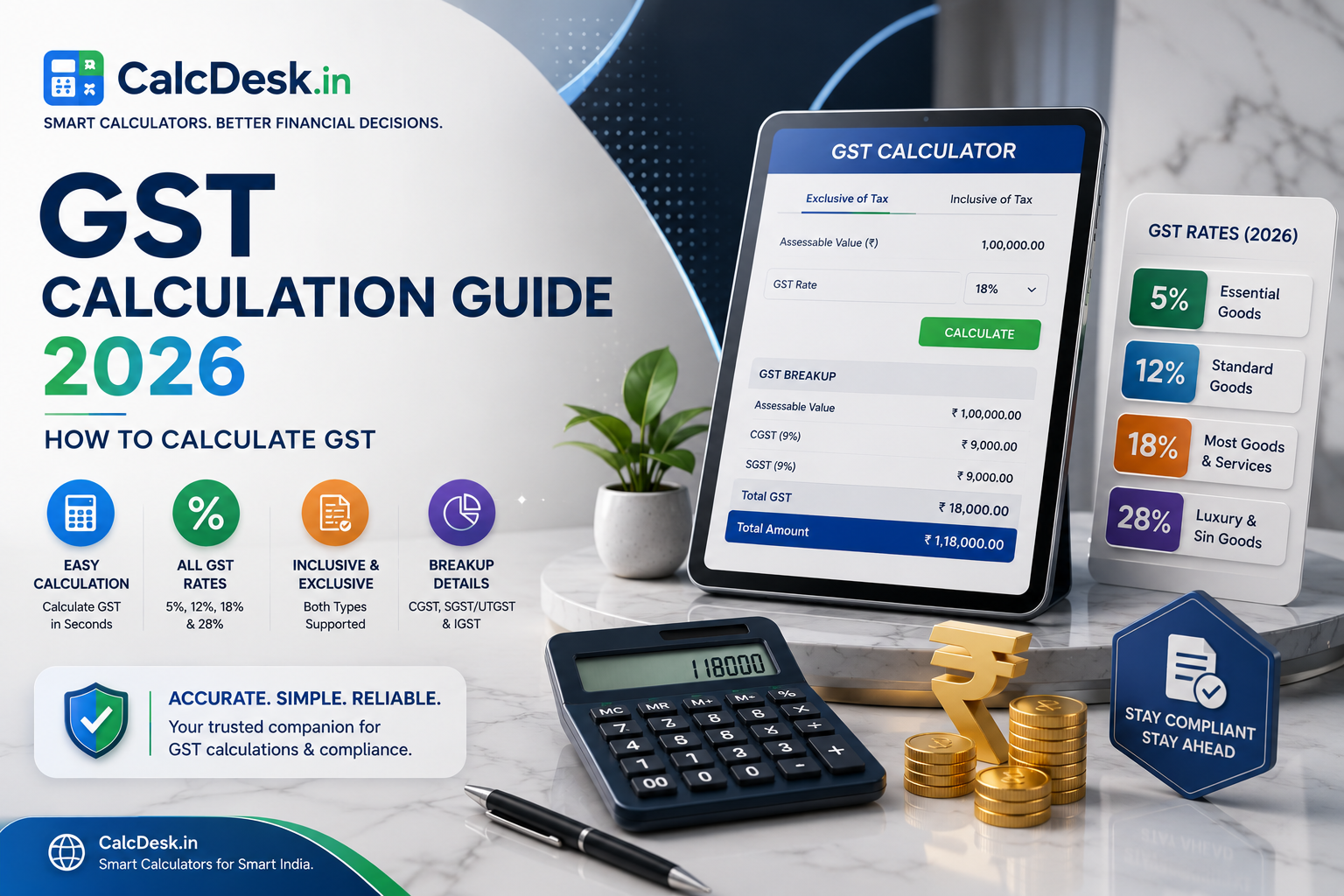
The GST Council has structured India’s GST under five main rate slabs. Understanding which slab applies to your goods or services is the first step in correct GST calculation:
Additional special rates exist: 0.25% on rough diamonds, 1.5% on cut and polished diamonds, 3% on gold and silver, and various cess rates on top of 28% GST for goods like cigarettes and SUVs. Check GSTN portal for the current HSN code-wise rate list.
GST Calculation Formula — Adding GST to Base Price
When you have a base price (excluding GST) and need to find the total payable price:
Forward GST Calculation
Total Price = Base Price + GST Amount
OR simply:
Total Price = Base Price × (1 + GST Rate ÷ 100)
Example: Adding 18% GST to ₹5,000
Example 1 — IT Service Invoice (18% GST)
Service value (base price): ₹5,000
GST Rate: 18%
GST Amount: ₹5,000 × 18% = ₹900
Total Invoice Amount: ₹5,000 + ₹900 = ₹5,900
CGST (9%): ₹450 | SGST (9%): ₹450
If inter-state supply: IGST (18%): ₹900 (no CGST/SGST split)
Reverse GST Calculation — Finding Base Price from Inclusive Amount
When you have a GST-inclusive price (like an MRP or total bill) and need to find the original base price:
Reverse GST Calculation
GST Amount = GST-Inclusive Price − Original Price
Example (18% GST, ₹11,800 inclusive):
Original Price = ₹11,800 ÷ 1.18 = ₹10,000
GST = ₹11,800 − ₹10,000 = ₹1,800
Reverse GST is critical for: ITC (Input Tax Credit) claims on purchases, verifying correct GST charged on receipts, accounting entries where you need to separate GST from total invoice values, and checking if a supplier has applied the correct GST rate.
CGST, SGST, and IGST — How the Split Works
GST in India is dual — it goes to both central and state governments. The split depends on whether the transaction is intra-state or inter-state:
| Transaction Type | Applicable Tax | Split for 18% GST |
|---|---|---|
| Intra-state (same state buyer and seller) | CGST + SGST | CGST 9% + SGST 9% |
| Inter-state (different states) | IGST only | IGST 18% |
| Import of goods/services | IGST + Customs | IGST 18% on CIF value |
| Exports | Zero-rated | 0% (with LUT) or IGST refund |
📌 Key rule: Always charge IGST for inter-state supplies and CGST+SGST for intra-state supplies. Charging the wrong component (e.g., IGST on an intra-state transaction) is a compliance error and requires amendment through GSTR-1A.
GST Calculation Examples at All Rate Slabs
Example 2: 5% GST — Packaged Food (₹2,000 base)
5% GST Intra-state Sale
Base price: ₹2,000
GST (5%): ₹100 | CGST (2.5%): ₹50 | SGST (2.5%): ₹50
Total invoice: ₹2,100
Example 3: 12% GST — Construction Material (₹50,000 base)
12% GST Inter-state Sale
Base price: ₹50,000
IGST (12%): ₹6,000 (since inter-state, no CGST/SGST split)
Total invoice: ₹56,000
Example 4: 28% GST — Luxury Car (₹10,00,000 base)
28% GST + Cess
Base price: ₹10,00,000
GST (28%): ₹2,80,000 | CGST (14%): ₹1,40,000 | SGST (14%): ₹1,40,000
Compensation Cess (say 15% on luxury cars): ₹1,50,000
Total invoice: ₹14,30,000
Effective rate on customer: 43%
GST on Services — Key Rates Table
| Service | GST Rate | Notes |
|---|---|---|
| IT / Software Services | 18% | Most common for tech companies |
| Restaurant (non-AC) | 5% | No ITC available |
| Restaurant (AC / hotel above ₹7,500) | 18% | With ITC |
| Rent (commercial property) | 18% | On monthly rent above ₹20L turnover |
| Professional services (CA, lawyer) | 18% | |
| Healthcare / hospital | 0% | Exempt |
| Education (school fees) | 0% | Exempt |
| Freight (road, air domestic) | 5% | On GTA services |
| Financial services | 18% | On commission/fees |
| Insurance premium | 18% | On premium amount |
Input Tax Credit (ITC) — Offsetting GST Paid on Purchases
Input Tax Credit is the mechanism that prevents cascading taxation in GST. If you’re a registered GST business and you pay GST on your purchases (inputs), you can claim that amount as a credit against the GST you collect on your sales (output tax).
Net GST Payable Formula
If ITC > Output GST → Refund or carry forward
If ITC < Output GST → Pay the difference to government
Example: You collected ₹90,000 GST on sales this month. You paid ₹60,000 GST on purchases. Net payable = ₹90,000 − ₹60,000 = ₹30,000. Read the complete ITC Guide for eligibility conditions, blocked credits, and how to claim ITC in GSTR-3B.
GST Registration Threshold — When Must You Register?
GST registration is mandatory once your aggregate turnover crosses these thresholds in a financial year:
| Business Type | Threshold for Regular States | Threshold for Special Category States |
|---|---|---|
| Goods (supply of goods) | ₹40 lakh | ₹20 lakh |
| Services (supply of services) | ₹20 lakh | ₹10 lakh |
| Both goods and services | ₹20 lakh | ₹10 lakh |
Special category states include Manipur, Mizoram, Nagaland, Tripura, Meghalaya, Sikkim, Arunachal Pradesh, Uttarakhand, and Himachal Pradesh. Inter-state supply of taxable goods/services requires mandatory registration regardless of turnover.
Common GST Calculation Mistakes
- Applying GST on the total invoice instead of taxable value: GST is applied on the taxable value (base price before GST). Never apply GST on top of an already GST-inclusive price — this results in double taxation.
- Charging IGST for intra-state or CGST+SGST for inter-state: Determine the place of supply correctly before selecting the GST component. Wrong component requires amendment.
- Wrong rate classification: Applying 18% to goods that attract 12% (or vice versa) is the most common mistake. Always verify the HSN/SAC code rate before invoicing.
- Not calculating GST on freight charges: If you’re charging freight separately on a taxable invoice, GST on freight must be applied at the same rate as the main goods (in most cases).
- ITC on ineligible purchases: You cannot claim ITC on personal expenses, motor vehicles (in most cases), food and beverages, beauty treatments, and club memberships. Claiming wrong ITC attracts interest and penalty.
GST Compliance Timeline
| Return | Who Files | Due Date | What It Covers |
|---|---|---|---|
| GSTR-1 | Regular taxpayers | 11th of next month (monthly) / Quarterly | Outward supplies |
| GSTR-3B | Regular taxpayers | 20th of next month | Summary + tax payment |
| GSTR-9 | Regular taxpayers | 31st December (annual) | Annual reconciliation |
| CMP-08 | Composition dealers | 18th of month after quarter | Quarterly tax statement |
Read the complete GST return due dates guide for all return types and late fee information.
💡 Tip: Use the GST Reverse Calculator to find base price from MRP quickly. For generating professional GST invoices with automatic CGST/SGST/IGST calculation and PDF download, try the free GST Invoice Generator.
🧮 Calculate GST Instantly — Free
Enter amount and rate. Get GST amount, total price, and CGST/SGST/IGST split in one click.
→ Open GST Calculator
3 thoughts on “GST Calculation Guide 2026 — How to Calculate GST | CalcDesk.in”