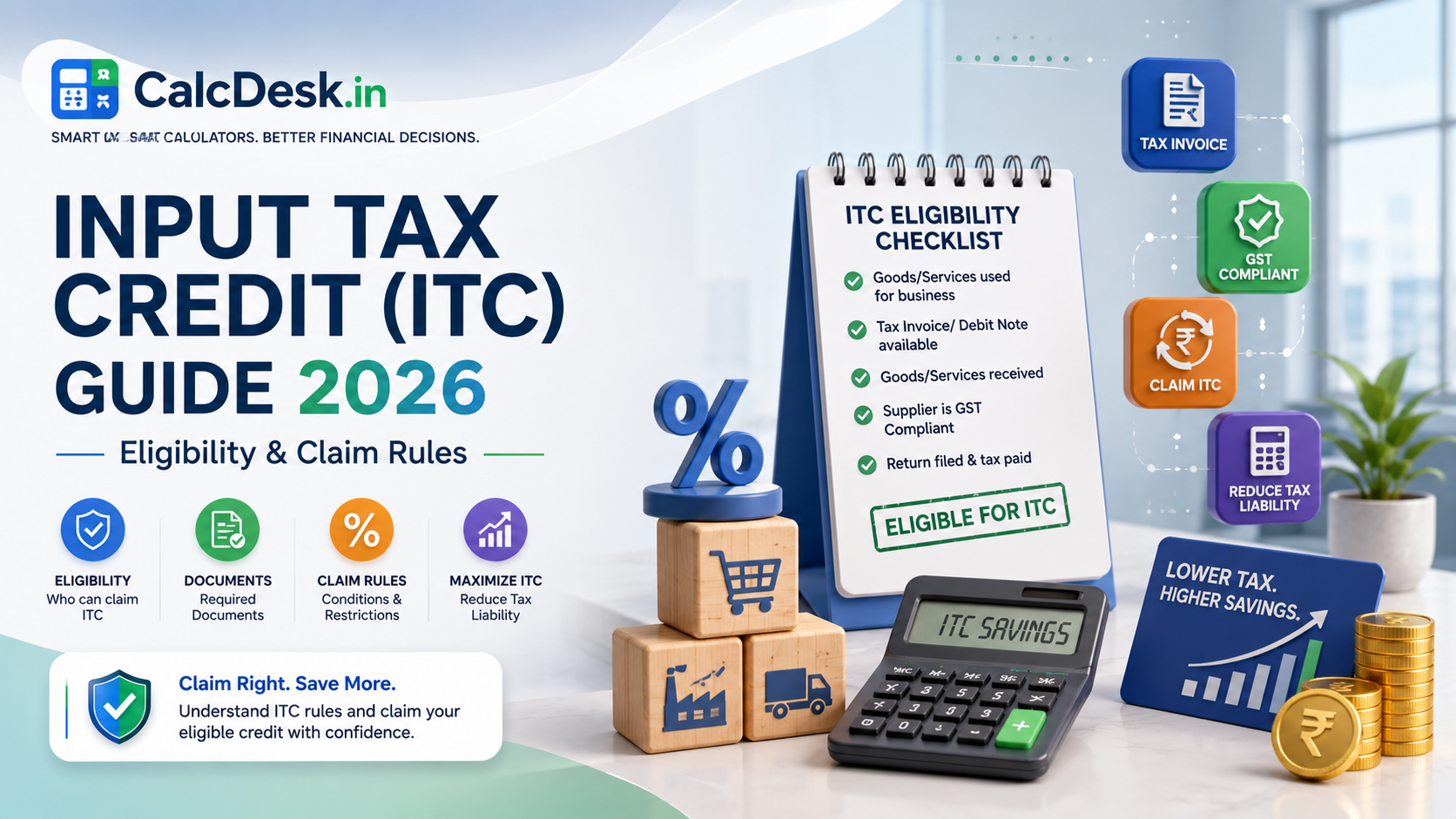
Input Tax Credit (ITC) Guide 2026 — Eligibility & Claim Rules
Input Tax Credit (ITC) is the mechanism that makes GST a true “value-added tax” instead of a tax stacked on top of tax. Yet ITC is also where most GST compliance errors occur — businesses either miss claiming eligible credit (losing money) or wrongly claim blocked credits (inviting penalties and interest). With GSTN’s matching mechanism via GSTR-2B now strictly enforced, understanding exactly what you can and cannot claim has never been more important.
This guide covers the legal conditions for claiming ITC, the complete list of blocked credits under Section 17(5), the claim process via GSTR-3B, and worked examples. Use CalcDesk’s free GST ITC Calculator to compute your net GST payable after ITC.
What is Input Tax Credit — The Core Mechanism
Net GST Payable Formula
If ITC > Output Tax → Excess can be carried forward or refunded (in specific cases)
If ITC < Output Tax → Pay the difference to government
Conditions to Claim ITC — Section 16
All five conditions below must be satisfied simultaneously to claim valid ITC:
- Valid tax invoice or debit note from a registered supplier
- Actual receipt of goods or services — you must have actually received what was invoiced
- Supplier has paid the tax to the government and filed their returns (reflected in your GSTR-2B)
- You have filed your own GST returns for the relevant period
- Payment made to supplier within 180 days of invoice date — including the GST component
Worked Example 1 — Basic ITC Calculation
Manufacturing business — monthly GST reconciliation
Output GST collected on sales this month: ₹3,50,000
Input GST paid on raw materials and eligible expenses: ₹2,40,000
Net GST Payable = ₹3,50,000 − ₹2,40,000 = ₹1,10,000
This ₹1,10,000 is what must be paid via GSTR-3B for the month
Worked Example 2 — ITC with Blocked Credits
Service business with mixed eligible/blocked purchases
Output GST collected: ₹2,00,000
Total GST paid on purchases: ₹1,50,000, broken down as:
— Office equipment & software: ₹80,000 (eligible)
— Employee health insurance (group, mandatory under law): ₹30,000 (eligible)
— Client entertainment & food expenses: ₹25,000 (BLOCKED — Sec 17(5))
— Company car for personal use of director: ₹15,000 (BLOCKED — Sec 17(5))
Eligible ITC = ₹80,000 + ₹30,000 = ₹1,10,000
Net GST Payable = ₹2,00,000 − ₹1,10,000 = ₹90,000
The ₹40,000 in blocked credits cannot be claimed regardless of having valid invoices
Blocked Credits Under Section 17(5) — Complete List
| Category | ITC Status | Exception (if any) |
|---|---|---|
| Motor vehicles (≤13 seats) | Blocked | Allowed if used for further supply, transport of passengers, or driving training |
| Food & beverages, outdoor catering | Blocked | Allowed if used for making same-category outward supply |
| Beauty treatment, health services, cosmetic surgery | Blocked | Allowed if mandatory under any law for employer |
| Club membership, health & fitness centre | Blocked | No exception |
| Employee travel benefits (vacation) | Blocked | No exception (LTA-related travel) |
| Works contract for immovable property | Blocked | Allowed if for further supply of works contract service |
| Goods/services for personal consumption | Blocked | No exception |
| Goods lost, stolen, destroyed, written off | Blocked | No exception |
| Free samples and gifts | Blocked | No exception |
| Tax paid under composition scheme | Blocked | No exception |
How to Claim ITC in GSTR-3B
ITC claim happens in Table 4 of GSTR-3B. The process:
- Review your auto-generated GSTR-2B — this shows eligible ITC based on suppliers’ filed returns
- Reconcile your purchase register against GSTR-2B — identify mismatches
- Claim only ITC reflected in GSTR-2B (mandatory matching since January 2022)
- Exclude blocked credits under Section 17(5) even if reflected in GSTR-2B
- File GSTR-3B with the net eligible ITC by the 20th of the following month
⚠️ The 180-day payment rule: If you don’t pay your supplier (including GST component) within 180 days of invoice date, you must reverse the ITC claimed, with 18% annual interest. You can reclaim it once payment is made — but the interest cost for the delay period is not reversed.
ITC Reversal Scenarios
| Scenario | Action Required |
|---|---|
| Payment not made within 180 days | Reverse ITC + 18% interest; reclaim after payment |
| Goods used partly for exempt supply | Reverse proportionate ITC (Rule 42/43) |
| Capital goods sold before useful life | Reverse ITC proportionate to remaining life |
| Switching to Composition Scheme | Reverse ITC on stock held as on date of switch |
| Business closure/deregistration | Pay tax on stock equivalent to ITC availed or output tax, whichever higher |
Common ITC Mistakes
- Claiming ITC on blocked categories: Most common error — claiming ITC on company cars, employee meals, or client entertainment
- Not reconciling with GSTR-2B: Claiming ITC that the supplier hasn’t reported yet leads to mismatches and notices
- Missing the 180-day payment deadline: Often overlooked for large invoices with extended credit terms
- Claiming ITC on personal expenses routed through business accounts
- Not reversing ITC for exempt supply proportion when a business deals in both taxable and exempt goods/services
💡 Tip: Set up a monthly reconciliation process between your purchase register and GSTR-2B before filing GSTR-3B. This catches mismatches early and avoids notices for excess ITC claims, which now attract automated scrutiny under GST’s enhanced data analytics systems.
🧮 Calculate ITC and Net GST Payable — Free
Enter your output tax and eligible input tax. Get your exact net GST liability instantly.
→ Open GST ITC CalculatorGSTR-2B — How Auto-Populated ITC Works
Since January 2022, the GST Council mandated that ITC claims in GSTR-3B must match what appears in GSTR-2B — the auto-generated monthly statement. Understanding this statement is essential for every registered taxpayer who claims ITC.
📌 GSTR-2A vs GSTR-2B — what is the difference? GSTR-2A is a dynamic, real-time statement that updates every time a supplier files GSTR-1. GSTR-2B is a static monthly snapshot generated on the 14th of each month, reflecting all GSTR-1 filings that happened up to the 13th. ITC claims must be based on GSTR-2B — not the live GSTR-2A — because GSTR-2B is the official reference used by GSTN for matching.
The critical rule under Rule 36(4): You can claim ITC only up to the amount appearing in your GSTR-2B for that month. If a supplier has not yet filed GSTR-1, their invoices will not appear in your GSTR-2B, and you legally cannot claim ITC on those invoices for that month — even if you have valid invoices and have received the goods.
⚠️ Risk scenario — supplier has not filed GSTR-1: Your supplier issues you an invoice for ₹5,00,000 + ₹90,000 GST (18%) in October. You receive the goods and want to claim ₹90,000 as ITC in October GSTR-3B. But the supplier files GSTR-1 only in December. Result: ₹90,000 does NOT appear in your October GSTR-2B. You cannot claim it in October. If you do, it is an excess ITC claim subject to reversal notice and 18% annual interest. Wait until December’s GSTR-2B shows the ₹90,000, then claim it. The solution: chase suppliers aggressively to file GSTR-1 on time every month.
From FY 2024-25, GSTN has added an additional flag: if your ITC mismatch with GSTR-2B exceeds ₹25 lakh in a month, it triggers a system-generated notice requiring explanation within 30 days. This is the GST authority’s data analytics catching up with compliance gaps in real time.
ITC Reconciliation — The Monthly Discipline
Proper ITC reconciliation is not optional — it is the single most important monthly compliance activity for any GST-registered business. Here is the complete step-by-step process that every business should follow, completed before filing GSTR-3B on the 20th.
- Step 1: Download GSTR-2B from the GST portal (gst.gov.in) on the 14th of the month. Go to: Services → Returns → View GSTR-2B. Download the Excel version for detailed invoice-level matching.
- Step 2: Export your purchase register from accounting software — Tally Prime, Zoho Books, QuickBooks India, or Busy. The export should include: supplier GSTIN, invoice number, invoice date, taxable value, CGST, SGST, IGST.
- Step 3: Match invoice by invoice on five fields: supplier GSTIN, invoice number, invoice date (within tolerance), taxable value (within ₹1 tolerance), GST amount. Most software tools now do this automatically.
- Step 4: Classify mismatches into three categories: (a) Invoice in your books but not in GSTR-2B — hold ITC, follow up with supplier; (b) Invoice in GSTR-2B but not in your books — add the missing invoice to your purchase register; (c) Value mismatch — contact supplier for corrected invoice or debit note.
- Step 5: Claim only matched and reconciled ITC in GSTR-3B Table 4A. Maintain the reconciliation file as documentary evidence.
- Step 6: For unmatched ITC from category (a), follow up with supplier. If resolved, the ITC will appear in next month’s GSTR-2B and can be claimed then. There is no time limit issue as long as you claim within the annual deadline (November 30th for the previous financial year).
💡 Tools for automated reconciliation: ClearTax GST, Tally Prime (built-in GSTR-2B match), Zoho Books (GSTR-2B reconciliation module), and the GSTN’s own offline Reconciliation Tool (free download from gst.gov.in) all automate the matching process. For businesses with over 500 invoices per month, automated tools save 3-4 hours of manual work per reconciliation cycle. The GSTN offline tool works well for smaller businesses and is completely free.
Monthly Reconciliation — Worked Example
Business: Manufacturing firm, monthly turnover ₹1 crore, average monthly ITC ₹8,00,000
GSTR-2B for October shows: ₹7,80,000 eligible ITC
Purchase register total: ₹8,00,000 input GST paid
Mismatch: ₹20,000 — 3 invoices from Supplier X not appearing in GSTR-2B
Action taken: Claim ₹7,80,000 in October GSTR-3B. Hold ₹20,000. Contact Supplier X — they confirm they will file GSTR-1 for October by November 20th.
Resolution: Supplier X files in November. ₹20,000 appears in November GSTR-2B. Claimed in November GSTR-3B.
Outcome: Zero ITC reversal risk. No interest liability. Full ₹8,00,000 eventually claimed without any compliance issue.
This discipline prevents three expensive consequences: ITC reversal demands (you must pay back the ITC plus 18% annual interest from the date of original claim), penalty proceedings (up to 100% of ITC claimed incorrectly), and GST audit triggers (businesses with consistent GSTR-2B mismatches are flagged for desk audit by the department).
Rule 86B — 1% Cash Payment Mandate
Rule 86B, introduced in January 2021, is a specific compliance requirement that catches many businesses by surprise. It mandates that certain taxpayers must pay at least 1% of their output GST liability in cash — they cannot offset the entire liability using ITC.
⚠️ Rule 86B applicability conditions: This rule applies to a registered person whose taxable outward supplies (excluding zero-rated and exempt supplies) exceed ₹50 lakh in the current month AND at least one of these additional conditions is met: (a) ITC totalling more than ₹1 lakh was reversed under Rule 42, Rule 43, or Section 17(5) during the current financial year; OR (b) No Income Tax Return was filed for the last two financial years (for either the person or the proprietor/managing partner/director holding 50%+ voting rights); OR (c) The registrant or their related person has received a demand order or assessment exceeding ₹1 lakh during the current or previous two financial years.
Rule 86B Cash Payment — Worked Example
Business: Trading company, October outward taxable supplies ₹80,00,000 (exceeds ₹50L threshold)
Additional condition: In April, ₹1.5 lakh ITC was reversed under Rule 17(5) — blocked credit reclaimed in error
Rule 86B triggered for October filing
October output GST liability: ₹14,40,000 (18% on ₹80L)
Minimum cash payment required: 1% × ₹14,40,000 = ₹14,400 in cash
Remaining ₹14,25,600 can be offset from ITC balance in Electronic Credit Ledger
Cash flow impact at scale: A business with ₹1 crore monthly output GST must mandatorily pay ₹1,00,000 in cash every month under Rule 86B — this must be funded from working capital, not offset via ITC.
Exemptions from Rule 86B include: government departments and local authorities, persons making supplies exclusively to government entities, and persons in their first six months of GST registration. To avoid Rule 86B triggering, the most important actions are: file ITR on time every year, avoid incorrectly claiming and then reversing blocked credits, and resolve any pending assessment orders promptly. Once triggered, the 1% cash mandate applies for the entire month — there is no partial exemption.