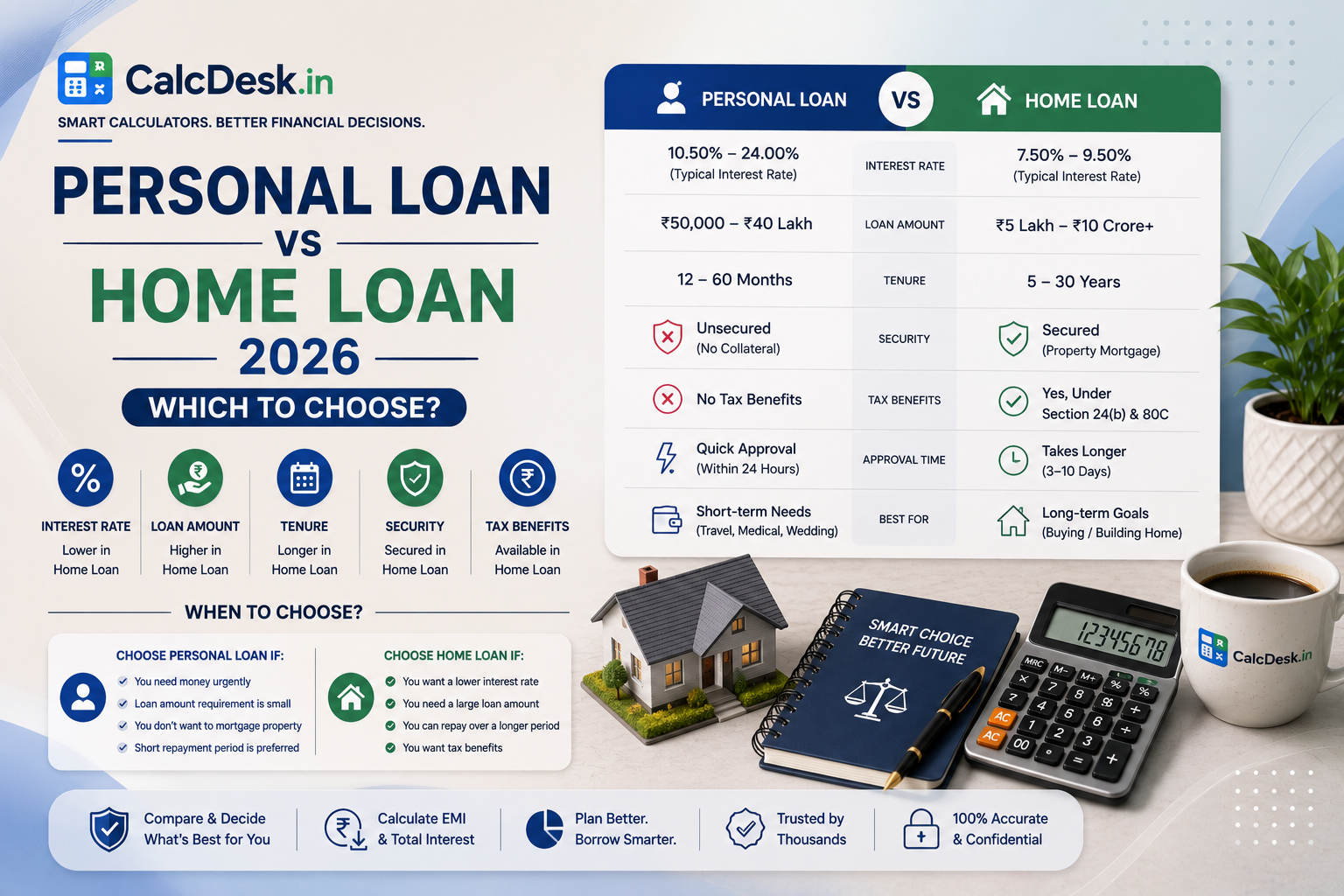
Personal Loan vs Home Loan 2026 — Which Should You Choose?
Need ₹10 lakh for home renovation — should you take a personal loan or a home loan top-up? The wrong choice can cost you lakhs in extra interest over the loan tenure. Personal loans and home loans serve fundamentally different purposes, carry vastly different interest rates, and have different tax implications. Understanding when to use each is essential before you sign any loan agreement.
This guide compares personal loans and home loans across interest rates, tenure, tax benefits, eligibility, and use cases — with worked examples showing the real cost difference. Use CalcDesk’s Personal Loan EMI Calculator and Home Loan EMI Calculator to compare your exact numbers.
Personal Loan vs Home Loan — Side-by-Side Comparison
| Feature | Personal Loan | Home Loan |
|---|---|---|
| Interest Rate | 10.5% – 24% p.a. | 8% – 9.5% p.a. |
| Collateral Required | None (unsecured) | Property (secured) |
| Maximum Tenure | 5-7 years | 20-30 years |
| Maximum Loan Amount | Up to ₹40 lakh (varies by lender) | Up to 80-90% of property value |
| Processing Time | 24-72 hours | 1-3 weeks |
| Tax Benefit | None (unless for business) | Sec 24(b) interest + Sec 80C principal (Old Regime) |
| Prepayment Charges | 2-5% (varies; nil for floating rate by RBI mandate) | Nil for floating rate loans (RBI mandate) |
| Usage Restriction | None — any purpose | Property purchase/construction/renovation only |
Worked Example 1 — ₹10 Lakh for Home Renovation: Personal Loan vs Top-Up
Comparing total cost for the same ₹10 lakh need
Option A: Personal Loan — ₹10,00,000 at 14% for 5 years
EMI = ₹23,267/month
Total interest paid: ₹3,96,020
Option B: Home Loan Top-Up — ₹10,00,000 at 9% for 10 years
EMI = ₹12,668/month
Total interest paid: ₹5,20,160
Even though Option B has higher total interest (due to longer tenure), the monthly burden is far lower. If you match tenure (5 years) for the top-up: EMI = ₹20,776/month, total interest = ₹2,46,560 — ₹1,49,460 less than the personal loan
Worked Example 2 — ₹5 Lakh for Wedding Expenses
Personal loan is the practical choice here
Personal Loan: ₹5,00,000 at 13% for 3 years
EMI = ₹16,851/month | Total interest = ₹1,06,636
Fast disbursal (24-48 hours), no collateral risk, no impact on existing home/property
Using a home loan top-up for wedding expenses would mean risking your house for a consumption expense — not recommended even though the rate is lower
When to Choose a Personal Loan
- Urgent need with fast disbursal: Medical emergencies, urgent travel, immediate cash flow needs
- No collateral available: Renters or those without property to pledge
- Short-term need: Wedding expenses, vacation, one-time large purchases you can repay in 2-5 years
- Don’t want to risk your home: For non-asset-building expenses, keeping your house as collateral-free is prudent
- Small amount needed: For amounts under ₹5 lakh, the processing speed advantage often outweighs the rate difference
When to Choose a Home Loan (or Top-Up)
- Property-related expense: Purchase, construction, or renovation of a house
- Large amount needed: Home loans support much higher amounts at lower rates
- You have an existing home loan: A top-up is faster to process and cheaper than a fresh personal loan
- You want tax benefits: Home loan interest (Sec 24b) and principal (Sec 80C) offer deductions under Old Regime
- You can commit to longer tenure: If lower EMI matters more than minimising total interest
Tax Benefit Comparison
| Loan Type | Tax Benefit | Limit |
|---|---|---|
| Home Loan Interest | Sec 24(b) — Old Regime only | ₹2,00,000/year (self-occupied) |
| Home Loan Principal | Sec 80C — Old Regime only | ₹1,50,000/year (combined with other 80C) |
| Personal Loan (general use) | None | — |
| Personal Loan (for home renovation/purchase) | Sec 24(b) if proceeds used for home — Old Regime | ₹2,00,000/year (combined with home loan interest) |
| Personal Loan (for business) | Interest deductible as business expense | No cap, subject to business income rules |
📌 Lesser-known fact: If you use a personal loan specifically for home renovation or purchase (and can prove this with documentation), the interest can qualify for Sec 24(b) deduction just like a home loan, subject to the same ₹2 lakh cap. Keep clear records connecting the loan to the property expense.
Eligibility Comparison
| Factor | Personal Loan | Home Loan |
|---|---|---|
| Minimum CIBIL Score | 700+ (some lenders accept 650+) | 650+ (750+ for best rates) |
| Income Proof | 3 months salary slips / 2 years ITR | 6 months salary slips / 2-3 years ITR |
| FOIR Limit | 40-50% of net income | 40-50% of net income |
| Employment Stability | Minimum 1-2 years | Minimum 2-3 years |
💡 Tip: If you have an existing home loan and need extra funds, always check with your current lender for a top-up loan first — it’s typically processed in 3-5 days (vs weeks for a fresh loan), and the interest rate is close to your existing home loan rate, far cheaper than a personal loan.
💰 Compare Your EMI for Both Loan Types — Free
Calculate exact EMI and total interest for personal loans and home loans side by side.
→ Open Personal Loan EMI CalculatorHome Loan Top-Up — The Best of Both Worlds
A home loan top-up is an additional loan disbursed on top of your existing home loan, using the same property as collateral. Because the risk to the bank is already secured, the interest rate is the same as your existing home loan — typically 8.5–9.5% — making it far cheaper than any personal loan at 10.5–18%.
The tax angle: if the top-up funds are used for construction or renovation of the same property, the interest qualifies under Section 24(b) for deduction up to ₹2 lakh per year for self-occupied property, in the Old Tax Regime. Banks do not actively verify end-use, but the tax benefit applies only when funds genuinely go toward renovation or construction — document all expenses carefully.
Eligibility criteria are straightforward: you must have completed at least 12–18 EMIs on your existing home loan, and the property’s current market value must support an adequate margin after deducting your outstanding loan. Most banks sanction top-ups up to 80% LTV (Loan-to-Value) of the current property value minus the outstanding principal.
Top-Up vs Personal Loan — Real Numbers
Situation: Home loan outstanding ₹30 lakh. Property now valued at ₹60 lakh. Need ₹5 lakh for renovation.
Top-up eligibility: ₹60L × 80% LTV = ₹48L. Less outstanding ₹30L = ₹18L top-up capacity
Interest rate — Top-up: 9% (same as home loan) vs Personal Loan: 15%
EMI comparison for ₹5L, 5-year tenure:
Top-up at 9%: EMI = ₹10,388/month | Personal Loan at 15%: EMI = ₹11,895/month
Monthly saving: ₹1,507 | Over 5 years: ₹90,420 saved
For ₹10L at same rates, the saving doubles. Process time for top-up: 3–5 working days with the same lender (vs instant personal loan but at 15%+).
Interest Rate Comparison — All Loan Types 2026
Loan interest rates in India vary significantly by loan type, lender category, and borrower profile. Here is a consolidated view of current rates across all major loan categories as of FY 2026-27. Note that home loan rates are linked to RLLR (Repo Linked Lending Rate) or MCLR plus a spread — they move with RBI repo rate changes, while personal loan rates are largely fixed.
| Loan Type | PSU Banks | Private Banks | NBFCs |
|---|---|---|---|
| Home Loan (purchase/construction) | 8.5–9.0% | 8.75–9.5% | 9.0–10.5% |
| Home Loan Top-Up | Same as home loan rate | Same as home loan rate | Same as home loan rate |
| Loan Against Property (LAP) | 9.0–10.0% | 9.5–11.0% | 10.0–13.0% |
| Personal Loan (salaried) | 10.5–13.0% | 11.0–14.0% | 13.0–18.0% |
| Personal Loan (self-employed) | 13.0–16.0% | 13.0–16.0% | 16.0–24.0% |
| Gold Loan | 7.5–9.0% | 8.0–10.0% | 9.0–12.0% |
| Car Loan (new vehicle) | 8.5–9.5% | 8.75–10.0% | 9.0–11.0% |
| Car Loan (used vehicle) | 12.0–14.0% | 12.0–16.0% | 14.0–18.0% |
Rates as of FY 2026-27; subject to revision with each RBI Monetary Policy Committee meeting. Home loan rate = RLLR/MCLR + spread (typically 0.25–1.5%). LAP rates are higher than home loan rates because non-primary-property collateral is assessed with a higher risk premium. Gold loan rates vary significantly by purity and tenure.
CIBIL Score Impact — Loan Applications and Multiple Inquiries
Your CIBIL score is the single most powerful variable in determining both loan approval and interest rate. Before applying anywhere, understand how the application process itself affects your score — poorly managed applications can lower your score at the worst possible time.
Hard inquiry vs soft inquiry: Every formal loan application you submit triggers a hard inquiry at the credit bureau — CIBIL records it and your score drops 5–10 points per inquiry. If you apply to 5 banks in one month, your score could fall 30–50 points before any loan is approved, ironically making you appear more credit-hungry and reducing your chances. A soft inquiry — checking your own score, or a bank sending you a pre-approved offer — has zero score impact.
Ideal CIBIL scores by loan type (FY 2026-27): Home loan — 750+ for best rates; 700–749 — approval likely but higher spread. Personal loan — 700+ for approval; below 650 — likely rejection or very high rate. Car loan — 700+ recommended. Score below 600 — rejection across most lenders for secured and unsecured loans.
Score recovery timeline: 6–12 months of consistent on-time payments typically recover 20–30 CIBIL points. Negative marks (defaults, settlements) can stay on your credit report for up to 7 years.
Strategy — apply smart, not wide: Apply to one lender first (the one most likely to approve you based on your profile and their published eligibility criteria). If rejected, wait a minimum of 3 months before applying elsewhere — this allows the hard inquiry impact to partially fade. Use your own CIBIL check (free once per year at CIBIL.com, or through most banking apps) to assess your score before any application. A pre-qualified offer from your existing bank (salary account or existing loan relationship) typically involves a soft inquiry, not a hard one — start there.
Balance Transfer for Personal Loans
Balance transfer — refinancing an existing loan to a new lender at a lower rate — is well-known for home loans but less commonly used for personal loans. Several banks and NBFCs do offer personal loan balance transfer, and in the right circumstances it can generate meaningful savings.
Typical charges at the new lender: processing fee of 1–2% of the outstanding principal. The old lender may charge a foreclosure fee if your loan is on a fixed rate — check this first. RBI mandates no prepayment penalty on floating rate personal loans, but most personal loans are on fixed rates, so foreclosure charges of 2–4% may apply.
When balance transfer makes mathematical sense: interest rate saving of at least 2% or more, remaining tenure of at least 24 months, and outstanding amount above ₹2 lakh. In the final 12 months of a loan, the math almost never works — processing costs eat the savings.
Personal Loan Balance Transfer — Numbers
Existing loan: ₹5,00,000 outstanding | Rate: 18% | Remaining tenure: 36 months
Current EMI: ₹18,076/month | Remaining interest payable: approximately ₹1,50,736
After BT to new lender at 12%:
New EMI: ₹16,607/month | Remaining interest payable: approximately ₹97,852
Gross interest saving: ₹52,884
Less: Processing fee at new lender (1.5% of ₹5L): ₹7,500
Less: Foreclosure fee at old lender (3% of ₹5L): ₹15,000
Net saving: ₹52,884 − ₹22,500 = ₹30,384 over 3 years
Caution: If old lender has zero foreclosure fee (floating rate), net saving improves to ~₹45,384. Always get exact fee figures in writing before initiating BT — verbal quotes are not binding.
1 thought on “Personal Loan vs Home Loan 2026 — Which to Choose | CalcDesk.in”