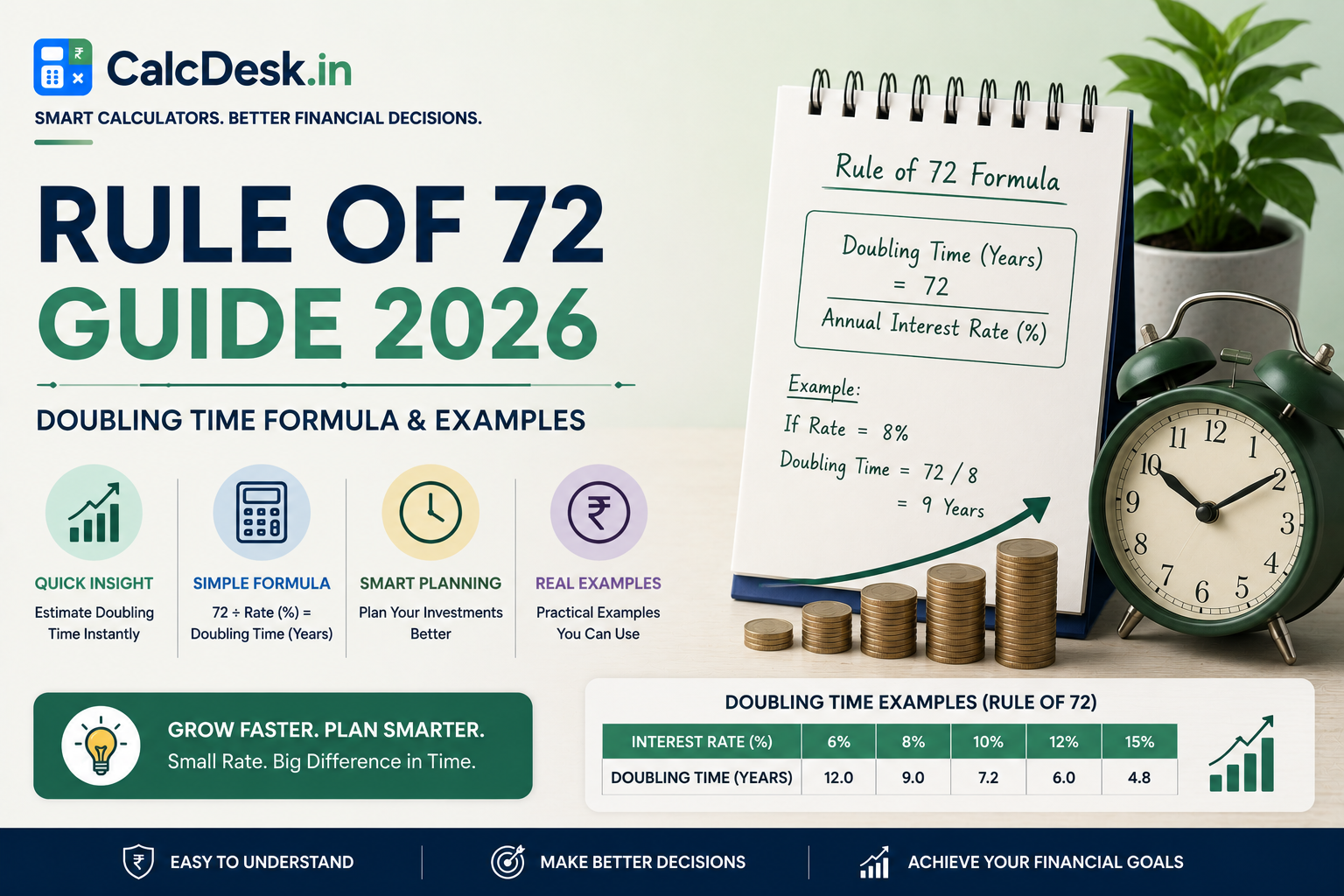
Rule of 72 — Instantly Estimate When Your Money Doubles
The Rule of 72 is one of the most useful mental shortcuts in personal finance — a single division tells you how long any investment takes to double. When a mutual fund returns 12% annually, you know immediately: your money doubles in 6 years (72÷12). When inflation runs at 6%, you know your purchasing power halves in 12 years (72÷6). When credit card interest is 36%, that unpaid balance doubles in just 2 years (72÷36). No calculator needed.
This guide explains the formula, accuracy limits, worked examples across common Indian investments, and extensions for tripling and quadrupling money. Use CalcDesk’s Compound Interest Calculator for precise projections beyond mental math.
The Formula
Rule of 72
At 6% → 72/6 = 12.0 years to double
At 7% → 72/7 = 10.3 years
At 8% → 72/8 = 9.0 years
At 9% → 72/9 = 8.0 years
At 12% → 72/12 = 6.0 years
At 15% → 72/15 = 4.8 years
At 36% → 72/36 = 2.0 years (credit card debt!)
Applied to Common Indian Investments
| Investment | Typical Return | Years to Double (Rule of 72) | Actual Doubling Time |
|---|---|---|---|
| Savings Account | 3.5% | 20.6 years | 20.1 years |
| PPF (7.1%, tax-free) | 7.1% | 10.1 years | 10.1 years |
| Bank FD | 7.0% | 10.3 years | 10.2 years |
| EPF | 8.25% | 8.7 years | 8.7 years |
| SCSS | 8.2% | 8.8 years | 8.8 years |
| Nifty 50 SIP (historical avg) | 12% | 6.0 years | 6.1 years |
| Mid Cap Fund | 15% | 4.8 years | 4.96 years |
| Credit Card Debt | 36% | 2.0 years (debt doubles!) | 2.3 years |
Worked Example 1 — FD vs Equity SIP over 30 Years
₹5 lakh invested — FD at 7% vs Equity SIP at 12%
FD (7%): Doubles every 10.3 years. Over 30 years: doubles approximately 2.9 times.
₹5L × 2^2.9 ≈ ₹37 lakh
Equity SIP (12%): Doubles every 6 years. Over 30 years: doubles 5 times.
₹5L × 2^5 = ₹1.6 crore
The 5% return difference creates a 4x wealth gap — purely from compounding speed over 30 years.
Worked Example 2 — Inflation Halving Purchasing Power
Rule of 72 applied to inflation
At 5% inflation: 72/5 = 14.4 years for purchasing power to halve.
A retiree with ₹1 crore at age 60 will find its purchasing power equivalent to just ₹50 lakh by age 74.
By age 89, it’s equivalent to just ₹25 lakh in today’s terms — severe erosion over a 30-year retirement.
This is why equity allocation remains essential even in retirement portfolios — FD returns barely beat inflation for high-bracket taxpayers.
Worked Example 3 — Credit Card Debt Trap
₹1 lakh unpaid credit card balance at 36% annual interest
72/36 = 2 years to double.
Year 0: ₹1,00,000 → Year 2: ₹2,00,000 → Year 4: ₹4,00,000 → Year 6: ₹8,00,000
Unpaid credit card debt of ₹1 lakh grows to ₹8 lakh in 6 years — without any additional charges.
This illustrates why eliminating high-interest debt is the highest guaranteed return available. Clearing 36% credit card debt is equivalent to earning 36% after-tax on an investment — impossible to match legitimately.
Extensions — Rule of 114 and Rule of 144
| Rule | Estimates | Formula | At 8% Return | At 12% Return |
|---|---|---|---|---|
| Rule of 72 | Time to double | 72 ÷ rate | 9.0 years | 6.0 years |
| Rule of 114 | Time to triple | 114 ÷ rate | 14.25 years | 9.5 years |
| Rule of 144 | Time to quadruple | 144 ÷ rate | 18.0 years | 12.0 years |
How Accurate Is It?
The Rule of 72 is most accurate between 6-12% annual rates, which covers the vast majority of Indian investment scenarios. At exactly 8%, the actual doubling time is 9.006 years — the rule says 9, nearly perfect. The rule slightly underestimates time at very high rates (36%: actual is 2.3 years, rule says 2) and slightly overestimates at very low rates (1%: actual is 69.7 years, rule says 72). For everyday comparison of investments, the rule’s margin of error is negligible.
For the mathematically curious: the exact formula is t = ln(2)/ln(1+r), where ln is the natural logarithm. The number 72 is chosen because it approximates 100 × ln(2) ≈ 69.3, rounded to 72 which has many more convenient divisors.
💡 Practical insight: Every 6% increase in annual return roughly halves the doubling time. Moving from FD (7%) to equity (13%) cuts doubling time from 10.3 years to 5.5 years. Over 30 years, this difference creates 5x more wealth — the mathematical argument for maintaining equity allocation in long-term portfolios.
📊 Calculate Compound Growth Precisely — Free
Enter any principal, rate, and years. See exact compounding with full breakdown.
→ Open Compound Interest CalculatorFrequently Asked Questions
Rule of 72 for Salary Growth and Career Planning
Beyond investments, Rule of 72 is a useful career planning tool. If your salary grows at a consistent rate, how long until it doubles?
| Annual Salary Growth | Years to Double Salary | Example |
|---|---|---|
| 5% (inflation-level increments) | 14.4 years | ₹6L → ₹12L in 14.4 years |
| 8% (average corporate increment) | 9 years | ₹8L → ₹16L in 9 years |
| 12% (strong performer) | 6 years | ₹10L → ₹20L in 6 years |
| 18% (job-hopping strategy) | 4 years | ₹12L → ₹24L in 4 years |
| 25% (startup equity + growth) | 2.9 years | ₹15L → ₹30L in ~3 years |
This is why job-hopping — while carrying other risks — mathematically accelerates wealth building when market increments (20-40%) far exceed within-company increments (8-12%). The Rule of 72 makes the salary doubling math immediately visible.
Rule of 72 for Loan EMI Planning
Rule of 72 is equally powerful applied to loans — it shows how quickly the lender’s interest effectively “doubles” the cost of what you borrowed:
Home Loan vs Personal Loan — Rule of 72
Home loan at 9%: 72/9 = 8 years for interest to equal principal. On a ₹50L loan held for 20 years, you pay approximately ₹60L in interest — more than the loan itself. The Rule of 72 makes this visible without amortisation tables.
Personal loan at 14%: 72/14 = 5.1 years. Interest costs are punishing over medium terms.
Credit card at 36%: 72/36 = 2 years — the debt itself doubles before most people realise the severity.
The higher the interest rate, the shorter the doubling time — and the more urgently you should prioritise repayment over investment.
📌 Decision rule using Rule of 72: If your investment CAGR doubling time is shorter than your loan’s effective cost doubling time, invest rather than prepay. If loan’s doubling time is shorter (higher interest rate), prepay first. For a 9% home loan (doubles in 8 years) vs 12% equity SIP (doubles in 6 years), SIP wins mathematically. For a 14% personal loan (doubles in 5.1 years) vs 12% SIP (doubles in 6 years), prepay the loan first.