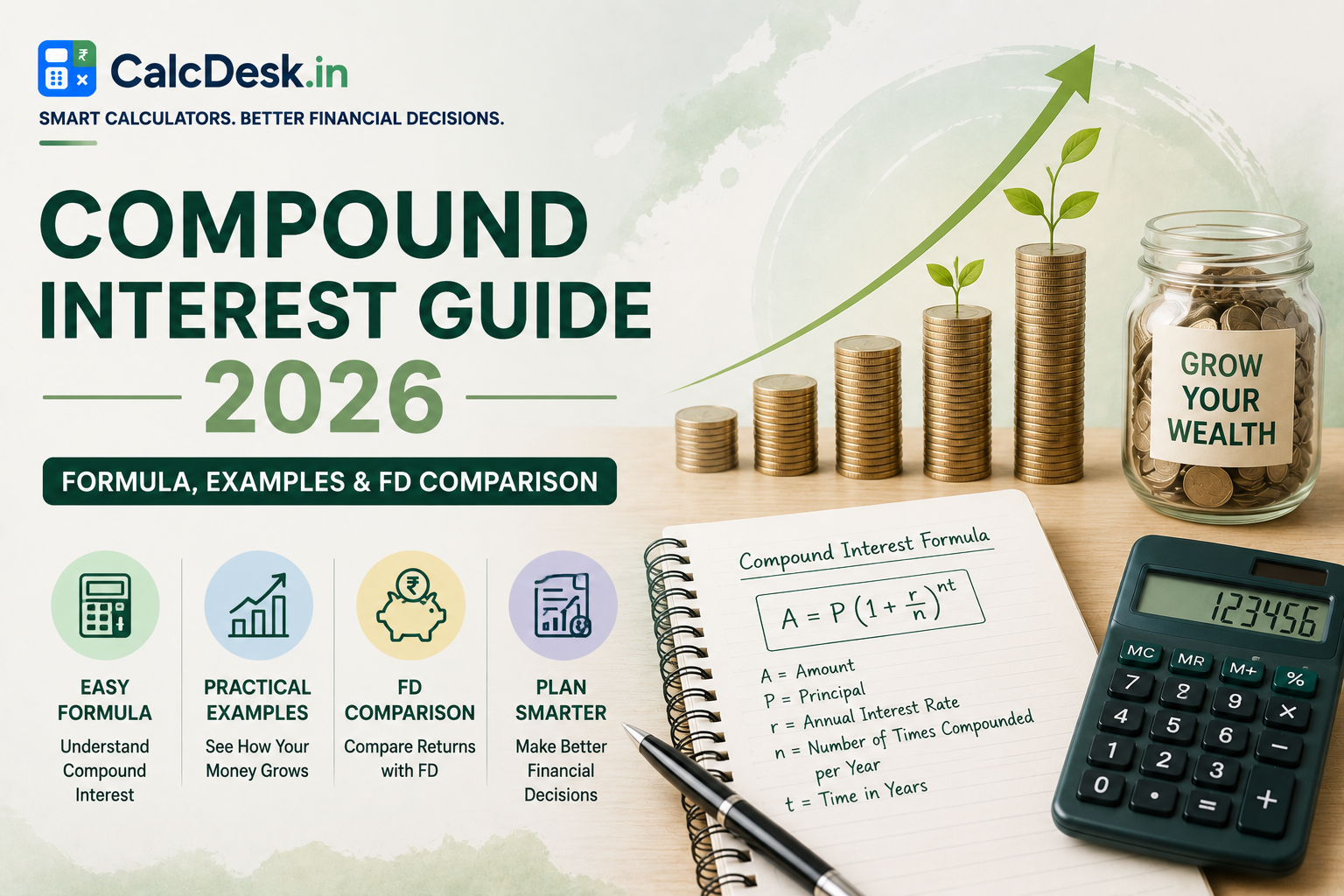
Compound Interest Guide 2026 — Formula, Examples & FD Comparison
Albert Einstein reportedly called compound interest the “eighth wonder of the world” — and whether or not he actually said it, the math behind it is genuinely remarkable. ₹1 lakh invested at 10% compound interest grows to ₹6.73 lakh in 20 years. The same amount at simple interest grows to just ₹3 lakh. The difference of ₹3.73 lakh comes entirely from interest earning interest — the core mechanism that makes long-term investing so powerful, and starting early so important.
This guide explains the compound interest formula, how compounding frequency changes your returns, worked examples using real Indian FD and investment rates, and the famous Rule of 72 shortcut. Use CalcDesk’s free Compound Interest Calculator to compute your exact growth for any principal, rate, and time period.
What is Compound Interest — The Core Concept
Compound interest is interest calculated on both the original principal and the accumulated interest from previous periods. Unlike simple interest, where you earn the same rupee amount of interest every period, compound interest grows exponentially because each period’s interest becomes part of the base for the next period’s calculation.
This compounding effect exists in nearly every Indian financial product: bank fixed deposits, recurring deposits, PPF, mutual fund SIPs, and even your home loan (where you pay compound interest on the outstanding balance).
The Compound Interest Formula
Compound Interest Formula
Compound Interest = A − P
Where:
A = Final amount (maturity value)
P = Principal (initial investment)
r = Annual interest rate (as decimal, e.g., 8% = 0.08)
n = Number of times interest compounds per year
t = Time period in years
Worked Example 1 — ₹1 Lakh, 8% Annual, 5 Years (Annual Compounding)
Standard annual compounding calculation
P = ₹1,00,000 | r = 8% = 0.08 | n = 1 (annual) | t = 5 years
A = 1,00,000 × (1 + 0.08/1)^(1×5)
A = 1,00,000 × (1.08)^5
A = 1,00,000 × 1.4693
A = ₹1,46,933
Compound interest earned = ₹46,933
Compare to simple interest: SI = 1,00,000 × 0.08 × 5 = ₹40,000 (₹6,933 less)
How Compounding Frequency Changes Your Returns
The same principal and rate give different results depending on how often interest is compounded:
| Compounding Frequency | n value | ₹1,00,000 @ 8% for 1 year | Effective Annual Rate |
|---|---|---|---|
| Annual | 1 | ₹1,08,000 | 8.00% |
| Semi-annual | 2 | ₹1,08,160 | 8.16% |
| Quarterly | 4 | ₹1,08,243 | 8.24% |
| Monthly | 12 | ₹1,08,300 | 8.30% |
| Daily | 365 | ₹1,08,328 | 8.33% |
📌 Real-world application: Most Indian bank FDs compound quarterly. Savings accounts compound daily but credit interest quarterly. PPF compounds annually. When comparing FD rates between banks, always check the compounding frequency along with the headline rate — a 7.5% rate compounded quarterly beats a 7.5% rate compounded annually.
Worked Example 2 — ₹5 Lakh FD, Quarterly Compounding, 3 Years
Typical bank FD compound interest calculation
P = ₹5,00,000 | r = 7.5% annual | n = 4 (quarterly) | t = 3 years
A = 5,00,000 × (1 + 0.075/4)^(4×3)
A = 5,00,000 × (1.01875)^12
A = 5,00,000 × 1.2506
A = ₹6,25,300
Compound interest earned = ₹1,25,300 over 3 years
TDS note: If interest exceeds ₹40,000/year, bank deducts 10% TDS under Section 194A
Worked Example 3 — Long-Term Power: ₹2 Lakh for 25 Years
Demonstrating exponential growth over decades
P = ₹2,00,000 | r = 10% annual | n = 1 | t = 25 years
A = 2,00,000 × (1.10)^25 = 2,00,000 × 10.835
A = ₹21,67,000
Compound interest earned = ₹19,67,000 — nearly 10× the original principal!
At simple interest: SI = 2,00,000 × 0.10 × 25 = ₹5,00,000 (total ₹7,00,000) — compound interest delivers 3× more wealth
Simple Interest vs Compound Interest — Side by Side
| Years | Simple Interest (₹1L @ 10%) | Compound Interest (₹1L @ 10%) | Difference |
|---|---|---|---|
| 5 | ₹1,50,000 | ₹1,61,051 | ₹11,051 |
| 10 | ₹2,00,000 | ₹2,59,374 | ₹59,374 |
| 15 | ₹2,50,000 | ₹4,17,725 | ₹1,67,725 |
| 20 | ₹3,00,000 | ₹6,72,750 | ₹3,72,750 |
| 25 | ₹3,50,000 | ₹10,83,471 | ₹7,33,471 |
The Rule of 72 — Quick Doubling Time Estimator
Rule of 72
Example: At 8% interest → 72/8 = 9 years to double
At 12% (equity SIP) → 72/12 = 6 years to double
At 6% (savings account) → 72/6 = 12 years to double
Read the full Rule of 72 guide to understand its accuracy range and practical applications for quick investment comparisons.
Compound Growth Across Indian Investment Options
| Investment | Typical Rate | Compounding | ₹5L grows to in 15 years |
|---|---|---|---|
| Savings Account | 3.5% | Quarterly (paid) | ₹8.41 lakh |
| Bank FD | 7.0% | Quarterly | ₹14.05 lakh |
| PPF | 7.1% (tax-free) | Annual | ₹14.25 lakh |
| NPS (Equity heavy) | 10-11% | Market-linked | ₹21–24 lakh |
| Equity Mutual Fund SIP | 12-14% | Market-linked | ₹27-35 lakh |
Why Starting Early Matters More Than Investing More
The 10-year head start comparison
Investor A: Invests ₹1,00,000 at age 25, lets it grow at 12% until age 60 (35 years)
A = 1,00,000 × (1.12)^35 = ₹52.80 lakh
Investor B: Invests ₹3,00,000 at age 35, lets it grow at 12% until age 60 (25 years) — 3× the capital, but 10 years late
A = 3,00,000 × (1.12)^25 = ₹51.30 lakh
Investor A invested ⅓ the amount but ends up with MORE money — purely due to 10 extra years of compounding
Compound Interest on Loans — The Flip Side
Compound interest works against you on loans. Your home loan, personal loan, and credit card balance all accrue compound interest on the outstanding amount. This is why credit card debt (which often compounds monthly at 36-42% annual rate) grows so dangerously fast if not paid off, and why prepaying loans early saves disproportionately more interest. Read the Home Loan EMI Guide to understand how compound interest works on your behalf in EMI structure.
Tips to Maximise Compound Growth
- Start as early as possible: Even a small amount invested in your 20s outgrows a larger amount invested in your 40s, as shown above
- Choose higher compounding frequency products: When rates are similar, more frequent compounding (monthly/quarterly) beats annual compounding
- Avoid withdrawing interest: Reinvesting interest (cumulative FD, growth mutual funds) maximises compounding vs. payout options where you receive interest periodically
- Increase time horizon over rate-chasing: A 2% higher rate for half the time period often loses to a lower rate held twice as long, due to exponential growth
- Use tax-efficient compounding vehicles: PPF’s tax-free compounding makes its effective post-tax return higher than a taxable FD at a similar headline rate
💡 Tip: When comparing investment options, always look at CAGR (Compound Annual Growth Rate) rather than absolute returns, especially for investments held over different time periods. Read the CAGR Guide to understand how to calculate and compare investment performance fairly.
📊 Calculate Compound Interest — Free
Enter principal, rate, time, and compounding frequency. See your money grow instantly.
→ Open Compound Interest Calculator