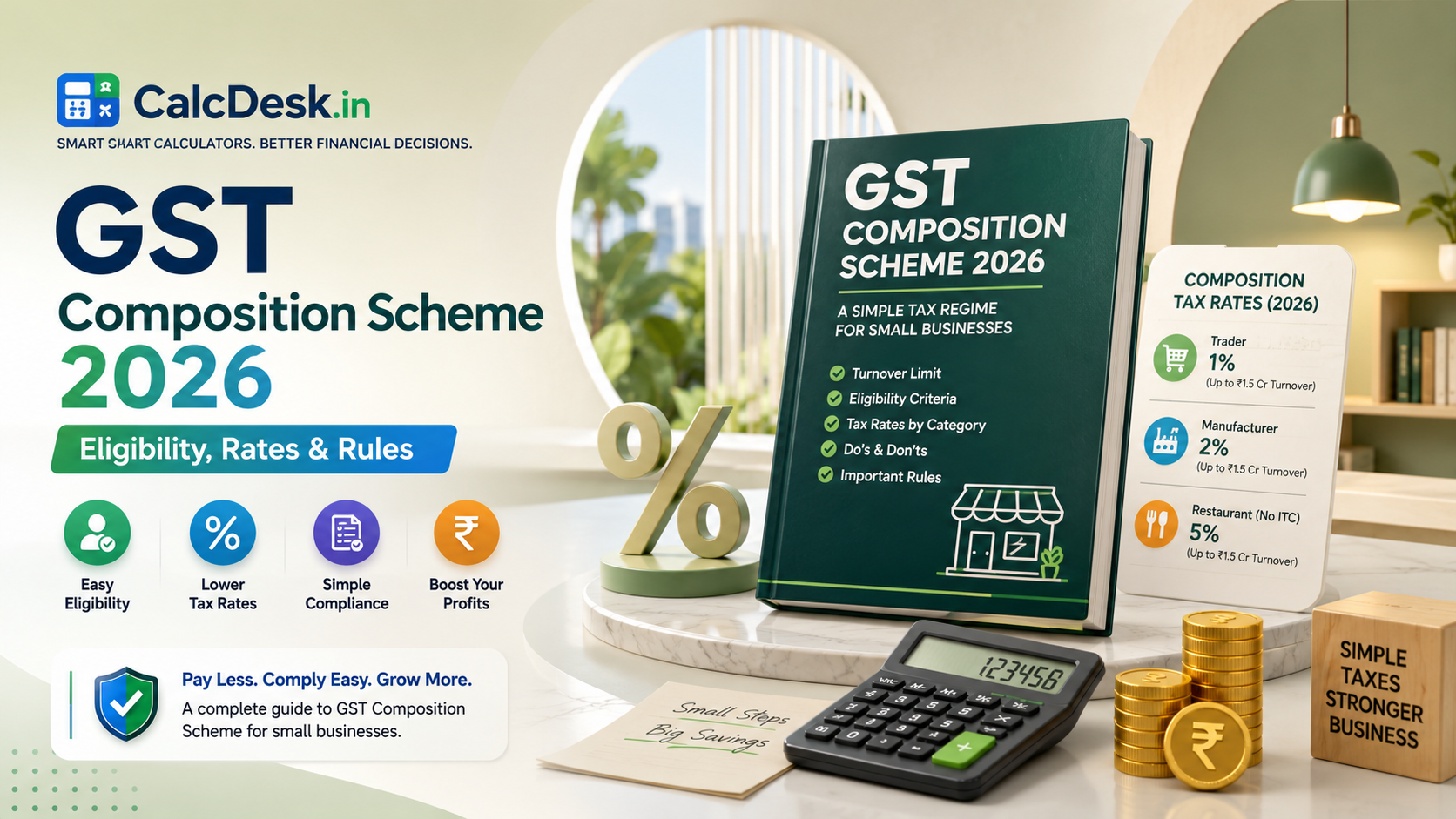
GST Composition Scheme 2026 — Eligibility, Rates & Rules
For small traders, manufacturers, and restaurant owners, the standard GST compliance burden — monthly returns, detailed invoicing, ITC reconciliation — can be overwhelming. The Composition Scheme under Section 10 of the CGST Act 2017 offers a simpler alternative: a flat, low tax rate on turnover with quarterly (not monthly) filing. But it comes with significant trade-offs, particularly the loss of Input Tax Credit and the inability to sell across state lines.
This guide explains who is eligible, the exact tax rates for different business types, the restrictions you must accept, and the quarterly CMP-08 filing process. Use CalcDesk’s free Composition Scheme Calculator to estimate your tax liability under this scheme.
What is the GST Composition Scheme
The Composition Scheme is an optional, simplified GST compliance mechanism designed for small businesses. Instead of charging GST on every sale and claiming ITC on purchases, composition dealers pay a fixed percentage of their total turnover as tax — regardless of their actual margin or input costs.
Eligibility Criteria for Composition Scheme
| Criteria | Requirement |
|---|---|
| Turnover limit (goods) | Up to ₹1.5 crore (₹75 lakh in special category states) |
| Turnover limit (services) | Up to ₹50 lakh (separate composition scheme for services) |
| Supply type | Intra-state only — no inter-state sales allowed |
| E-commerce sales | Not allowed if selling via platforms collecting TCS (e.g., Amazon, Flipkart) |
| Notified goods restriction | Cannot manufacture ice cream, pan masala, tobacco products |
| Casual/non-resident taxable person | Not eligible |
Composition Scheme Tax Rates by Business Type
GST Composition Scheme Rate Chart
Restaurants (non-alcohol serving): 5% of turnover (2.5% + 2.5%)
Service Providers (separate scheme): 6% of turnover (3% + 3%)
Tax is calculated on TOTAL TURNOVER, not on profit margin
Worked Example 1 — Retail Trader
Small electronics retailer, ₹80 lakh annual turnover
Annual turnover: ₹80,00,000
Composition tax rate (trader): 1%
Annual tax payable: ₹80,000
Quarterly tax (paid via CMP-08): ₹20,000/quarter
No ITC can be claimed on purchases — if the trader paid ₹2,00,000 in GST on stock purchases (at 18% on cost), this entire amount is a sunk cost, unlike regular GST registration where it would offset against output tax
Worked Example 2 — Restaurant
Small restaurant (no alcohol), ₹60 lakh annual turnover
Annual turnover: ₹60,00,000
Composition tax rate (restaurant): 5%
Annual tax payable: ₹3,00,000
Compare to regular GST registration: at 5% GST on restaurant bills (with ITC denied for non-AC restaurants anyway), the effective tax burden may be similar, but composition scheme avoids monthly GSTR-1/3B filing — just quarterly CMP-08 and annual GSTR-4
Worked Example 3 — Service Provider
Small consultancy firm, ₹40 lakh annual turnover
Annual turnover: ₹40,00,000
Composition tax rate (services): 6%
Annual tax payable: ₹2,40,000
Compare to regular registration at 18% GST with ITC: if the firm has minimal input costs (most consultancy services have low GST-bearing expenses), the 6% composition rate may actually cost more in absolute terms than 18% with full ITC, since service businesses typically have thin input costs to offset against
What You CANNOT Do Under Composition Scheme
- Cannot claim Input Tax Credit (ITC) on any purchases — this is the single biggest restriction
- Cannot charge GST on invoices — must issue a “Bill of Supply” instead of a tax invoice, and cannot collect tax from customers separately
- Cannot make inter-state sales — restricted to intra-state supply only
- Cannot sell through e-commerce operators that collect TCS (Tax Collected at Source)
- Cannot supply notified goods like ice cream, pan masala, tobacco, and certain other items
- Must mention “composition taxable person” on every bill of supply and at the place of business
⚠️ Mandatory display requirement: Composition dealers must display “Composition Taxable Person” prominently at every place of business and on every bill of supply issued. Failure to comply can attract penalties under GST law.
CMP-08 — Quarterly Tax Payment
Composition dealers pay tax quarterly using Form CMP-08, a self-assessed statement-cum-challan:
| Quarter | Period | Due Date |
|---|---|---|
| Q1 | April – June | 18 July |
| Q2 | July – September | 18 October |
| Q3 | October – December | 18 January |
| Q4 | January – March | 18 April |
In addition to CMP-08, composition dealers must file an annual return GSTR-4 by 30 April following the end of the financial year, summarising the entire year’s transactions.
Composition Scheme vs Regular GST Registration
| Factor | Composition Scheme | Regular GST Registration |
|---|---|---|
| Tax rate | 1-6% of turnover | 5-28% on taxable value |
| ITC claim | Not allowed | Allowed |
| Inter-state sales | Not allowed | Allowed |
| Return filing | Quarterly (CMP-08) + Annual (GSTR-4) | Monthly (GSTR-1, 3B) + Annual (GSTR-9) |
| Invoice type | Bill of Supply (no GST shown) | Tax Invoice (GST shown) |
| Best for | Small local traders, restaurants with low input costs | Manufacturers, B2B sellers, inter-state businesses |
💡 Decision tip: If your business has high input GST costs (you buy raw materials/inventory that already carry significant GST), regular registration with ITC often works out cheaper despite higher headline rates. The Composition Scheme is best suited for businesses with low purchase-side GST or service businesses with minimal taxable inputs.
🧮 Calculate Composition Scheme Tax — Free
Enter your turnover and business type. See your exact quarterly tax liability under the Composition Scheme.
→ Open Composition Scheme CalculatorAnnual Return Under Composition — GSTR-4
Many composition dealers confuse CMP-08 (quarterly payment) with the annual return obligation. These are two separate filings with different due dates and different consequences for late filing. Getting this wrong results in penalties that compound unnecessarily.
GSTR-4 is the annual return that composition dealers must file summarising the entire financial year’s activity. It is not a substitute for CMP-08 — both are mandatory.
| Filing | Form | Frequency | Due Date | Late Fee |
|---|---|---|---|---|
| Quarterly tax payment + statement | CMP-08 | Every quarter | 18th of month after quarter end (18 July, 18 Oct, 18 Jan, 18 Apr) | ₹200/day (₹100 CGST + ₹100 SGST) up to ₹5,000 |
| Annual return | GSTR-4 | Once per financial year | 30 April of following year (e.g., 30 April 2026 for FY 2026-27) | ₹50/day (₹25 CGST + ₹25 SGST) up to ₹2,000; NIL return: ₹20/day up to ₹500 |
GSTR-4 requires you to declare: all outward supplies made during the year; inward supplies received from registered dealers; inward supplies from unregistered dealers (reverse charge applicable); total tax paid via CMP-08 during the year; any balance tax payable after reconciliation.
Common GSTR-4 errors to avoid: Mismatch between the CMP-08 payments reflected and what GSTR-4 shows as tax paid — reconcile carefully. Not declaring inward supplies from unregistered dealers (on which reverse charge may apply). Turnover reported in GSTR-4 not matching the books of accounts — this invites scrutiny. Always reconcile GSTR-4 figures against your purchase and sales register before filing.
Composition Scheme for E-Commerce Sellers
If you sell goods online through Amazon, Flipkart, Meesho, or any other e-commerce platform, you cannot register under the GST Composition Scheme — this is a hard statutory bar, not a guideline.
Section 10(2)(d) CGST Act: A composition dealer cannot make inter-state outward supplies of goods or services. E-commerce sales are typically inter-state — when a seller in Maharashtra ships to a buyer in Karnataka via Amazon, that is an inter-state supply. Composition dealers are barred from this. Additionally, e-commerce operators are required to collect TCS (Tax Collected at Source) at 1% from sellers — composition dealers cannot receive TCS credit as they do not file GSTR-3B where TCS credits are claimed.
The picture is different for restaurants and food businesses listing on food delivery aggregators like Swiggy and Zomato:
Restaurants on Swiggy/Zomato — composition allowed: Under Section 9(5) of the CGST Act, GST on food delivery through e-commerce operators is paid by the operator (Swiggy/Zomato), not the restaurant. The restaurant’s own supply is treated separately. GST Council Circular 167/23/2021 clarified that restaurants registered under the Composition Scheme can supply through Swiggy and Zomato — the aggregator handles the tax on delivery, the restaurant continues to pay composition tax on its dine-in and takeaway turnover. A tiffin service or dhaba on composition can list on Zomato without violating the scheme. A garment seller on Amazon cannot.
Switching Between Composition and Regular — How It Works
Switching GST registration between the Composition Scheme and regular GST is not a mid-year option. Both the opt-out and opt-in are prospective and tied to the financial year boundary. Many dealers make the mistake of assuming they can switch whenever their situation changes — and end up either stuck in the wrong scheme for the rest of the year or in violation of composition rules.
Golden rule: Any switch — whether from composition to regular or back — must be planned before April 1 and executed before the new financial year begins. You cannot switch mid-year except when the law forces it (turnover breach, inter-state supply, etc.).
| Action | Form to File | When | Key Consequence |
|---|---|---|---|
| Opt OUT of composition (switch to regular GST) | Form GST CMP-04 on GST portal | Before start of next FY (file in March for April effect); or immediately if forced by turnover breach | File Form GST ITC-01 within 30 days of switch to claim ITC on stock held on the date of switching (inputs, semi-finished goods, finished goods, capital goods) |
| Switch BACK to composition from regular | Form GST CMP-02 (intimation) at start of FY | Only from start of a new financial year — cannot switch back in the same year you opted out | Must reverse any ITC claimed while on regular scheme that relates to stock on hand at time of switching back (file GST ITC-03 for reversal) |
| Forced exit (turnover crosses limit) | Automatic — must file CMP-04 from day limit is breached | Immediately on breach; all invoices from that date must be regular tax invoices | All supplies from breach date must be under regular scheme; issue credit notes for bills of supply issued after breach |
When switching from composition to regular, the ITC-01 claim is time-bound and valuable. A composition dealer sitting on ₹5L worth of stock (on which input GST of ₹25,000 was paid) can claim that ₹25,000 as ITC upon switching to regular — but only if ITC-01 is filed within 30 days of the switch date. Missing this window means the ITC is lost permanently.