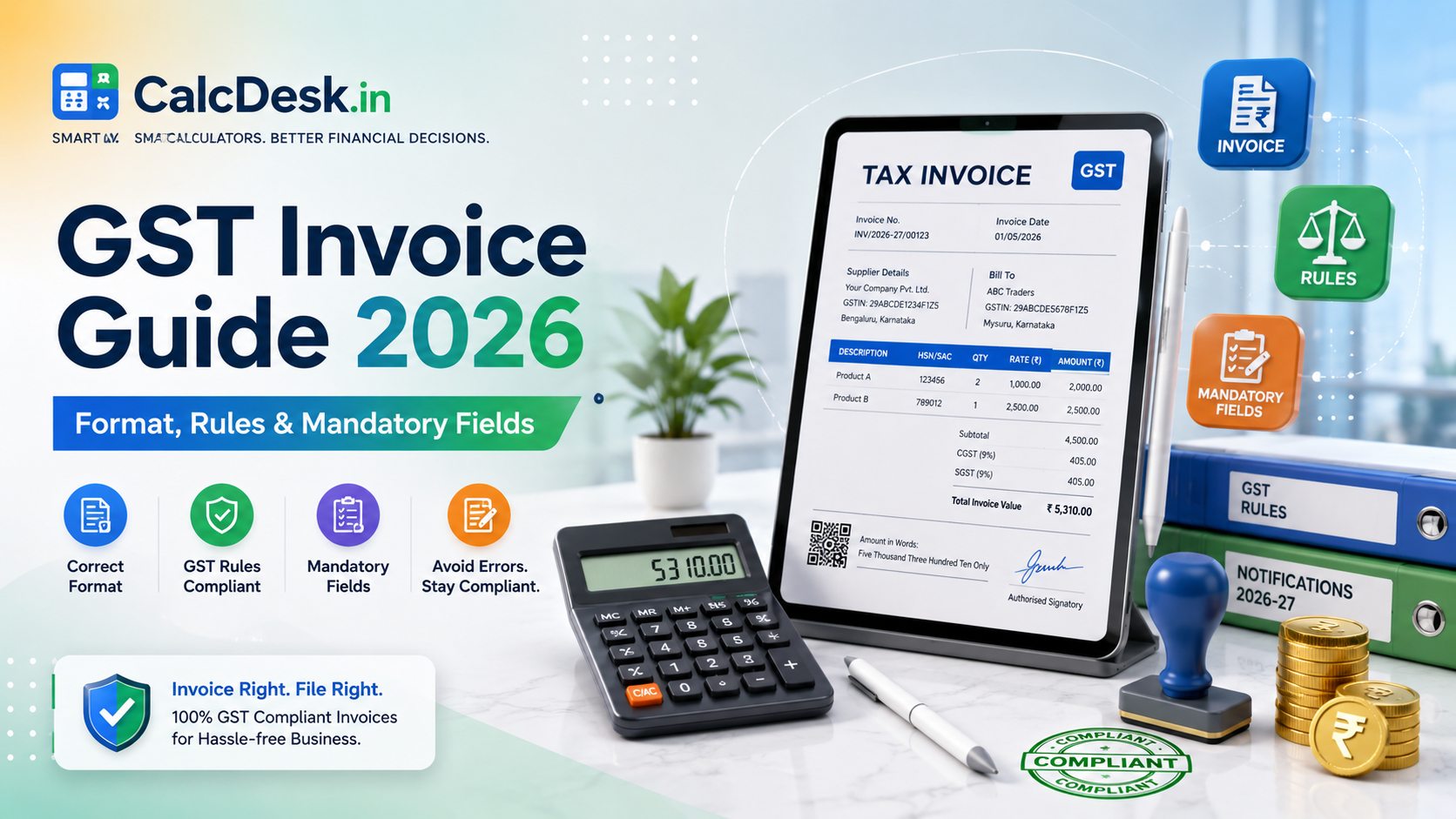
GST Invoice Guide 2026 — Format, Rules & Mandatory Fields
An incorrectly formatted GST invoice isn’t just a paperwork issue — it can deny your customer their Input Tax Credit (ITC), invite scrutiny during a GST audit, and create reconciliation mismatches in your GSTR-1 filing. Yet many small businesses still issue invoices missing mandatory fields like HSN codes or place of supply. Getting your GST invoice format right from day one saves enormous compliance headaches later.
This guide covers every mandatory field required on a GST invoice under the CGST Act 2017, the e-invoicing threshold and process, HSN/SAC code requirements, and the difference between tax invoices and bills of supply. Use CalcDesk’s free GST Invoice Generator to create compliant invoices instantly with automatic tax calculation and free PDF download.
Mandatory Fields on a GST Tax Invoice
Under Rule 46 of the CGST Rules 2017, every tax invoice must contain these fields:
GST Invoice Mandatory Fields Checklist
- ✓ Invoice number — consecutive serial number, unique for the financial year
- ✓ Invoice date
- ✓ Supplier’s legal name, address, and GSTIN
- ✓ Recipient’s name, address, and GSTIN (if registered)
- ✓ HSN code (goods) or SAC code (services)
- ✓ Description of goods/services
- ✓ Quantity (for goods) and unit (nos, kg, etc.)
- ✓ Total taxable value of goods/services
- ✓ Applicable GST rate (CGST, SGST, or IGST shown separately)
- ✓ Amount of tax charged (CGST + SGST or IGST)
- ✓ Place of supply (mandatory for inter-state transactions)
- ✓ Address of delivery (if different from place of supply)
- ✓ Whether tax is payable on reverse charge basis
- ✓ Signature/digital signature of supplier or authorised representative
Sample GST Invoice Layout — Field by Field
| Section | Content |
|---|---|
| Header | Company name, logo, GSTIN, address, invoice title “TAX INVOICE” |
| Invoice details | Invoice no., date, due date, place of supply |
| Bill to / Ship to | Recipient name, GSTIN, billing & shipping address |
| Line items table | HSN/SAC, description, qty, rate, taxable value, GST%, CGST/SGST/IGST amount |
| Totals | Subtotal, total CGST, total SGST/IGST, grand total |
| Footer | Amount in words, bank details, terms, authorised signatory |
E-Invoicing — Who Needs It and How It Works
E-invoicing requires B2B invoices to be electronically registered with the government through the Invoice Registration Portal (IRP) before being issued to customers. The IRP validates the invoice and issues a unique Invoice Reference Number (IRN) plus a QR code, which must be printed on the physical/digital invoice.
E-Invoicing Applicability Timeline
Turnover above ₹100 Cr → Mandatory since Jan 2021
Turnover above ₹50 Cr → Mandatory since Apr 2021
Turnover above ₹20 Cr → Mandatory since Apr 2022
Turnover above ₹10 Cr → Mandatory since Oct 2022
Turnover above ₹5 Cr → Mandatory since Aug 2023
📌 E-invoicing applies to B2B and export invoices only. B2C invoices (sales to unregistered consumers) do not require e-invoice registration, though businesses above the threshold may still need to generate a dynamic QR code for B2C invoices above certain value.
HSN and SAC Codes — Classification Requirements
| Annual Turnover | HSN Digits Required (Goods) | SAC Digits Required (Services) |
|---|---|---|
| Up to ₹5 crore | 4 digits | 4 digits (full 6-digit SAC recommended) |
| Above ₹5 crore | 6 digits | 6 digits |
| Export/Import invoices | 8 digits (mandatory) | — |
You can look up the correct HSN code for your product on the GSTN portal HSN search tool. Using an incorrect HSN code can result in wrong GST rate application, leading to under or over-charging.
Tax Invoice vs Bill of Supply vs Export Invoice
| Document Type | When Used | GST Shown? |
|---|---|---|
| Tax Invoice | Regular taxable supply | Yes, CGST/SGST or IGST |
| Bill of Supply | Composition dealer or exempt goods/services | No GST charged |
| Export Invoice | Supply outside India | Zero-rated (with LUT) or IGST refund claim |
| Credit/Debit Note | Post-invoice adjustments (returns, price changes) | Adjusted GST amount |
Time Limit for Issuing GST Invoices
- Goods (normal supply): Before or at the time of removal/delivery
- Services: Within 30 days of supply of service (45 days for banks/NBFCs)
- Continuous supply of goods: Before or at the time of each statement/payment
- Continuous supply of services: Before or at the due date of payment per contract
Common GST Invoice Mistakes
- Missing or wrong GSTIN: A single digit error invalidates the entire invoice for ITC purposes
- Not mentioning place of supply for inter-state transactions: Required to determine correct IGST applicability
- Wrong HSN/SAC code: Leads to incorrect tax rate and potential demand notices
- Non-sequential invoice numbering: GST law requires consecutive serial numbers — skipping numbers or duplicate numbers is a compliance violation
- Charging GST as a Composition dealer: Composition scheme dealers cannot charge GST on invoices — they must issue a Bill of Supply instead
💡 Tip: CalcDesk’s GST Invoice Generator automatically handles CGST/SGST vs IGST split based on whether the transaction is intra-state or inter-state, calculates totals, and produces a free downloadable PDF — eliminating manual calculation errors entirely.
📄 Generate GST Invoices — Always Free
Create professional, GST-compliant invoices with automatic tax calculation. No payment required.
→ Open GST Invoice GeneratorB2C vs B2B Invoices — Different Rules for Different Buyers
GST invoice requirements are not uniform across all transactions. The type of buyer — registered dealer or unregistered consumer — determines which invoice format applies, what information is mandatory, and whether the buyer can claim Input Tax Credit.
| Invoice Type | Buyer | GSTIN Required? | ITC Claimable by Buyer? | Special Rules |
|---|---|---|---|---|
| B2B Invoice | GST-registered business | Yes — mandatory | Yes | Full tax invoice required; reported in GSTR-1 Table 4A/4B |
| B2C Large Invoice | Unregistered buyer, inter-state supply >₹2.5 lakh | No (buyer unregistered) | No | State of buyer must be mentioned; full invoice required |
| B2C Small Invoice | Unregistered buyer, ≤₹2.5 lakh or intra-state | No | No | Simplified invoice allowed; consolidated invoicing per day permitted |
| B2C with Dynamic QR | Unregistered buyer, supplier turnover >₹500 Cr | No | No | Dynamic QR code mandatory on the invoice |
GSTIN error on B2B invoice — the ITC consequence: If a supplier issues a B2B invoice with the wrong buyer GSTIN (even a single digit error), the buyer cannot claim Input Tax Credit on that invoice. The invoice will not appear in the buyer’s GSTR-2B auto-population, and manually claiming ITC based on a mismatched invoice invites notices during GST audit. The penalty for issuing an incorrect invoice under Section 122 of the CGST Act is ₹10,000 or the amount of tax involved, whichever is higher. Always verify the buyer’s GSTIN on the GST portal’s “Search Taxpayer” tool before finalising the invoice.
Credit Note and Debit Note — When and How to Issue
Post-invoice adjustments are handled through credit notes and debit notes. These are not optional accounting entries — they are statutory documents under Section 34 of the CGST Act 2017 and must be reported in your GSTR-1 filing.
Credit Note — When to Issue and the Time Limit That Catches Businesses Off-Guard
When to issue a Credit Note: A supplier issues a credit note when (a) goods are returned by the buyer, (b) the price of goods or services is revised downward after the invoice is issued, (c) a post-supply discount is given that was not included in the original invoice, or (d) excess tax was charged on the original invoice.
Critical time limit: A credit note for any supply made during a financial year must be issued by the earlier of — (i) September 30 of the next financial year, or (ii) the date of filing the annual return (GSTR-9) for that year. This means: if you supplied goods in March 2026 and there is a return or price revision, your credit note must be issued by September 30, 2026 at the latest. Businesses that miss this window cannot reduce their tax liability through a credit note — the GST paid on the original supply is forfeited.
Example: A supplier in Mumbai issues an invoice dated March 10, 2026 for ₹5,00,000 + 18% GST = ₹5,90,000. In June 2026, the buyer returns ₹1,00,000 worth of goods. The supplier must issue a credit note by September 30, 2026 for ₹1,00,000 + ₹18,000 GST. This credit note is declared in GSTR-1 Table 9B and reduces both the tax liability and the buyer’s ITC accordingly.
Format requirement: The credit note must clearly mention the original invoice number and date to which it relates, the reason for issuance, the revised taxable value, and the adjusted GST amount. It must be declared in GSTR-1 in the relevant month’s filing.
Debit Note — no time limit: A debit note is issued by the supplier when the price is revised upward or additional GST needs to be charged after the original invoice. Unlike credit notes, there is no time limit for issuing a debit note — it can be issued in any subsequent period. The buyer’s ITC increases by the amount on the debit note once it is auto-populated in GSTR-2B.
GST Invoice for Exports — Zero-Rated Supply Rules
Export of goods and services is treated as a zero-rated supply under Section 16 of the IGST Act 2017. This means no GST is ultimately borne on export supplies, but the mechanism for achieving this zero-rating involves a choice between two routes with different cash flow implications.
Two Routes for Zero-Rated Export Supplies
Supply goods/services without paying IGST → Claim refund of ITC accumulated
Invoice must state: “Supply meant for export under LUT without payment of IGST”
LUT filed annually on GST portal (Form RFD-11) before the financial year begins
Refund of ITC: 90% within 7 working days, balance on verification
Route 2 — Pay IGST Upfront:
Pay IGST on export invoice → Claim full IGST refund later
Invoice must state: “Supply meant for export on payment of integrated tax”
Link Shipping Bill to GST invoice on ICEGATE portal for refund processing
Refund timeline: 60-90 days typically (longer cash flow cycle)
LUT (Letter of Undertaking) — practical details: The LUT is an annual undertaking filed on the GST portal that allows you to export without paying IGST upfront. Any regular exporter with a clean GST compliance record can file an LUT. It must be filed before the start of each financial year (or before the first export of that year). Filing is entirely online at gstin.gov.in → Services → User Services → Furnish Letter of Undertaking. The LUT is valid for one full financial year. Most exporters prefer the LUT route because it avoids blocking working capital in upfront IGST payment and has a faster refund cycle.
Shipping Bill linkage for refund (Route 2): For the IGST-paid route, the shipping bill filed with Customs on the ICEGATE portal must be linked to the GST invoice. GSTN and Customs share data electronically, and if the invoice number and GSTIN match correctly, the refund is processed automatically. Mismatches between the invoice details on GSTR-1 and the Shipping Bill are the most common reason for export refund delays.
Invoice Numbering — What the Law Requires and What to Avoid
GST Rule 46 mandates a specific invoice numbering discipline that many small businesses overlook until a scrutiny notice arrives. The rules are straightforward but have practical implications for accounting software setup and multi-branch businesses.
What the law requires: Every tax invoice must carry a consecutive serial number, unique for the financial year, containing only alphabets, numerals, or special characters — hyphen (-), slash (/), or dash — and no other characters. Maximum length: 16 characters. The numbering must restart at the beginning of each financial year (April 1). Valid formats include: INV/2026-27/001, GST-001/25-26, DEL/INV/001 — all acceptable. Invalid: using the same number twice, having gaps in the sequence that suggest missing invoices, or carrying over the previous year’s sequence without reset.
For multi-branch businesses: If your business operates from multiple locations (Delhi office, Mumbai office, etc.) and issues invoices from each location under the same GSTIN (single state registration), use a branch prefix to maintain uniqueness: DEL-2026-001, MUM-2026-001, etc. This prevents duplicate invoice numbers across branches while keeping the sequence within 16 characters. If each branch has a separate GSTIN (multi-state registration), each GSTIN has its own independent invoice series — no conflict.
Common errors that attract GST notices: (1) Duplicate invoice numbers — often caused by accounting software bugs or manual entry errors; always configure your software to reject duplicates. (2) Gaps in the invoice sequence — a sequence jump from invoice 1045 to 1050 with no 1046-1049 raises a presumption of suppressed sales during GST scrutiny. Maintain a log of cancelled invoices (with a formal cancellation entry) to explain any gaps. (3) Not resetting the sequence at the start of a new financial year — issuing invoice number 1201 in April 2026 continuing from March 2026 can create year-wise mismatches in GSTR-1 reconciliation and annual return filing.
Penalty for invoice numbering violations: Under Section 122 of the CGST Act, issuing an incorrect or non-compliant invoice attracts a penalty of ₹10,000 or the amount of tax involved in the incorrect invoice, whichever is higher. For systematic numbering errors across many invoices, this can accumulate quickly. Investing time in configuring your accounting software’s invoice series correctly at the start of each financial year is far less costly than addressing penalty notices retroactively. If you issue invoices manually or through Excel, create a dedicated invoice register with auto-incrementing numbers and lock it at year-end.