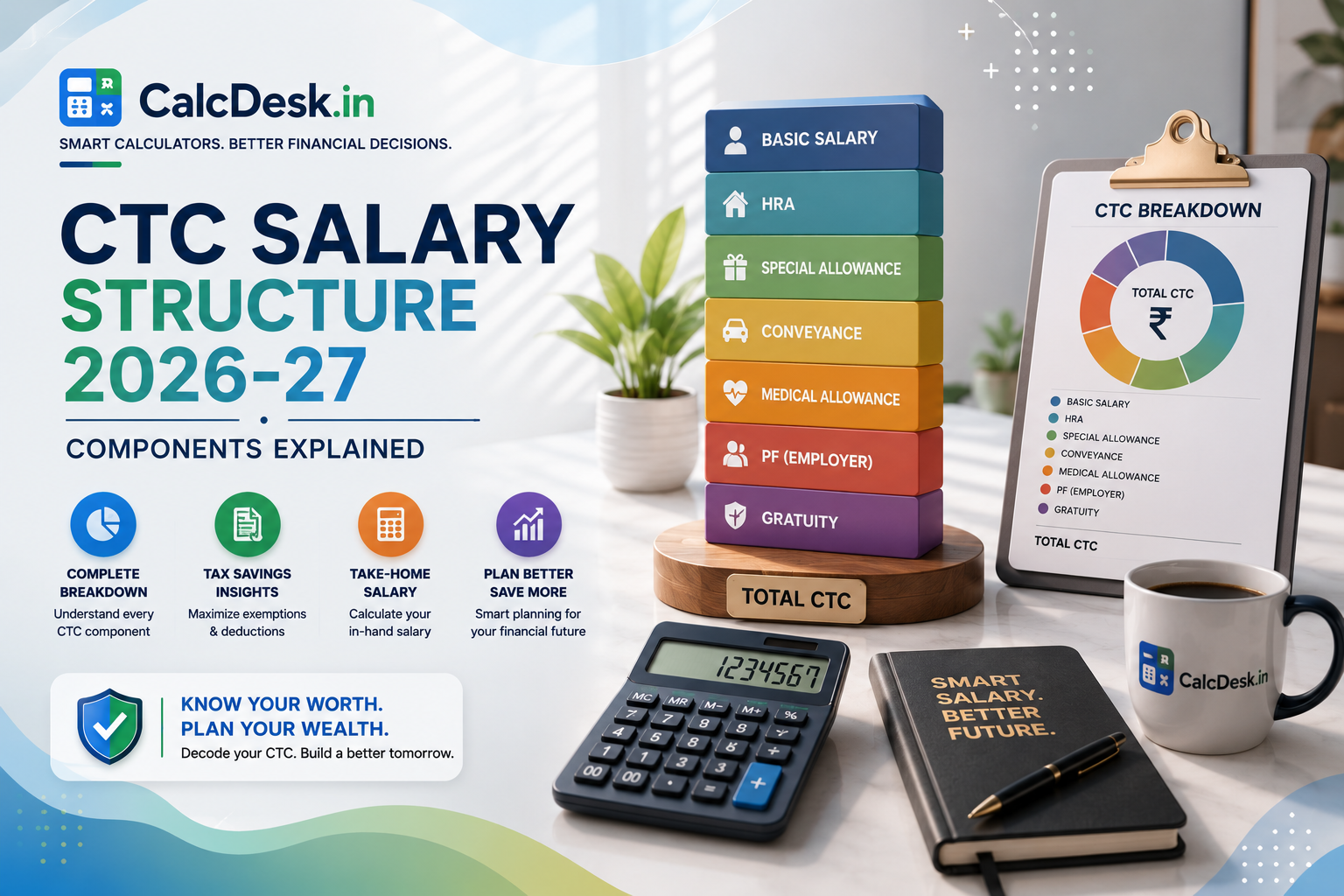
CTC Salary Structure 2026-27 — Every Component Explained
Your offer letter shows ₹18 lakh CTC, but you have no idea what that breaks down to until your first salary slip arrives — and even then, terms like “special allowance,” “gratuity provision,” and “employer PF” can be confusing. Understanding your CTC structure isn’t just academic: knowing which components are taxable, which are exempt, and how to negotiate the breakup can directly increase your take-home salary without your employer spending a rupee more.
This guide breaks down every standard CTC component, explains how each affects your take-home pay and tax liability, and shows you how to request a tax-efficient restructuring. Use CalcDesk’s Take-Home Salary Calculator to see your exact in-hand salary from any CTC structure.
Standard CTC Components — The Complete Breakdown
| Component | Typical % of CTC | Taxable? |
|---|---|---|
| Basic Salary | 40-50% | Fully taxable |
| House Rent Allowance (HRA) | 40-50% of Basic | Partially exempt (Old Regime, Sec 10(13A)) |
| Special Allowance | Balancing figure | Fully taxable |
| Leave Travel Allowance (LTA) | ~8-10% of basic | Exempt twice in 4-year block (Old Regime) |
| Employer PF Contribution | 12% of Basic | Not taxable to employee (employer cost) |
| Gratuity Provision | 4.81% of Basic | Not taxable until paid; then exempt up to ₹20L |
| Meal Vouchers/Coupons | Fixed, e.g. ₹2,200/month | Exempt up to ₹50/meal for working days |
| Employer NPS (80CCD(2)) | Up to 14% of Basic (New Regime) | Not taxable up to limit |
| Performance Bonus/Variable Pay | Varies (often 10-20%) | Fully taxable when paid |
Worked Example — Decoding an ₹18 Lakh CTC Offer
Complete breakup of a typical ₹18 lakh CTC package
| Component | Annual Amount |
|---|---|
| Basic Salary (45% of CTC) | ₹8,10,000 |
| HRA (45% of Basic) | ₹3,64,500 |
| Special Allowance | ₹4,67,652 |
| LTA | ₹54,000 |
| Employer PF (12% of Basic) | ₹97,200 |
| Gratuity Provision (4.81% of Basic) | ₹38,961 |
| Meal Vouchers | ₹26,400 |
| Health Insurance Premium | ₹41,287 |
| Total CTC | ₹18,00,000 |
Gross Salary (CTC minus employer PF, gratuity, insurance) = ₹16,22,552
This gross figure is what you’d see as your annual taxable salary before further employee-side deductions
Basic Salary — The Foundation Component
Basic salary forms the base for calculating several other components: HRA exemption (10(13A)), PF contribution (12% of basic), and gratuity (15/26 × basic per year). Companies typically structure basic between 40-50% of CTC.
📌 Higher basic isn’t always better: A higher basic increases PF and gratuity (good for long-term savings) but reduces take-home pay immediately due to higher PF deduction, and can push more of your HRA into the taxable zone if rent doesn’t proportionally increase. The optimal split depends on your priorities — immediate cash flow vs long-term forced savings.
HRA — House Rent Allowance
HRA is typically structured as a percentage of basic salary, usually 40-50%. Its tax treatment depends on actual rent paid and city of residence — read the complete HRA Exemption Guide for the exact calculation formula.
Special Allowance — The Flexible Component
Special allowance is usually the “balancing” component that makes up the difference between CTC and all other defined components. It is fully taxable with no exemptions, making it the least tax-efficient part of your salary. Many companies allow you to convert part of special allowance into tax-efficient perquisites through a Flexible Benefits Plan (FBP).
Tax-Efficient Components You Can Request
| Component | Tax Treatment | Typical Limit |
|---|---|---|
| Meal vouchers/coupons | Exempt | ₹50/meal × working days (≈₹26,400/year) |
| Telephone/Internet reimbursement | Exempt against bills | As per company policy |
| Books and periodicals | Exempt against bills | As per company policy |
| Leave Travel Allowance (LTA) | Exempt (twice in 4-yr block) | Actual travel cost (domestic) |
| Employer NPS contribution | Exempt up to limit | 14% of Basic (New Regime), 10% (Old Regime) |
| Car/driver reimbursement | Partially exempt | ₹1,800-2,400/month + driver ₹900/month |
Employer PF and Gratuity — The Hidden CTC Components
Employer PF contribution (12% of basic) and gratuity provision (4.81% of basic) are part of your CTC but you don’t receive them as monthly cash — they accumulate as retirement benefits. This is why your monthly in-hand salary is always noticeably less than CTC divided by 12. Read the EPF Guide and Gratuity Guide for full details on how these accumulate over your career.
How to Request a Better CTC Structure
- Ask for FBP options: Many companies allow restructuring special allowance into meal vouchers, telephone reimbursement, and other exempt categories
- Request employer NPS: If not already included, ask HR to add employer NPS contribution — this is tax-exempt and benefits both regimes
- Negotiate basic salary ratio: If you have a home loan or pay high rent, request higher basic for better HRA/Sec 24 exemption capacity (Old Regime) — though this also increases PF deduction
- Understand variable pay terms: Check if bonus/variable pay is guaranteed or performance-linked, and what percentage is typically achieved historically at the company
💡 Tip: When comparing job offers, never compare raw CTC numbers. A ₹20L CTC with poor structuring (low basic, high variable, no NPS) might give less take-home than an ₹18L CTC with efficient structuring. Always ask for the detailed breakup and calculate expected take-home before accepting an offer.
💼 Calculate Your Exact Take-Home Salary — Free
Enter your CTC structure and see your monthly in-hand salary with full breakdown.
→ Open Take-Home Salary CalculatorSalary Restructuring — Save ₹30,000 Tax Without Reducing CTC
Most employees accept their default salary structure without realising that restructuring allowances — at no cost to the employer — can save ₹20,000–₹40,000 in income tax annually. This works because certain allowances are exempt from tax under the Income Tax Act, unlike Special Allowance which is fully taxable. Here is a concrete worked example.
Worked Example — ₹18L CTC, currently all in Basic + HRA + Special Allowance
Step 1 — Add Meal Allowance (Sec 10(14)):
Amount: ₹2,200/month = ₹26,400/year. Fully exempt — no tax. Employer reduces Special Allowance by ₹26,400 (CTC unchanged). Tax saving at 30% slab: ₹26,400 × 30% = ₹7,920/year
Step 2 — Add Telephone/Internet Reimbursement:
Amount: ₹2,000/month = ₹24,000/year. Submit actual phone/internet bills to employer. Exempt against bills. Reduces Special Allowance. Tax saving at 30%: ₹7,200/year
Step 3 — Add Employer NPS Contribution under Sec 80CCD(2):
Employer contributes ₹50,000/year to NPS on employee’s behalf. This is over and above the ₹1.5L Sec 80C limit. Deductible for employee up to 10% of Basic Salary. Tax saving at 30%: ₹15,000/year
Total annual tax saving: ₹7,920 + ₹7,200 + ₹15,000 = ₹30,120
Take-home increase: ₹30,120 ÷ 12 = ₹2,510/month more in hand with same CTC
💡 How to request restructuring: Email your HR or payroll team and ask if a Flexible Benefits Plan (FBP) is available. If yes, choose meal allowance, telephone reimbursement, and request employer NPS contribution. If your company does not have an FBP, your HR may still accommodate individual restructuring requests — especially the NPS employer contribution, which is cost-neutral for the employer (it replaces an equal amount of taxable special allowance). Note: Meal and telephone allowances require submission of bills/receipts each month. NPS contribution reduces liquidity — funds are locked until age 60 — but builds a retirement corpus with excellent long-term returns.
Notice Period Pay and Full and Final Settlement — Tax Treatment
When an employee resigns, the full and final settlement (FnF) involves several components, each with different tax treatment. Many employees — and even payroll teams — get the tax treatment wrong, leading to either over-deduction of TDS or unexpected tax liabilities.
Full Scenario — Employee resigning after 6 years, Basic salary ₹70,000/month
1. Notice period pay-out (employer buys out notice): Taxable as salary. Added to that month’s gross income and full TDS deducted at applicable slab rate.
2. Notice period recovery (employee pays instead of serving): ₹70,000 deducted from last salary. This recovery is deductible — it reduces your taxable salary for that month. In practice, many payroll systems do not correctly reflect this deduction, leading to excess TDS. Verify your last salary slip and claim the deduction in ITR if over-deducted.
3. Leave encashment on resignation: Fully taxable as salary income. If 30 days leave accumulated: ₹70,000 × 30 ÷ 26 = ₹80,769. Fully taxable; TDS deducted at slab.
4. Leave encashment on retirement: Exempt up to ₹25 lakh for private sector employees (for central government employees: fully exempt). For private sector, least of: actual encashment | ₹25L | 10 months’ average basic | cash equivalent of leave balance. Tax planning tip: Do not encash leave when resigning — carry it to retirement when it becomes largely tax-free.
5. Gratuity in FnF (6 years of service): Formula: ₹70,000 × 15 × 6 ÷ 26 = ₹2,42,307. Exempt up to ₹20 lakh for private sector (easily within limit). Tax on this gratuity = ₹0.
6. FnF payment timeline: Employer must pay FnF within 30–45 days of last working day under the Payment of Gratuity Act and applicable Shops and Establishments Act. If delayed, you can approach the Labour Commissioner.
⚠️ Common FnF tax error — double standard deduction: In the year you change jobs, you receive two Form 16s (one from each employer). Each employer grants you the ₹75,000 standard deduction (New Regime) or ₹50,000 (Old Regime) independently. But you are entitled to only one standard deduction for the full year. If you submit both Form 16s in ITR-1 without adjustment, you will under-report taxable income. Your ITR must add both salaries together and claim only one standard deduction. The new employer should account for previous employer income if you submitted Form 12B — but verify in your final Form 16.
Frequently Asked Questions
Common CTC Misconceptions Debunked
CTC (Cost to Company) is one of the most misunderstood terms in Indian employment. Employers and employees frequently miscommunicate because each interprets CTC differently. Here are the five most common misconceptions, corrected:
- Myth: CTC = In-hand salary. Reality: In-hand salary is typically 60-75% of CTC after EPF contributions, professional tax, income tax TDS, gratuity provision, and insurance premiums. A ₹12L CTC often means ₹75,000-80,000/month in-hand, not ₹1 lakh.
- Myth: Variable pay is guaranteed. Reality: Variable/performance pay is conditional on individual and company performance. Never plan monthly expenses assuming 100% variable pay realisation. Base your financial planning on fixed CTC only.
- Myth: Higher CTC = higher tax. Reality: The components within CTC determine tax. A ₹12L CTC structured well (HRA, LTA, NPS, meal coupons) can have significantly lower tax than a poorly structured ₹10L CTC with no exemptions.
- Myth: Employer EPF contribution is take-home. Reality: 12% employer EPF (on basic) goes directly into your EPF account — accessible only at retirement or specific withdrawal conditions. It never enters your bank account as monthly income.
- Myth: Gratuity is annual income. Reality: Gratuity is paid only after 5 years of continuous service. It is provisioned annually in CTC but paid as a lump sum at exit or retirement.
How to Read Your Offer Letter — CTC Verification Checklist
Before accepting any job offer, verify these points in the offer letter:
- What percentage of CTC is fixed vs variable? (Request minimum 70% fixed for financial stability)
- Is employer EPF contribution within or above the CTC? (Some companies show it separately — clarify before accepting)
- What is the basic salary as a percentage of CTC? (Should be 40-50%; lower basic reduces PF, gratuity, and HRA calculations significantly)
- Is gratuity included in CTC or a separate benefit? (Many IT companies include it in CTC, reducing effective monthly take-home)
- Are health and term insurance premiums part of CTC or provided separately? (If in CTC, they reduce monthly cash in hand)
💡 Negotiation tip: When negotiating a job offer, always negotiate on fixed in-hand salary rather than total CTC. Ask HR for a detailed CTC breakup showing monthly take-home. A ₹15L CTC at Company A might yield ₹95,000/month in-hand while ₹14L CTC at Company B yields ₹1,02,000/month — purely due to structuring differences.