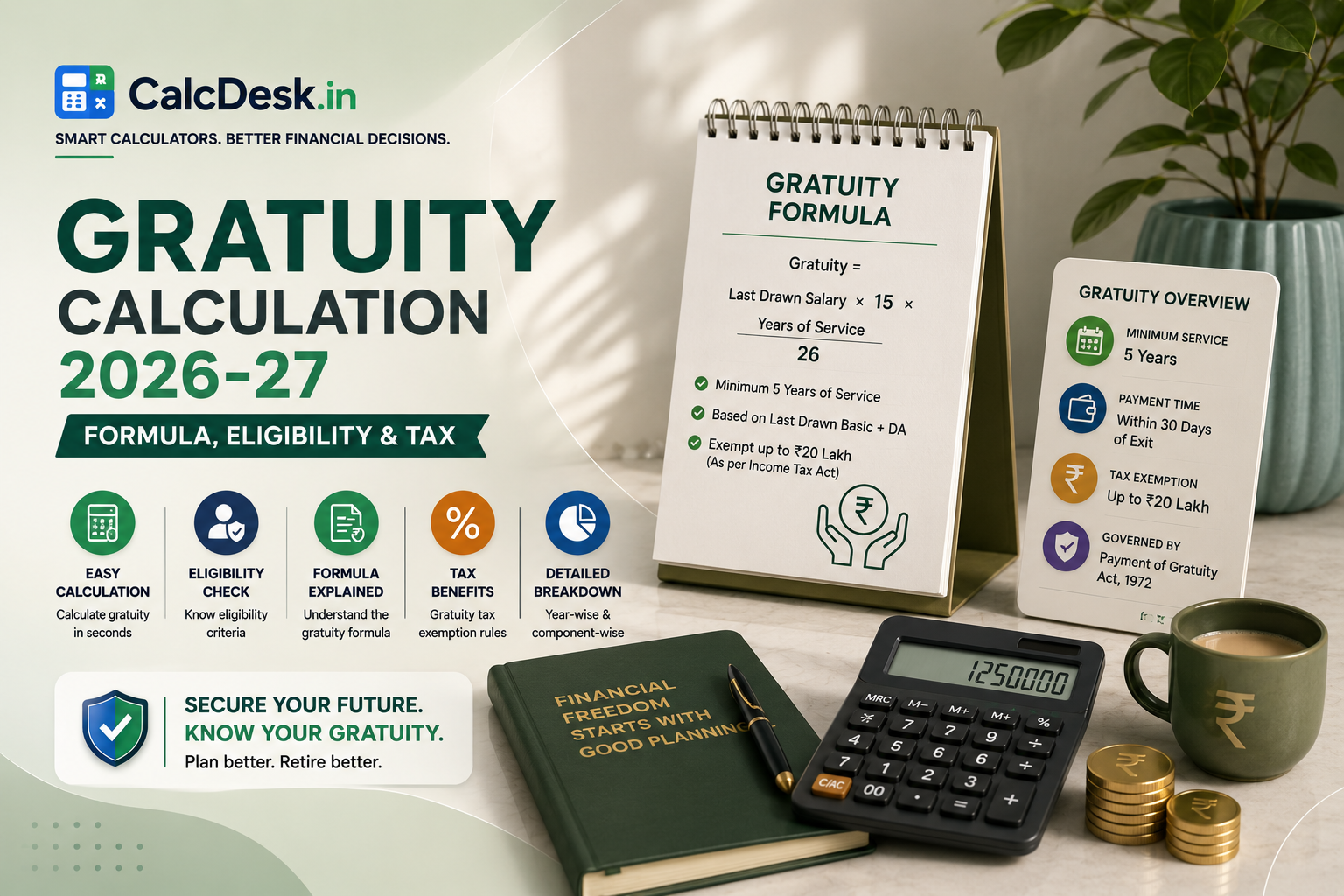
Gratuity Calculation 2026-27 — Formula, Eligibility & Tax
Gratuity is a lump-sum benefit your employer pays as a token of appreciation for your years of service — but it’s also a legal entitlement under the Payment of Gratuity Act 1972, not a discretionary bonus. After completing 5 years with the same employer, you become eligible for gratuity, and the amount can be substantial: an employee with ₹60,000 last drawn salary and 20 years of service is entitled to over ₹6.9 lakh. Yet many employees don’t track their gratuity accrual or understand how resignation timing can affect the final amount.
This guide covers the exact gratuity formula, the 5-year eligibility rule, the rounding rules for partial years, tax exemption limits, and worked examples across different salary and tenure combinations. Use CalcDesk’s free Gratuity Calculator to compute your exact entitlement.
What is Gratuity — Legal Basis
Gratuity is governed by the Payment of Gratuity Act 1972, applicable to establishments with 10 or more employees. It is a statutory benefit paid by the employer (not deducted from your salary) upon: retirement, resignation (after 5 years), death, or disablement due to accident or disease. Many companies also maintain a separate Gratuity Trust Fund or take a Group Gratuity insurance policy to fund this liability.
Gratuity Calculation Formula
Gratuity Formula (Covered Under the Act)
Where:
Last Drawn Salary = Basic Salary + Dearness Allowance (DA only)
Years of Service = Completed years (rounded as per 6-month rule)
26 = Working days in a month (Gratuity Act assumes 26 working days/month)
15 = 15 days’ wages per year of service
The 6-Month Rounding Rule
📌 Rounding rule: If your service period in the final year is 6 months or more, it rounds UP to the next full year. If less than 6 months, it rounds DOWN. Example: 12 years 7 months → rounds to 13 years. 12 years 5 months → rounds to 12 years. This makes a real difference — timing your exit just past the 6-month mark in your final year increases your gratuity.
Worked Example 1 — 10 Years Service, ₹50,000 Last Drawn Salary
Mid-career employee resignation
Last drawn salary (Basic + DA): ₹50,000/month
Years of service: 10 years (exact)
Gratuity = (15 × 50,000 × 10) ÷ 26
Gratuity = 75,00,000 ÷ 26
Gratuity = ₹2,88,461
Worked Example 2 — 20 Years Service, ₹80,000 Last Drawn Salary
Senior employee at retirement
Last drawn salary: ₹80,000/month
Years of service: 20 years
Gratuity = (15 × 80,000 × 20) ÷ 26 = 2,40,00,000 ÷ 26
Gratuity = ₹9,23,076
Capped at the statutory maximum of ₹20 lakh — this amount is well within the cap, so the full amount is payable and tax-exempt
Worked Example 3 — 15 Years 7 Months Service (Rounding Applied)
Demonstrating the 6-month rounding rule
Last drawn salary: ₹65,000/month
Actual service: 15 years 7 months → rounds UP to 16 years
Gratuity = (15 × 65,000 × 16) ÷ 26 = 1,56,00,000 ÷ 26
Gratuity = ₹6,00,000
If they had resigned 2 months earlier (15 years 5 months → rounds down to 15 years): Gratuity = (15 × 65,000 × 15) / 26 = ₹5,62,500 — a ₹37,500 difference from timing alone
Gratuity Tax Exemption Rules — FY 2026-27
| Employee Type | Tax Exemption Limit | Formula Cap |
|---|---|---|
| Government employees | Fully exempt | No upper limit |
| Private sector (covered under Act) | Up to ₹20 lakh | Lower of: ₹20L, actual gratuity, or 15-day formula |
| Private sector (not covered under Act) | Up to ₹20 lakh | Lower of: ₹20L, actual gratuity, or half-month average × years (÷30 formula) |
Gratuity for Employees NOT Covered Under the Act
Smaller establishments (fewer than 10 employees) may not be covered under the Payment of Gratuity Act, but can still pay gratuity voluntarily using a different formula:
Gratuity Formula (NOT Covered Under the Act)
Uses 30 days instead of 26, and 10-month average instead of last drawn salary
Eligibility Conditions
- Minimum 5 years continuous service with the same employer (waived in case of death or disablement)
- “Continuous service” includes authorised leave, sickness, legal strikes, and lockouts — but not unauthorised absence
- Applicable on resignation, retirement, retrenchment, death, or disablement
- Employer must pay within 30 days of it becoming payable, or pay interest on delayed payment
Common Gratuity Mistakes
- Calculating on gross salary instead of Basic + DA: Gratuity uses only basic and DA — not HRA, special allowance, or other components
- Not accounting for the 6-month rounding rule: Resigning a few weeks before the 6-month mark can mean losing an entire year’s worth of gratuity
- Assuming gratuity is paid before 5 years: Except for death/disablement, no gratuity is payable if you leave before completing 5 years
- Forgetting about the ₹20 lakh tax cap: For very senior employees with high salaries and long tenure, gratuity above ₹20 lakh becomes taxable as salary income
💡 Tip: If you’re nearing your 5-year mark or a year boundary and considering resignation, check your exact eligibility date carefully. Even waiting 2-3 extra weeks can mean the difference between zero gratuity and a substantial payout, or between one year’s worth of difference in calculation.
🎁 Calculate Your Gratuity — Free
Enter your last drawn salary and years of service. Get your exact gratuity entitlement instantly.
→ Open Gratuity CalculatorGratuity Ceiling — History and Current Status
The tax-free gratuity ceiling has been revised upward several times since the Payment of Gratuity Act came into force. Understanding its history helps senior employees know when and why gratuity above the ceiling becomes taxable.
📌 Ceiling history: Original (1972): ₹3.5 lakh. Revised 1997: ₹10 lakh. Revised 2018 (effective 29 March 2018): ₹20 lakh — current ceiling for FY 2026-27. The Code on Social Security 2020 (not yet fully implemented) proposed extending gratuity coverage to gig and platform workers but did not change the ₹20L ceiling. For central government employees, a separate set of rules under Central Civil Services (Pension) Rules applies — government gratuity is not subject to the ₹20L ceiling and can be higher.
High-Earner Scenario — Gratuity Above ₹20L Ceiling
Employee with Basic Salary: ₹1,50,000/month | Years of service: 25 years
Gratuity formula: (15 × 1,50,000 × 25) / 26 = ₹56,25,00,000 / 26 = ₹21,63,461
Tax-exempt portion (ceiling): ₹20,00,000
Taxable portion: ₹21,63,461 − ₹20,00,000 = ₹1,63,461 — taxable as salary income
At 30% bracket + cess: ₹1,63,461 × 31.2% = ₹51,000 approximate tax on the excess
Net gratuity received after tax: ₹21,63,461 − ₹51,000 = ₹21,12,461
Gratuity in CTC — How Employers Calculate the Provision
Employer Gratuity Provision — The 4.81% Formula
Derivation: (Basic × 15 / 26 / 12) / Basic = 15/(26×12) = 0.04808 ≈ 4.81%
Example: Basic = ₹50,000/month
Monthly provision = ₹50,000 × 4.81% = ₹2,404/month
Annual provision shown in CTC = ₹2,404 × 12 = ₹28,846/year
CTC Gratuity vs Actual Payout — When They Match and When They Don’t
After 10 years (Basic constant at ₹50,000 throughout): CTC accumulated = ₹28,846 × 10 = ₹2,88,460. Actual payout = (15 × 50,000 × 10) / 26 = ₹2,88,461. They match exactly — the 4.81% derivation is designed to align at any year mark when basic is held constant.
After 20 years (Basic constant at ₹50,000): CTC accumulated = ₹28,846 × 20 = ₹5,76,920. Actual payout = (15 × 50,000 × 20) / 26 = ₹5,76,923. Again, they match closely.
The catch — if you leave before 5 years: ₹28,846/year appears in your CTC as gratuity. Over 4 years, that’s ₹1,15,384 shown in CTC statements. Actual gratuity received: ₹0. The provision is a deferred benefit that only crystallises at 5 years. Never count CTC gratuity as real take-home income until you have crossed the 5-year threshold with the same employer.
The catch — basic salary growth: In practice, basic salary grows each year. If basic rises from ₹50,000 to ₹80,000 over 20 years, the actual gratuity payout is based on ₹80,000 (last drawn) — significantly higher than the CTC provision calculated on earlier lower basics.
Gratuity Claim Process — Step by Step
Knowing the legal process protects you if an employer delays or disputes your gratuity. The Payment of Gratuity Act has a clear timeline with penalties for non-compliance.
- Employee submits Form I (Application for Gratuity) to the employer within 30 days of becoming eligible — on resignation, retirement, or upon completing 5 years. On death or disablement: nominee/legal heir submits Form J.
- Employer must determine the gratuity amount within 15 days of receiving the application and send a notice in Form L (acceptance with amount) or Form M (rejection with written reason).
- Payment deadline: Employer must pay within 30 days of the date gratuity becomes payable. If the date is disputed, the undisputed amount must still be paid within 30 days.
- Interest on delay: If the employer fails to pay within 30 days without sufficient cause, interest accrues at 10% per annum on the delayed amount from the due date to the payment date.
- Dispute resolution: If the employer wrongfully refuses or underpays, file an application to the Controlling Authority — typically the Assistant Labour Commissioner or Deputy Labour Commissioner of your district. The Authority has powers to determine the correct gratuity amount and direct the employer to pay with applicable interest.
- Appeal process: An appeal against the Controlling Authority’s order can be filed with the Appellate Authority within 60 days. Further appeal lies with the High Court.
💡 Register your nominee early: File Form F (Nomination Form) with your employer at joining and update it after marriage or any change in family status. An up-to-date nominee registration prevents delays in gratuity payment to your family if anything happens to you. The nomination is separate from EPF nomination — you need to file both.
⚠️ If you receive a Form M (rejection): Request a copy of the written reason and escalate immediately to the Labour Commissioner. Common grounds for rejection — “not covered under the Act” (check if your establishment has 10+ employees) or “tenure dispute” — are often factually incorrect. Keep all employment records, appointment letters, and salary slips to establish continuous service.