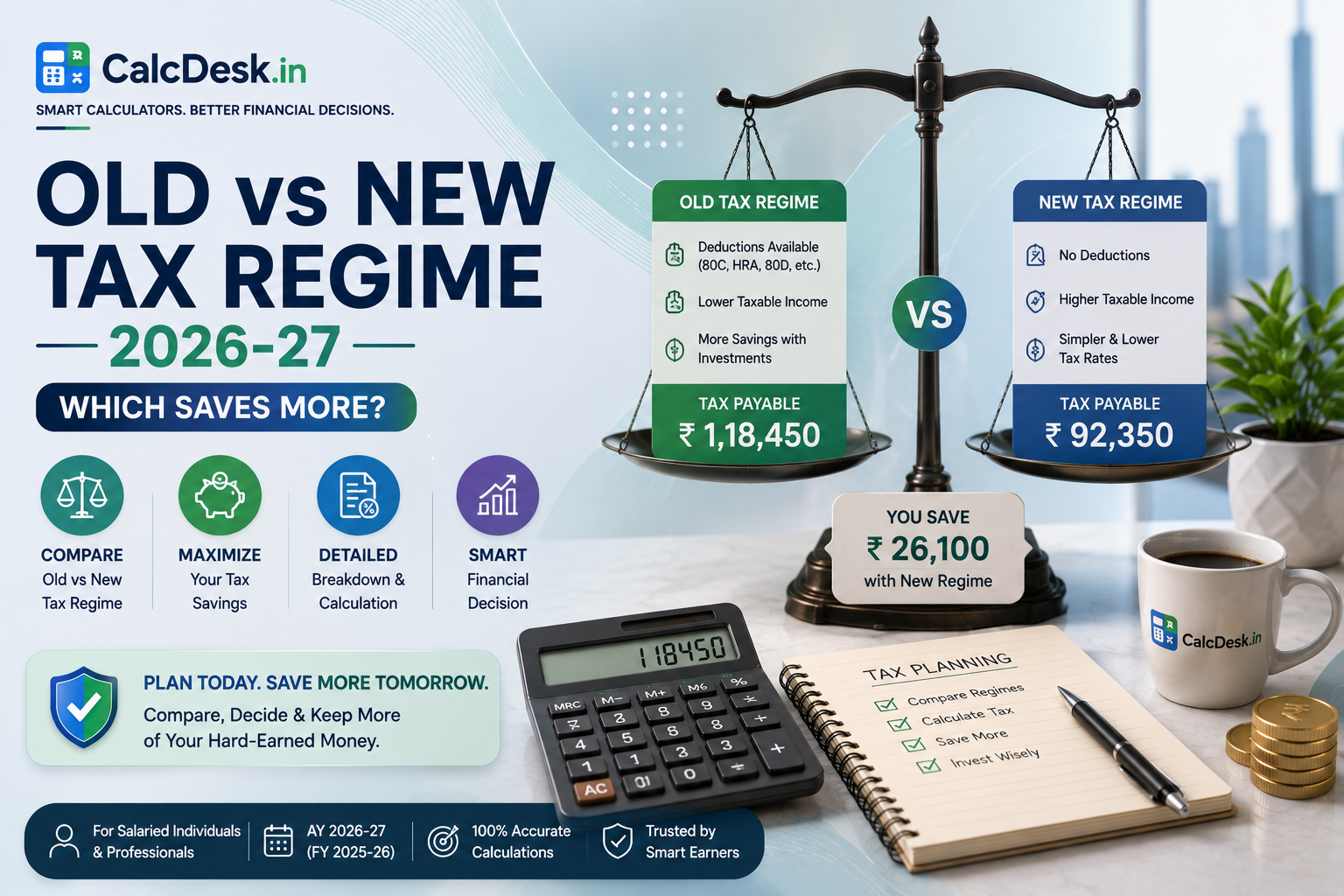
Old vs New Tax Regime 2026-27 — Which Saves More Tax?
The single most important financial decision for every salaried Indian in FY 2026-27 is choosing between the Old Tax Regime and the New Tax Regime. A wrong choice can cost you anywhere from ₹10,000 to over ₹1,00,000 in extra tax — paid for no reason. With the New Regime now the default under the Income Tax Act 1961, millions of taxpayers are losing money simply because they never did the math. This guide does that math for you, across six income levels, with every deduction scenario accounted for.
You’ll find the complete tax slabs for both regimes, a break-even deduction analysis, three detailed worked examples, a regime-selection checklist, and a direct link to CalcDesk’s free Income Tax Calculator so you can verify your own numbers instantly.
Old vs New Tax Regime — Key Differences at a Glance
The Old Regime offers more deductions and exemptions but has higher tax rates. The New Regime offers lower tax rates but removes most deductions. Here’s the complete comparison for FY 2026-27:
| Feature | Old Regime | New Regime (Default) |
|---|---|---|
| Standard Deduction (Salaried) | ₹50,000 | ₹75,000 |
| HRA Exemption (Sec 10(13A)) | ✅ Available | ❌ Not available |
| LTA Exemption (Sec 10(5)) | ✅ Available | ❌ Not available |
| Sec 80C (PF, PPF, ELSS, LIC) | ✅ Up to ₹1,50,000 | ❌ Not available |
| Home Loan Interest Sec 24(b) | ✅ Up to ₹2,00,000 | ❌ Not available |
| Sec 80D (Health Insurance) | ✅ Up to ₹50,000+ | ❌ Not available |
| NPS Sec 80CCD(1B) | ✅ ₹50,000 extra | ❌ Not available |
| Employer NPS Sec 80CCD(2) | ✅ Up to 10% of Basic | ✅ Up to 14% of Basic |
| Zero Tax Threshold (with rebate) | ₹5 lakh | ₹12 lakh |
| Sec 87A Rebate | ₹12,500 (if income ≤ ₹5L) | ₹60,000 (if income ≤ ₹12L) |
| Default Regime from FY 2024-25 | Must opt in explicitly | Default (no action needed) |
| Surcharge Cap for High Income | 37% (income above ₹5 Cr) | 25% cap (all income levels) |
New Regime Tax Slabs FY 2026-27
The New Regime has more granular slabs designed to benefit the middle class. These slabs apply to taxable income after the standard deduction of ₹75,000:
| Taxable Income Range | Tax Rate | Tax on This Slab |
|---|---|---|
| Up to ₹4,00,000 | Nil | ₹0 |
| ₹4,00,001 – ₹8,00,000 | 5% | Up to ₹20,000 |
| ₹8,00,001 – ₹12,00,000 | 10% | Up to ₹40,000 |
| ₹12,00,001 – ₹16,00,000 | 15% | Up to ₹60,000 |
| ₹16,00,001 – ₹20,00,000 | 20% | Up to ₹80,000 |
| ₹20,00,001 – ₹24,00,000 | 25% | Up to ₹1,00,000 |
| Above ₹24,00,000 | 30% | — |
Important: Add 4% Health and Education Cess on the total tax amount. Sec 87A rebate eliminates tax entirely if taxable income ≤ ₹12 lakh (effectively zero tax up to ₹12.75 lakh gross after ₹75,000 standard deduction).
Old Regime Tax Slabs FY 2026-27
The Old Regime has been unchanged for several years. Its slabs are simpler but the rates at the middle level are significantly higher than the New Regime:
| Taxable Income Range | Tax Rate | Tax on This Slab |
|---|---|---|
| Up to ₹2,50,000 | Nil | ₹0 |
| ₹2,50,001 – ₹5,00,000 | 5% | Up to ₹12,500 |
| ₹5,00,001 – ₹10,00,000 | 20% | Up to ₹1,00,000 |
| Above ₹10,00,000 | 30% | — |
Important: Add 4% Health and Education Cess. Sec 87A rebate of ₹12,500 applies if taxable income ≤ ₹5 lakh. Standard deduction is ₹50,000. All major deductions (80C, HRA, 80D, home loan interest) are available.
Break-Even Deduction Analysis — When Does Old Regime Win?
The question is not “which regime is better?” — it’s “are your deductions big enough for Old Regime to beat New Regime?” Here’s the break-even deduction threshold across income levels:
| Gross Income | New Regime Tax* | Old Regime Tax (zero deductions)* | Break-Even Deduction |
|---|---|---|---|
| ₹8,00,000 | ₹0 (rebate) | ₹46,800 | Old Regime never wins |
| ₹10,00,000 | ₹20,800 | ₹1,04,000 | ~₹3,25,000 |
| ₹12,00,000 | ₹0 (rebate) | ₹1,56,000 | Old Regime rarely wins |
| ₹15,00,000 | ₹1,09,200 | ₹2,34,000 | ~₹3,75,000 |
| ₹20,00,000 | ₹2,34,000 | ₹4,06,200 | ~₹5,00,000 |
| ₹30,00,000 | ₹5,46,000 | ₹7,54,200 | ~₹6,50,000 |
| ₹50,00,000 | ₹11,70,000 | ₹14,04,000 | ~₹7,00,000 |
*Tax figures include 4% cess, calculated after standard deduction only. Old Regime column shows tax with only standard deduction and no other deductions.
💡 Key insight: For income up to ₹12 lakh, the New Regime’s Sec 87A rebate makes tax zero — the Old Regime cannot compete regardless of deductions. For higher incomes, you need substantial deductions for the Old Regime to win.
Worked Example 1 — ₹10 Lakh Salary, Moderate Deductions
Profile: IT professional, ₹10L CTC, pays rent, basic investments
Income: ₹10,00,000 gross salary
Old Regime Calculation:
| Deduction | Amount |
|---|---|
| Standard Deduction | ₹50,000 |
| HRA Exemption (₹15,000/month rent, non-metro) | ₹72,000 |
| Sec 80C (PF + ELSS) | ₹1,50,000 |
| Sec 80D (health insurance) | ₹25,000 |
| Total Deductions | ₹2,97,000 |
| Taxable Income | ₹7,03,000 |
| Old Regime Tax + Cess | ₹46,736 |
New Regime Calculation:
Taxable income = ₹10,00,000 − ₹75,000 = ₹9,25,000
Tax: ₹20,000 (5% on ₹4L–₹8L) + ₹12,500 (10% on ₹8L–₹9.25L) = ₹32,500
Add 4% cess: ₹33,800
✅ New Regime saves ₹12,936 here
Worked Example 2 — ₹15 Lakh Salary, High Deductions
Profile: Senior manager, ₹15L CTC, metro city, home loan, full investments
Income: ₹15,00,000 gross salary
Old Regime Calculation:
| Deduction | Amount |
|---|---|
| Standard Deduction | ₹50,000 |
| HRA Exemption (₹25,000/month rent, metro) | ₹1,80,000 |
| Sec 80C (PF + ELSS + PPF) | ₹1,50,000 |
| Sec 80CCD(1B) — NPS | ₹50,000 |
| Home Loan Interest Sec 24(b) | ₹1,80,000 |
| Sec 80D (health insurance, self + parents) | ₹50,000 |
| Total Deductions | ₹6,60,000 |
| Taxable Income | ₹8,40,000 |
| Old Regime Tax + Cess | ₹78,000 |
New Regime: Taxable = ₹15L − ₹75K = ₹14.25L → Tax = ₹1,57,500 + 4% cess = ₹1,63,800
✅ Old Regime saves ₹85,800 here — a clear winner
Worked Example 3 — ₹30 Lakh Income, High Earner
Profile: Senior professional, ₹30L income, maximum deductions
Income: ₹30,00,000
Old Regime with full deductions:
| Deduction | Amount |
|---|---|
| Standard Deduction | ₹50,000 |
| HRA Exemption | ₹2,40,000 |
| Sec 80C | ₹1,50,000 |
| NPS 80CCD(1B) | ₹50,000 |
| Home Loan Interest 24(b) | ₹2,00,000 |
| 80D (self + parents) | ₹75,000 |
| Total Deductions | ₹7,65,000 |
| Taxable Income | ₹22,35,000 |
| Old Regime Tax + Cess | ₹5,18,856 |
New Regime: Taxable = ₹30L − ₹75K = ₹29.25L → Tax ≈ ₹6,14,400 + cess = ₹6,38,976
✅ Old Regime saves ₹1,20,120 here — significant advantage
When to Choose the New Regime
The New Regime is the better choice in these scenarios:
- Income up to ₹12.75 lakh: Zero tax under New Regime — no deduction in Old Regime can match this
- No significant HRA: If you live in your own house or employer provides accommodation, you lose HRA — New Regime is likely better
- No home loan: Without the ₹2 lakh interest deduction, Old Regime loses a major advantage
- Minimal 80C investments: If you don’t invest in PF, PPF, or ELSS actively, New Regime is better
- Very high income (₹50L+) with limited deductions: New Regime’s 25% surcharge cap can save substantial amounts for very high earners
- Self-employed or business income with low allowable expenses: New Regime often works better
When to Choose the Old Regime
The Old Regime wins when you have substantial, real deductions — not just hypothetical ones:
- Metro city employees paying high rent: HRA exemption of ₹1.5–2.5 lakh annually is a powerful deduction
- Home loan holders: ₹2 lakh interest deduction per year gives a significant advantage
- Full 80C utilisation: If you’re already maximising PF, ELSS, PPF, and LIC — ₹1.5L deduction is guaranteed
- NPS investors: Additional ₹50,000 via Sec 80CCD(1B) on top of 80C
- Health insurance payers: ₹25,000 self + ₹25,000 parents = ₹50,000 under 80D
- Combination of the above: Total deductions of ₹4–7 lakh are achievable and make Old Regime clearly superior
Common Mistakes When Choosing Between Regimes
- Not informing employer in time: If you don’t tell HR before April, TDS is deducted under New Regime by default. You can claim refund at ITR filing, but it creates cash flow issues.
- Forgetting employer NPS contribution: Sec 80CCD(2) — your employer’s NPS contribution — is available in both regimes. This is a free benefit that doesn’t need a regime decision.
- Counting gross HRA as the full exemption: HRA exemption is the minimum of three amounts. If your rent is modest, actual exemption may be far lower than you think.
- Assuming Old Regime is always better for home loan holders: If your home loan is in early years and interest is ₹3–4L but the deduction cap is ₹2L, the extra interest gives no benefit. New Regime may still win.
- Not reviewing annually: As your income grows or deductions change (loan closes, rent changes), the better regime can flip. Review every April.
Tax Optimisation Tips for FY 2026-27
💡 Tip 1 — Use employer NPS regardless of regime: If your employer offers NPS contribution under Sec 80CCD(2), restructure your CTC to maximise this. It’s allowed in both regimes and reduces taxable income by up to 14% of basic in the New Regime.
💡 Tip 2 — For income exactly at ₹12–₹13L: Try to bring taxable income to ₹12L or below under New Regime (via voluntary PF, NPS) to get the full Sec 87A rebate — zero tax instead of paying 15% slab tax on the ₹12–₹13L portion.
💡 Tip 3 — Salaried vs pensioners differ: Pensioners get standard deduction of ₹75,000 under New Regime and ₹50,000 under Old Regime. Family pensioners get ₹15,000 under both. If your pension income is around ₹12L or below and you have modest deductions, New Regime is excellent.
💡 Tip 4 — HRA for rented accommodation even in your own city: If you pay rent to a parent (not spouse) and they’re in a lower income bracket, HRA + Section 80GG deduction can be beneficial. This only works in Old Regime.
Regime Selection Checklist
Answer these questions to guide your decision:
- YES → Is your gross income ≤ ₹12.75L? Choose New Regime — zero tax
- YES → Do you pay metro rent ≥ ₹20,000/month? HRA benefit strongly favours Old Regime
- YES → Do you have an active home loan with ≥ ₹1.5L annual interest? Lean towards Old Regime
- YES → Are you maxing 80C (₹1.5L) + NPS (₹50K) + 80D (₹25K+)? Old Regime almost certainly better above ₹12L
- NO → Are you not paying rent or have minimal deductions? New Regime is likely better
- NO → Does your employer not offer NPS and you have no home loan? New Regime is likely better
⚠️ Deadline alert: Inform your employer of your regime choice at the start of the financial year (April). After TDS is deducted under one regime, switching requires filing ITR and claiming refund — money is blocked until then.
🧮 Calculate Your Tax Under Both Regimes — Free
Enter your income, HRA, deductions, and rent. See exact tax for Old and New Regime side by side in seconds.
→ Open Income Tax CalculatorAlso check out the HRA Exemption Calculator to find your exact HRA exemption amount, and the Take-Home Salary Calculator to see your net salary after taxes under both regimes.
For more context on the Union Budget changes that shaped these regimes, read the Budget 2025 Key Tax Changes guide and the detailed Income Tax Slabs 2026-27 article.
1 thought on “Old vs New Tax Regime 2026-27 — Which Saves More? | CalcDesk.in”