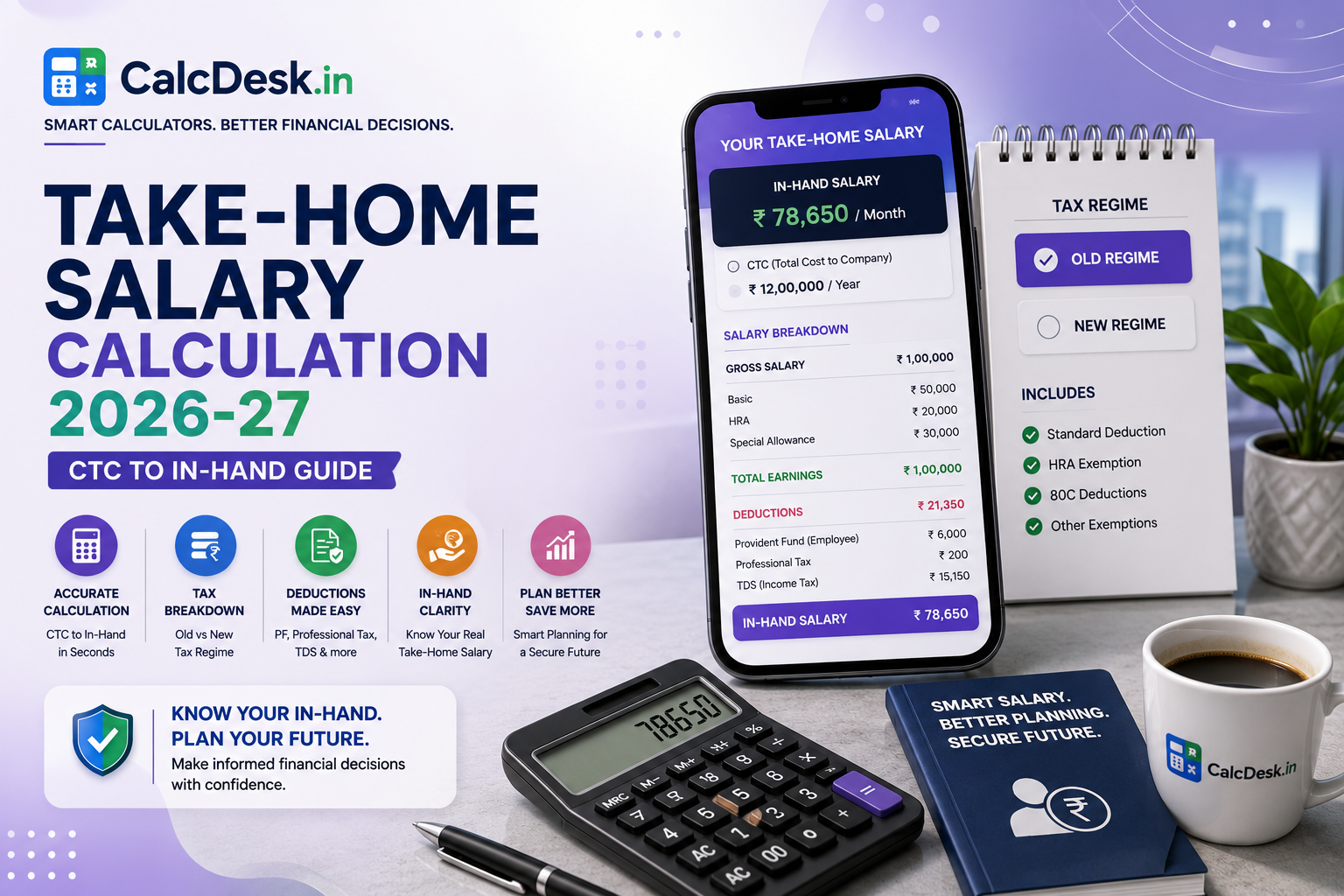
Take-Home Salary Calculation 2026-27 — From CTC to In-Hand
You accepted a ₹12 lakh CTC offer — but when your first salary credit hits, it’s ₹80,000, not ₹1 lakh. Where did ₹20,000 go? This is the gap between CTC and take-home salary that surprises most employees joining their first job or switching companies. Understanding exactly which deductions happen, and how to legally minimise them, can put thousands more in your pocket every month.
This guide walks through the complete CTC-to-take-home calculation for FY 2026-27 with worked examples at ₹6 lakh, ₹12 lakh, and ₹20 lakh CTC levels — comparing Old and New Tax Regime outcomes. Use CalcDesk’s free Take-Home Salary Calculator to compute your exact monthly in-hand figure.
CTC vs Gross Salary vs Net Salary — The Definitions
These three terms are often confused. Here’s how they differ:
| Term | What It Includes | Who Sees This |
|---|---|---|
| CTC (Cost to Company) | Everything the company spends on you: gross salary + employer PF + gratuity provision + health insurance premium + any other benefits | Offer letter, HR system |
| Gross Salary | CTC minus employer contributions (employer PF, gratuity provision). What you actually earn before employee deductions | Salary slip header |
| Net / Take-Home Salary | Gross salary minus employee deductions (employee PF, professional tax, income tax TDS, other deductions) | Bank credit, salary slip bottom |
The CTC to Take-Home Formula
Take-Home Salary Calculation — Step by Step
− Employer PF (12% of Basic, max ₹1,800/month)
− Employer ESI (if applicable: 3.25% of gross, if gross ≤ ₹21,000/month)
− Gratuity provision (4.81% of Basic annually)
= GROSS SALARY
GROSS SALARY
− Employee PF (12% of Basic, max ₹1,800/month)
− Employee ESI (if applicable: 0.75% of gross)
− Professional Tax (₹200/month in most states)
− Income Tax TDS (monthly instalment)
− Other deductions (NPS, health insurance, loan EMI if any)
= NET TAKE-HOME SALARY
Worked Example 1 — ₹8 Lakh CTC (New Regime)
Entry-level IT employee, Bengaluru
Note: Zero tax because gross (₹7.46L) after ₹75K standard deduction = ₹6.71L taxable — well below ₹12L threshold. Full Sec 87A rebate applies.
Worked Example 2 — ₹15 Lakh CTC, New vs Old Regime
Mid-level professional, Mumbai, comparing regimes
Salary Structure Assumed:
| Component | Annual | Monthly |
|---|---|---|
| Basic | ₹6,00,000 | ₹50,000 |
| HRA | ₹3,00,000 | ₹25,000 |
| Special Allowance | ₹4,38,000 | ₹36,500 |
| Employer PF | ₹72,000 | ₹6,000 |
| Gratuity | ₹28,860 | ₹2,405 |
| CTC Total | ₹15,00,000 | ₹1,25,000 |
New Regime: Taxable income ≈ ₹13.62L (after ₹75K std deduction). Tax ≈ ₹97,500. Monthly TDS ≈ ₹8,125
Monthly take-home (New Regime): Gross (₹13.38L/12=₹1,11,500) − PF ₹6,000 − PT ₹200 − TDS ₹8,125 = ≈ ₹97,175/month
Old Regime (with HRA ₹1.8L, 80C ₹1.5L, 80D ₹25K): Tax ≈ ₹68,120. Monthly TDS ≈ ₹5,677
Monthly take-home (Old Regime): ≈ ₹99,623/month — ₹2,448/month more
Worked Example 3 — ₹25 Lakh CTC, Senior Professional
Senior manager, Delhi, home loan + full deductions
Basic: ₹10L | HRA: ₹5L | Special allowance: ₹7L | Employer PF: ₹1.2L | Gratuity: ₹0.48L = ₹25L CTC
Gross: ₹23.32L | Monthly gross: ₹1,94,333
New Regime TDS: Taxable ≈ ₹22.57L → Tax + cess ≈ ₹4,08,000 → Monthly TDS ≈ ₹34,000
Old Regime (deductions: HRA ₹2.4L, 80C ₹1.5L, home loan ₹2L, NPS ₹50K, 80D ₹50K = ₹6.9L):
Taxable ≈ ₹16.42L → Tax + cess ≈ ₹2,74,000 → Monthly TDS ≈ ₹22,833
New Regime take-home: ₹1,94,333 − ₹10,000 PF − ₹200 PT − ₹34,000 TDS = ≈ ₹1,50,133/month
Old Regime take-home: ₹1,94,333 − ₹10,000 − ₹200 − ₹22,833 = ≈ ₹1,61,300/month
Old Regime gives ₹11,167/month more = ₹1,34,004 extra per year
Quick Reference — Approximate Monthly Take-Home at Various CTC Levels
| Annual CTC | New Regime In-Hand/Month | Old Regime In-Hand/Month* |
|---|---|---|
| ₹5,00,000 | ~₹36,500 | ~₹37,500 |
| ₹8,00,000 | ~₹55,500 | ~₹56,000 |
| ₹12,00,000 | ~₹85,000 | ~₹85,500 |
| ₹15,00,000 | ~₹97,200 | ~₹99,600 |
| ₹20,00,000 | ~₹1,28,000 | ~₹1,36,000 |
| ₹25,00,000 | ~₹1,50,100 | ~₹1,61,300 |
| ₹30,00,000 | ~₹1,72,000 | ~₹1,88,000 |
*Old Regime assumes reasonable deductions (HRA, 80C, 80D). Exact figures depend on salary structure, city, PF basis, and actual deductions. Use the calculator for precision.
Deductions Explained — What Comes Out of Your Salary
Employee Provident Fund (EPF)
Under the EPF Act 1952, both employee and employer contribute 12% of basic salary + DA. Contribution is capped if basic exceeds ₹15,000/month — in that case, statutory minimum contribution = 12% × ₹15,000 = ₹1,800/month (though most companies contribute on full basic). Read the full EPF Calculation Guide for complete rules.
Professional Tax
Professional Tax is a state-level tax deducted from salary. Not all states levy it. Monthly PT in major states:
| State | Monthly PT (approx) |
|---|---|
| Maharashtra, Karnataka, Andhra Pradesh, Tamil Nadu | ₹200/month (₹2,400/year) |
| West Bengal | Up to ₹200/month based on slab |
| Gujarat, Rajasthan, Uttar Pradesh, Delhi | Nil (no PT) |
Income Tax TDS
Your employer calculates your projected annual tax at the start of the year and divides by 12 to deduct monthly TDS. Under the New Regime, this is straightforward. Under the Old Regime, you must submit investment proofs (rent receipts, insurance premiums, etc.) to your employer for correct TDS computation. The TDS Guide explains this in detail.
How to Maximise Your Take-Home Salary Legally
- Restructure CTC to include allowances: Replace a portion of special allowance with meal allowance (₹50/meal × working days, tax-free), telephone reimbursement, or books and periodicals allowance — these have tax exemptions
- Choose the right tax regime: New Regime for income up to ₹12.75L; Old Regime if deductions are ≥ ₹3.75L for ₹15L+ income
- Maximise employer NPS contribution: Request HR to add employer NPS contribution (Sec 80CCD(2)) — available in both regimes, reduces taxable income without extra cost to you
- Voluntary PF contribution: Reduces taxable income but reduces take-home; only beneficial if in 30% tax bracket
- Submit proofs on time: Late submission means employer withholds extra TDS which you recover only via ITR refund months later
💼 Calculate Your Take-Home Salary — Free
Enter your CTC, salary structure, city, and tax regime. Get exact monthly in-hand salary with full breakdown.
→ Open Take-Home Salary Calculator