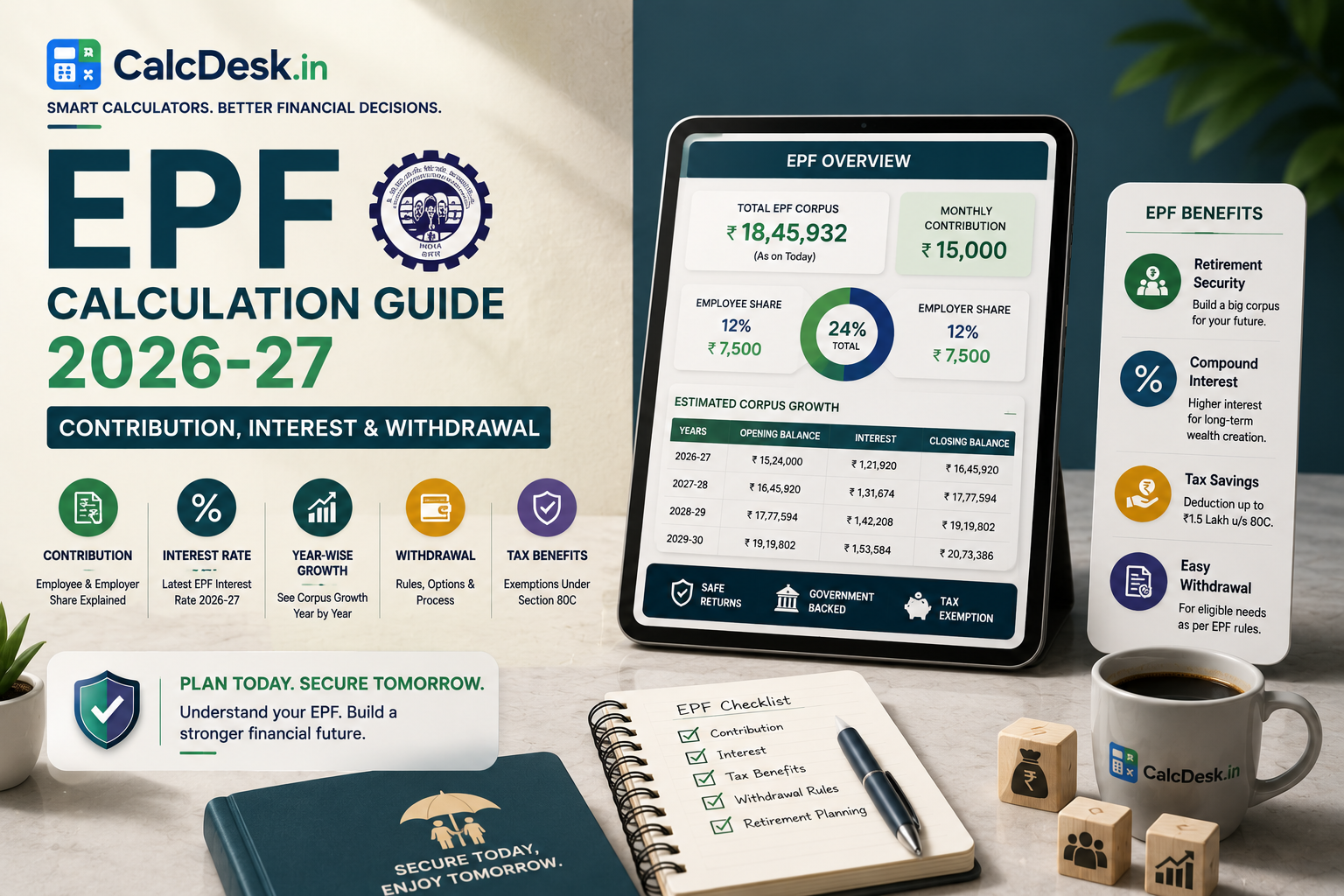
EPF Calculation Guide 2026-27 — Contribution, Interest & Withdrawal
Every salaried employee in an organisation with 20 or more employees sees “PF” deducted from their salary slip every month — but few understand exactly how this builds into a retirement corpus over decades. EPF (Employees’ Provident Fund), governed by the EPF Act 1952 and administered by EPFO, is one of the most reliable forced-savings mechanisms in India, combining employee contribution, employer contribution, and a separate pension scheme into one retirement package.
This guide explains the contribution structure, current interest rate, maturity calculation with examples, withdrawal rules, the 5-year tax-free condition, and the EPS pension formula. Use CalcDesk’s free EPF Calculator to project your retirement corpus.
What is EPF — Legal Basis and Applicability
EPF is mandatory for establishments with 20 or more employees under the Employees’ Provident Funds and Miscellaneous Provisions Act 1952. It applies to employees earning basic + DA up to ₹15,000/month mandatorily; employees earning more can opt in with employer consent. Most IT and corporate companies enrol all employees regardless of salary.
EPF Contribution Structure — Where Your Money Goes
Monthly EPF Contribution Breakdown
Employer Contribution: 12% of (Basic + DA), split as:
→ 8.33% to EPS (Pension), capped at ₹1,250/month
→ 3.67% (or more, if 8.33% exceeds cap) to EPF
Total going to YOUR EPF account = Employee 12% + Employer 3.67%
Worked Example 1 — ₹25,000 Basic Salary
Monthly EPF contribution breakdown
Basic + DA: ₹25,000
Employee contribution (12%): ₹3,000 → fully to EPF
Employer EPS contribution: 8.33% of ₹15,000 (capped) = ₹1,250 → to EPS
Employer EPF contribution: ₹3,000 − ₹1,250 = ₹1,750 → to EPF
Total monthly EPF credit: ₹3,000 + ₹1,750 = ₹4,750
Annual EPF contribution: ₹57,000 (excluding interest)
Current EPF Interest Rate and Calculation
EPFO declares the interest rate annually. For FY 2024-25, the rate was 8.25% per annum. Interest is calculated monthly on the running balance but credited annually at financial year-end.
Worked Example 2 — 25-Year EPF Growth Projection
₹25,000 basic salary, growing 8% annually, 8.25% EPF interest
| Year | Approx Closing Balance |
|---|---|
| Year 5 | ₹3.41 lakh |
| Year 10 | ₹9.18 lakh |
| Year 15 | ₹19.87 lakh |
| Year 20 | ₹38.46 lakh |
| Year 25 | ₹70.12 lakh |
This assumes basic salary grows 8% annually and includes both employee + employer EPF (not EPS) contributions compounding at 8.25%.
EPF Withdrawal Rules
| Scenario | Withdrawal Allowed | Tax Treatment |
|---|---|---|
| Retirement (58 years) | Full withdrawal | Tax-free |
| Unemployed 2+ months | Full withdrawal | Tax-free if 5+ years service |
| Job switch | Transfer recommended (not withdrawal) | N/A — preserves continuity |
| Withdrawal before 5 years | Allowed but taxable | TDS 10% (PAN) / 20% (no PAN) if >₹50,000 |
| Medical emergency | Partial withdrawal | Tax-free |
| Home purchase/construction | Partial (after 5 years service) | Tax-free |
⚠️ The 5-year rule is critical: If you withdraw EPF before completing 5 years of continuous service (transfers count towards this), the entire withdrawal becomes taxable in the year of withdrawal. Always transfer your EPF to your new employer when switching jobs rather than withdrawing.
EPS — Employees’ Pension Scheme Explained
EPS Pension Formula
Pensionable Salary = Average of last 60 months’ basic+DA (capped at ₹15,000)
Pensionable Service = Years of service (minimum 10 years required)
EPS Pension Example — 25 years of service
Pensionable salary: ₹15,000 (capped) | Service: 25 years
Monthly Pension = (15,000 × 25) / 70 = ₹5,357/month
How to Check EPF Balance and UAN
- UMANG App: Link your UAN, view balance and passbook instantly
- EPFO Member Portal: unifiedportal-mem.epfindia.gov.in
- Missed Call: Give a missed call to 011-22901406 from registered mobile
- SMS: Send “EPFOHO UAN ENG” to 7738299899
EPF vs VPF — Voluntary Contribution
You can voluntarily contribute more than 12% through VPF (Voluntary Provident Fund), up to 100% of basic salary, earning the same EPF interest rate. This is one of the highest guaranteed, tax-free returns available — better than most FDs — making it attractive for those in higher tax brackets under the Old Regime. Read the NPS vs EPF comparison for a complete retirement planning analysis.
💡 Tip: Always link your UAN with Aadhaar and bank account for seamless online withdrawal and transfer. KYC-incomplete UAN accounts face delays of weeks during withdrawal processing.
💼 Calculate Your EPF Maturity — Free
Enter your basic salary, contribution rate, and years of service. See your projected EPF corpus at retirement.
→ Open EPF CalculatorEPF Interest Rate History (2015–2025)
EPFO’s Central Board of Trustees (CBT) declares the EPF interest rate annually, typically between February and April each year. The rate is based on the income earned by EPFO from its investments in government securities, bonds, and ETFs. Here is the declared rate for each financial year over the past decade:
| Financial Year | EPF Interest Rate |
|---|---|
| 2015-16 | 8.80% |
| 2016-17 | 8.65% |
| 2017-18 | 8.55% |
| 2018-19 | 8.65% |
| 2019-20 | 8.50% |
| 2020-21 | 8.50% |
| 2021-22 | 8.10% |
| 2022-23 | 8.15% |
| 2023-24 | 8.25% |
| 2024-25 | 8.25% |
The trend over this decade shows a gradual decline from the high of 8.8% in 2015-16 to a low of 8.1% in 2021-22, followed by a modest recovery to 8.25% in 2023-24 and 2024-25. This decline mirrors the broader fall in G-sec yields as India’s interest rate environment softened. Despite the dip, EPF at 8.25% still outperforms PPF (7.1%) and most bank fixed deposit rates (6.5-7.5%), which is why VPF (Voluntary Provident Fund) contributions remain attractive for salaried employees in higher tax brackets. The EPF interest rate declaration for FY 2026-27 is expected before the end of that financial year and is likely to be in the 8.1-8.25% range based on EPFO investment corpus performance.
EPFO Online Services — Your Complete UAN Guide
The Universal Account Number (UAN) is the single most important identifier for your EPF account throughout your working life. It stays the same across all employers and job changes, while your Member ID (PF number) changes with each new employer. Here is how to use every major EPFO online service efficiently:
Step 1 — Activate your UAN: Your employer generates and shares your UAN when you join. To activate it, visit unified.epfindia.gov.in → For Employees → Activate UAN. Enter your UAN, Aadhaar number, and registered mobile number. An OTP is sent to your Aadhaar-linked mobile. Once activated, you can access all EPFO member services. If your employer has not shared your UAN, ask your HR department — they are legally required to provide it.
Step 2 — Link Aadhaar (mandatory for withdrawal): EPFO mandates Aadhaar linking for all online withdrawals and transfers. Log in to the Member portal → KYC section → upload Aadhaar details. Your employer then approves the KYC digitally. Without approved Aadhaar KYC, online withdrawal claims will be rejected, and you will need to submit physical forms to the EPFO regional office instead.
Step 3 — Check your EPF passbook: Visit passbook.epfindia.gov.in with your UAN and password. The passbook shows every monthly contribution credit (employee and employer separately), the annual interest credit, and the running balance. Verify the passbook after every job change to confirm your previous employer’s contributions have been correctly transferred or closed.
Step 4 — Transfer EPF on job change: When you change jobs, do not withdraw your EPF. Instead, submit an online transfer request via the Member portal → One Member One EPF Account → Transfer Request. Enter your old Member ID and new Member ID. Your previous employer approves the transfer digitally. The transferred balance is credited to your new EPF account and continuity of service is maintained for pension eligibility and the 5-year tax-free withdrawal condition.
Step 5 — Raise a grievance: For unresolved issues (incorrect balance, employer not depositing contributions, withdrawal delays), use the EPFO grievance portal at epfigms.gov.in. Lodge a complaint with your UAN and EPF account number. EPFO is required to resolve registered grievances within a defined timeline.
Common UAN errors and fixes: (1) UAN not activated by employer — employer must activate the UAN before you can use it; follow up with HR. (2) Aadhaar-name mismatch — if your name on Aadhaar differs from EPF records (spelling variation, missing middle name), you need to submit a Joint Declaration Form (JDF) along with supporting documents to the EPFO regional office for correction. Name mismatch is the most common reason for withdrawal claim rejection. (3) Multiple UANs — if you have two UANs from different employers, report this to EPFO to have them merged; operating two UANs simultaneously is against EPFO rules.
EPF Withdrawal Tax Rules — When It’s Tax-Free and When It’s Not
The tax treatment of EPF withdrawal depends almost entirely on one condition: whether you have completed five years of continuous service. Understanding this rule correctly can save you a significant tax outgo on what may be a large accumulated corpus.
Five-Year Rule — Tax-Free vs Taxable Withdrawal
Tax-free withdrawal: If you withdraw EPF after completing 5 years of continuous service, the entire withdrawal amount — your employee contribution, employer contribution, and all accumulated interest — is completely tax-free. Importantly, “continuous service” counts across employers if you transferred your EPF each time rather than withdrawing it. So if you worked 2 years at Company A and 3 years at Company B, and transferred EPF from A to B, your combined 5 years qualifies for tax-free withdrawal from Company B’s EPF.
Taxable withdrawal (before 5 years): If you withdraw before completing 5 years of continuous service, the entire amount — including the employer’s contribution and all interest — is added to your taxable income in the year of withdrawal and taxed at your applicable income slab rate.
TDS on early withdrawal: If withdrawal exceeds ₹50,000 before 5 years of service and PAN is provided, EPFO deducts 10% TDS. If PAN is not provided, TDS is 30%. You can submit Form 15G (for individuals below 60 years with total income below the taxable limit) or Form 15H (for senior citizens) to avoid TDS if your total income does not exceed the taxable threshold — but the income remains technically taxable and must be disclosed in your return.
Exemptions even before 5 years: No tax applies even on early withdrawal if the reason is ill health of the member, discontinuance of the employer’s business, or any cause beyond the member’s control (as certified by the EPFO Commissioner).
Worked example: An employee with 3 years of service withdraws ₹4 lakh from EPF. TDS deducted by EPFO: ₹40,000 (10% of ₹4 lakh). The ₹4 lakh is added to salary income. If the employee is in the 20% slab, total tax on this ₹4 lakh = ₹80,000, with ₹40,000 already deducted as TDS and ₹40,000 payable at the time of return filing.
EPF Death Claim — Process for Nominees
Who can claim: The registered nominee receives the EPF balance directly on the member’s death. If no nominee is registered, legal heirs can claim, but will require a succession certificate or legal heir certificate from a competent court, which significantly delays settlement. Register your nominee on the UAN portal immediately after joining — it takes 5 minutes and could save your family months of legal proceedings.
Documents required for death claim: The nominee must submit Form 20 (EPF death withdrawal claim), the member’s death certificate (original or attested copy), the nominee’s Aadhaar and bank account details (linked to UAN if possible), and a succession certificate if there is no registered nominee. The employer also completes their part of the form confirming the member’s service details.
Settlement timeline: EPFO is mandated to settle death claims within 30 days of receiving complete documents. If the claim is not settled within 30 days without a justified reason, the nominee is entitled to interest on the delayed payment amount.
What gets paid to the nominee: The nominee or legal heir receives (a) the member’s EPF balance (employee contribution + employer EPF contribution + accumulated interest), (b) an insurance benefit under EDLI (Employees’ Deposit Linked Insurance) scheme — currently a minimum of ₹2.5 lakh up to a maximum of ₹7 lakh based on the last salary, and (c) EPS (pension) benefits — if the member had less than 10 years of service, the EPS corpus is paid as a lump sum; if the member had 10 or more years of service, the family receives a monthly family pension under EPS.
Action item for every employee: Log in to your UAN portal today, go to the Manage section, and verify your nominee details are correctly registered with the correct name, Aadhaar, and relationship. This single step protects your family from procedural delays during an already difficult time.
1 thought on “EPF Calculation Guide 2026-27 — Contribution, Interest & Withdrawal | CalcDesk.in”