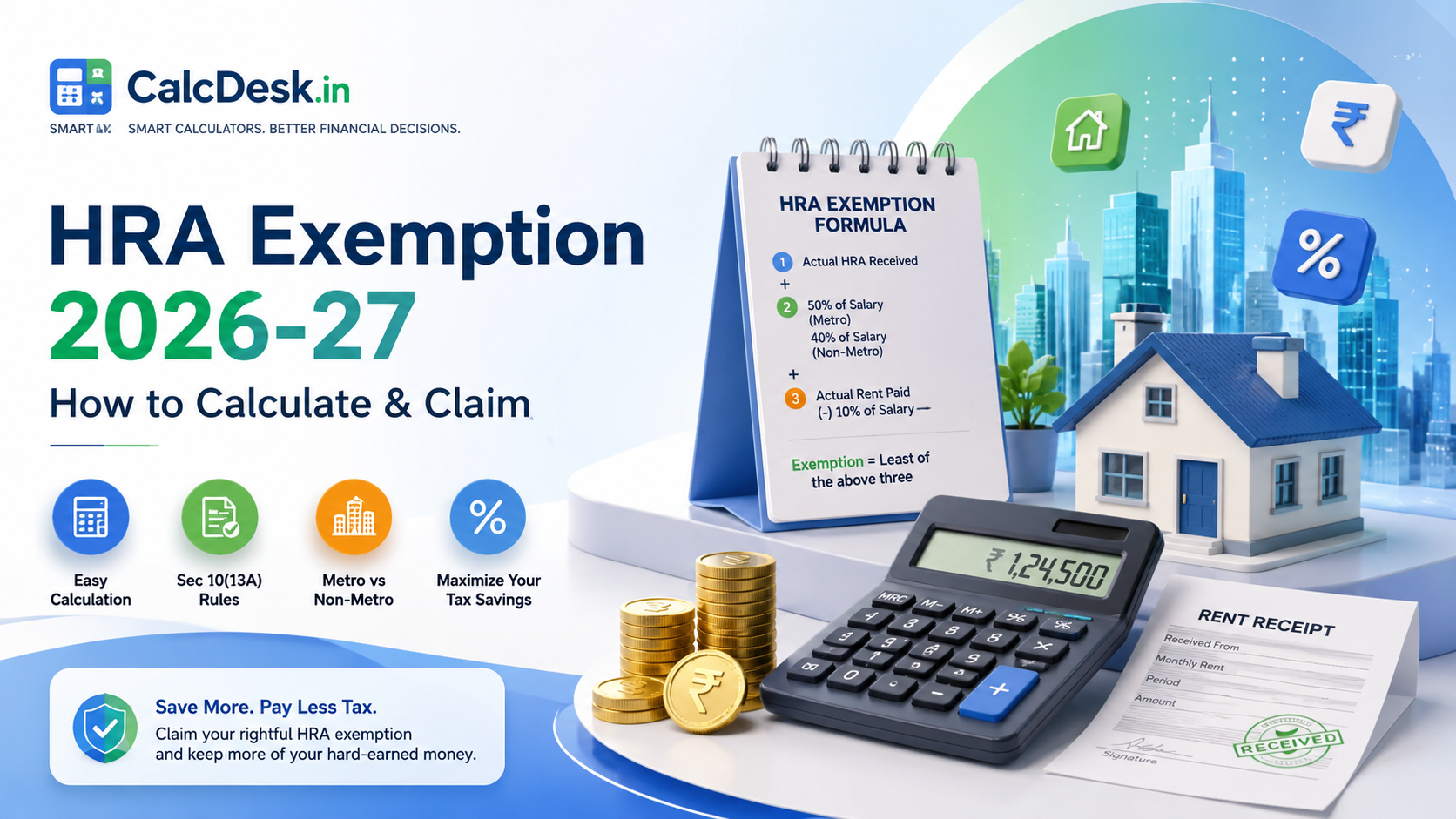
HRA Exemption 2026-27 — How to Calculate & Maximise Your Claim
HRA exemption is one of the most valuable tax breaks available to salaried Indians — yet it’s also one of the most misunderstood. Thousands of employees either under-claim their exemption (losing money) or claim incorrectly (inviting scrutiny). If your employer pays you House Rent Allowance and you live in rented accommodation, Section 10(13A) of the Income Tax Act 1961 allows you to exempt a significant portion of that HRA from tax. For a ₹15 lakh earner in Mumbai paying ₹25,000/month rent, HRA exemption can save ₹60,000–₹75,000 in tax every year.
This guide explains the exact HRA exemption formula, the metro vs non-metro distinction, three fully worked examples across different salary levels, common mistakes to avoid, and the documents you need. Use CalcDesk’s free HRA Exemption Calculator to get your exact exemption figure instantly.
What is HRA Exemption — The Legal Basis
House Rent Allowance (HRA) is a salary component paid by employers to help employees cover their rental costs. Under Section 10(13A) of the Income Tax Act 1961, the portion of HRA that qualifies as “exempt” is not added to your taxable income. The exemption is governed by Rule 2A of the Income Tax Rules.
Key conditions that must be met to claim HRA exemption:
- You must be a salaried employee receiving HRA as part of your salary package
- You must actually be living in rented accommodation
- You must actually be paying rent — not just receiving HRA
- You cannot claim HRA exemption for accommodation in a house you own
- You must be under the Old Tax Regime — HRA exemption is NOT available under New Regime
The HRA Exemption Formula — Three Minimums
The HRA exemption is the minimum (lowest) of these three amounts:
HRA Exemption = Minimum of these three
② Annual rent paid − 10% of annual Basic Salary
③ 50% of annual Basic Salary (if metro) / 40% (if non-metro)
Taxable HRA = Total HRA received − HRA Exemption
Metro cities for this rule: Delhi, Mumbai, Chennai, Kolkata
📌 “Basic Salary” for HRA purposes means Basic + Dearness Allowance (DA) only. Other allowances (HRA itself, LTA, medical) are excluded. If your salary slip shows Basic ₹40,000 and DA ₹5,000, the base for HRA calculation is ₹45,000/month.
Worked Example 1 — ₹8 Lakh Salary, Non-Metro (Bengaluru)
IT employee in Bengaluru, moderate rent
Annual Basic: ₹4,80,000 (₹40,000/month)
Annual HRA received: ₹1,92,000 (₹16,000/month)
Annual rent paid: ₹2,16,000 (₹18,000/month)
City: Bengaluru (non-metro for HRA purposes)
Calculate the three amounts:
① Actual HRA: ₹1,92,000
② Rent − 10% of Basic: ₹2,16,000 − ₹48,000 = ₹1,68,000
③ 40% of Basic (non-metro): 40% × ₹4,80,000 = ₹1,92,000
HRA Exemption = Minimum = ₹1,68,000
Taxable HRA = ₹1,92,000 − ₹1,68,000 = ₹24,000
Tax saved (at 20% slab): ₹1,68,000 × 20% = ₹33,600
Worked Example 2 — ₹15 Lakh Salary, Metro (Mumbai)
Senior manager in Mumbai, high rent
Annual Basic: ₹7,20,000 (₹60,000/month)
Annual HRA received: ₹3,60,000 (₹30,000/month)
Annual rent paid: ₹3,60,000 (₹30,000/month)
City: Mumbai (metro)
Calculate the three amounts:
① Actual HRA: ₹3,60,000
② Rent − 10% of Basic: ₹3,60,000 − ₹72,000 = ₹2,88,000
③ 50% of Basic (metro): 50% × ₹7,20,000 = ₹3,60,000
HRA Exemption = Minimum = ₹2,88,000
Taxable HRA = ₹3,60,000 − ₹2,88,000 = ₹72,000
Tax saved (at 30% slab): ₹2,88,000 × 30% = ₹86,400 (before cess)
Worked Example 3 — ₹20 Lakh Salary, Delhi, Paying Rent to Parents
High earner, pays rent to parents
Annual Basic: ₹9,00,000 (₹75,000/month)
Annual HRA received: ₹3,60,000 (₹30,000/month)
Annual rent paid to parents: ₹2,40,000 (₹20,000/month)
City: Delhi (metro)
Calculate the three amounts:
① Actual HRA: ₹3,60,000
② Rent − 10% of Basic: ₹2,40,000 − ₹90,000 = ₹1,50,000
③ 50% of Basic (metro): 50% × ₹9,00,000 = ₹4,50,000
HRA Exemption = Minimum = ₹1,50,000
Tax saved (30% slab): ₹1,50,000 × 30% = ₹45,000
Note: Parents must declare ₹2,40,000 rental income in their ITR. If they are in the nil or 5% slab, this is still highly tax-efficient for the family overall.
HRA Exemption Table — Different Scenarios at a Glance
| Basic (Annual) | HRA Received | Rent Paid | City Type | HRA Exemption |
|---|---|---|---|---|
| ₹3,00,000 | ₹1,20,000 | ₹1,20,000 | Non-metro | ₹90,000 |
| ₹4,80,000 | ₹1,92,000 | ₹1,80,000 | Non-metro | ₹1,32,000 |
| ₹6,00,000 | ₹2,40,000 | ₹2,40,000 | Metro | ₹1,80,000 |
| ₹7,20,000 | ₹3,60,000 | ₹3,00,000 | Metro | ₹2,28,000 |
| ₹9,00,000 | ₹4,50,000 | ₹4,20,000 | Metro | ₹3,30,000 |
| ₹12,00,000 | ₹6,00,000 | ₹5,00,000 | Metro | ₹3,80,000 |
Metro vs Non-Metro — Which Cities Qualify?
For HRA exemption purposes, only four cities are classified as metros — and this classification has not changed since the rule was introduced:
| Metro (50% of Basic) | Non-Metro (40% of Basic) |
|---|---|
| Delhi (NCR included) | Bengaluru, Hyderabad, Pune |
| Mumbai (MMR included) | Ahmedabad, Jaipur, Lucknow |
| Chennai | Chandigarh, Kochi, Nagpur |
| Kolkata | All other cities |
⚠️ Bengaluru, Hyderabad, and Pune are NOT metros for HRA purposes — even though they are major IT hubs with high rents. Employees in these cities get only 40% of basic as the cap, not 50%. This is a common misconception that leads to wrong calculations.
Documents Required to Claim HRA Exemption
- Rent receipts: Monthly receipts from landlord. Must include landlord name, address, amount, period, and signature. Revenue stamp (₹1) required if monthly rent exceeds ₹5,000 (though this rule is rarely enforced)
- Rent agreement: Preferably registered. At minimum, a notarised agreement helps establish the arrangement
- Landlord’s PAN: Mandatory if annual rent exceeds ₹1,00,000. Without this, employer will not allow HRA exemption in Form 16
- Bank transfer proof: Pay rent by NEFT/UPI so you have a digital trail. Cash rent is not illegal but hard to prove
- Form 12BB: Declaration submitted to your employer at the start of the year stating HRA claim details
Common HRA Exemption Mistakes
- Claiming 50% of basic for non-metro cities: Bengaluru, Hyderabad, Pune employees often claim 50% — but the limit is 40%. This leads to incorrect Form 16 and potential IT notice
- Using gross salary instead of basic for the 10% deduction: The formula says “10% of Basic” — not 10% of total CTC or gross salary. Using gross inflates the deduction and reduces your claimed exemption incorrectly
- Not collecting rent receipts regularly: If your employer asks for receipts in February, collecting 12 months of back-dated receipts is a red flag. Collect receipts monthly or quarterly
- Forgetting landlord’s PAN above ₹1 lakh rent: Missing PAN means no HRA benefit in TDS calculation; you’d need to claim the refund via ITR
- Claiming HRA while living in own house: If you own the house you live in, HRA is fully taxable. Owning a house in another city is different — you can claim HRA for where you rent
HRA Under New Regime — The Trade-Off
The New Tax Regime does not allow HRA exemption. If you’re choosing between regimes and pay significant rent, this is a critical factor. For a ₹10 lakh earner in Mumbai with ₹20,000/month rent, HRA exemption under Old Regime can be ₹1.5–2 lakh annually. At 20% slab, that’s ₹30,000–₹40,000 in tax savings that you forfeit under New Regime.
Read the full Old vs New Regime Guide to see whether HRA plus your other deductions make Old Regime worth choosing. Also try the Take-Home Salary Calculator to compare net salary under both regimes.
💡 Tax planning tip: If you live in your own house but your parents live in a rented house in the same city, you cannot claim HRA for them. But if you pay rent to your parents for a property they own and you genuinely reside there, the arrangement can be tax-efficient — especially if your parents are senior citizens with lower tax liability.
Section 80GG — HRA Exemption for Self-Employed or Employees Without HRA
If your employer does not provide HRA (or if you’re self-employed), you can claim rent deduction under Section 80GG instead. The limit is the minimum of: (a) ₹5,000/month (₹60,000/year), (b) 25% of total income, or (c) rent paid minus 10% of total income. This is significantly lower than 10(13A) benefits but available to those without HRA in their salary structure.
🏘️ Calculate Your HRA Exemption — Free
Enter your basic, HRA received, rent paid, and city. Get your exact exemption and taxable HRA in seconds.
→ Open HRA Calculator
1 thought on “HRA Exemption 2026-27 — How to Calculate & Claim | CalcDesk.in”